Pig farmers hope to breed success
Updated: 2011-08-22 09:57
By Yang Wanli and Shi Baoyin (China Daily)
|
|||||||||||


|
 |
|
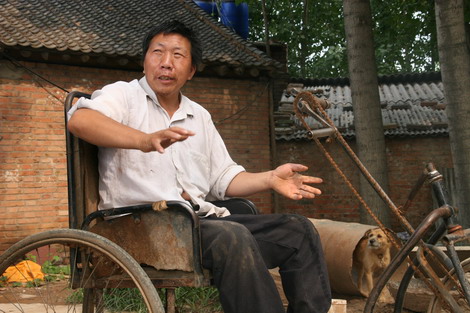
Yang Zhongxi explains why he quit the business in Henan province this year. [Photo / China Daily] |
At one end, small family farms are buckling under the weight of volatile prices, disease and rising costs.
At the other end, industrial-scale farms are becoming part of the landscape. But between these two options is a new cooperative venture that combines the personal attention of the family farm with the economic advantages of a corporation.
Yang Zhongxi, 44, of Qinyang, Henan province, has had to change his farming methods recently.
He used to raise more than 100 pigs at a time, making him the most prolific pig farmer in his village. In May 2010, he spent 100,000 yuan ($15,700) building a new barn capable of holding 200 pigs, plus hundreds of ducks and chickens.
But higher costs and lower returns took their toll and he quit the pig business earlier this year. Only the birds inhabit the big new barn.
"The cost of raising hogs has soared this year," he said. "Four or five years ago, a baby pig cost 300 yuan. It is double that now."
It has always been a high-risk business, but local farmers welcomed it, Yang said. "Generally, we could still make money." Ten years ago, 15 or 16 small-scale breeders lived in his village. Now only two are left.
Yang said the price of feed, usually field corn, increased in his village by 0.4 yuan a kilogram early this year. A pig usually requires 300 kg of feed during its five-month growth period, so feeding each pig suddenly cost an extra 120 yuan. Five years ago, Yang said, the cost of raising a hog totaled about 1,000 yuan; now it's about 1,500 yuan. The selling price, 2,500 yuan, hasn't changed.
"Doing city jobs only paid 10 to 20 yuan a day years ago, and people would rather raise hogs," Yang said. "But now, people make 100 yuan a day by doing city jobs. Who would choose breeding pigs?"
Too much work
Ten miles away, Li Qinying barely maintains her hog barn. Twenty pigs live in what used to hold nearly 150, and they are the last she will raise.
"It's too tiring," said Li, 54. "People say the more plowing and weeding, the better the crop. It doesn't make sense in this industry.
"Epidemic prevention is a big problem," Li said. Early last year, dozens of young pigs got sick and died overnight. The cause remains a mystery. "It is hard to accept because I took them as my babies and sometimes didn't step out of the pig house for months."
The wildly fluctuating price also is killing Li's passion for raising pigs.
A couple of weeks ago, she heard that the market price had hit 20.4 yuan a kg, and she planned to sell some pigs. But the price dropped to 19.2 yuan the next day. "The final deal was just 18.2 yuan. That hurt me badly."
More reason
Li is among many family breeders across the country who have chosen to leave the business since an outbreak of H1N1 flu in 2008. Steadily rising costs have deterred them, too, and one result was a near 60 percent jump in pork prices early this year.
Jin Yingfu, director of Qinyang husbandry bureau, said Henan has produced 50 million hogs on average every year, accounting for nearly 10 percent of the country's total. Qinyang's average production is more than 200,000, ranking it in the middle range.
The production has come from nearly 26,000 family breeders in Qinyang. Ninety percent of them have fewer than 1,000 pigs. Fewer than 25 have 1,000 to 4,000 pigs.
That is changing. "Many small-scale breeders withdrew from the market early this year in view of the rising breeding costs as well as the epidemics," Jin said.
From January through March, the market price for hogs in some cities in Henan held at 14 to 15 yuan a kilogram, according to the Henan Statistics Bureau. It climbed in the second quarter, and peaked near 19 yuan a kg.
However, Jin said the rising price didn't inspire farmers to buy many more piglets. "Farmers worried about another sharp drop in meat prices due to oversupply."
To drive down pork prices and avert fluctuations longer term, the central government invested heavily in the industry to feed its growing middle class, which is consuming more meat. The government decided in July to resume a 2.5 billion yuan (about $389 million) subsidy to spur pig breeding and prevent future supply shocks.
The subsidies are based on production. The minimum is 200,000 yuan for producers of 500 to 900 hogs, and the maximum is 800,000 yuan for producers with more than 3,000 hogs. Small family pig farmers, then, are left out.