Sept 11 shapes rise of emerging nations
Updated: 2011-09-13 11:03
By Peter Apps (China Daily)
|
|||||||||||


|
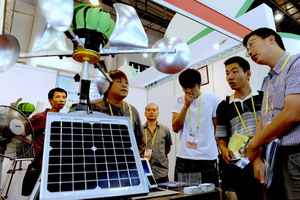
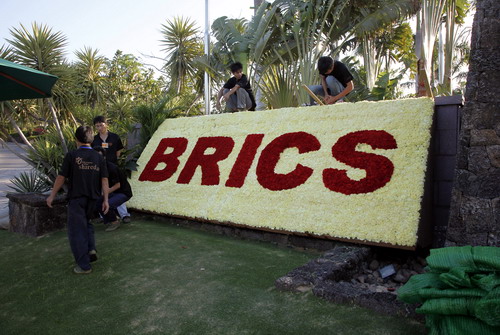
Preparations being made for a gathering of leaders from Brazil, Russia, India, China and South Africa (BRICS) in Sanya, Hainan province, earlier this year.[Photo / Bloomberg] |
Developing economies gain ground, change world picture
LONDON - As his global teleconference broke up in disarray on Sept 11, 2001, a top economist at a US investment bank began to ponder what the attacks on the United States might tell him about the future shape of the world. His conclusions had little to do with al-Qaida.
Jim O'Neill of Goldman Sachs Group Inc had been at a meeting in the World Trade Center only two days before, and flew home to London just hours before airliners slammed into New York's twin towers. About to become the head of the bank's global economics team, he was looking for a "big idea" to put a stamp on his leadership.
Soon, he had it: The decade after Sept 11 would be defined not by the world's sole superpower or the war on terror but by the rise of the four biggest emerging market economies - China, Russia, India and Brazil. O'Neill nicknamed them the "BRIC" nations after the first letter of their names.
"I'll never forget that day," O'Neill told Reuters. "It was right at the core of how I came up the whole thing ... Something clicked in my head that the lasting consequence of 9/11 had to be the end of American dominance of globalization ... that seems to be exactly what happened."
O'Neill, who now heads Goldman Sachs' global asset management business, coined the BRIC phrase in a pamphlet published in November 2001. The numbers from the past decade suggest the trend he identified will resonate more in world history than the strikes and their aftermath.
When O'Neill dreamed up the BRIC acronym, the four big emerging powers made up 8 percent of the world economy. The top five world economies were, in order, the United States, Japan, Germany, Britain and France.
Ten years later, the BRICs have grown faster than even O'Neill expected, constituting nearly 20 percent of the global economy. China is the world's second-largest economic power, while Britain - the closest ally of the US in the decade-long war on terror - has dropped out of the top five, overtaken by Brazil. India and Russia are not far behind.
Within days of the attacks on New York and Washington, the US launched a costly and attention-sapping global "war on terror" and was plotting retaliation against not just al-Qaida but also other members of what it saw as a wider "axis of evil", including Saddam Hussein's Iraq.
At first sight, the US and its allies appear to have won their war. The al-Qaida network is badly damaged, Osama bin Laden and other key leaders are dead and the group has not pulled off a major terror strike in the West for years.
What is less obvious is the cost of that apparent victory, both financially and diplomatically.
"For most of the first decade of the century, as the world economy gradually shifted its center of gravity toward Asia, the United States was preoccupied with a mistaken war of choice in the Middle East," said Joseph Nye, a former US undersecretary of state and defense as well as former chair of the National Intelligence Council and now a Harvard professor of international relations.
US actions, he said, critically undermined its "soft power" in diplomacy, values and culture, while diverting and ultimately weakening its military and economic "hard power".
The day before the attacks, the US national debt stood at a sliver under $5.8 trillion. A decade later, it has skyrocketed to $14.7 trillion.
Unfunded tax cuts, a post-financial crisis stimulus and other increased domestic spending account for much of that. But the US' post-9/11 conflicts added heavily to the burden.
One recent estimate from Brown University put the cost of the US wars in Iraq, Afghanistan and Pakistan at up to $4.4 trillion - nearly a third of the total.
Wolfgang Ischinger, a former German deputy foreign minister appointed as ambassador to the US in 2001, said Sept 11 "burst the bubble" of any illusion that one superpower could rule the world.
"But in terms of importance for the global power situation, for global governance, I think the rise of the BRICS will have the more enduring effect."
South Africa joined the emerging economy bloc last year to make the group known as BRICS.
Ian Bremmer, president of political risk consultancy Eurasia Group, said the world has already moved on from Sept 11.
"In hindsight, 2008 was the seminal moment," Bremmer told Reuters. "Not only did we have the financial crisis, we also had the Beijing Olympics. Before that, China was seen simply as an emerging market - a backwater. Suddenly we saw them coming into their own."
China's financial and economic weight is growing. It now holds $1.2 trillion of US government debt, making China by far the biggest foreign investor in those securities.
When a government debt crisis hit Europe this year as buyers shunned the most indebted countries, leaders turned to China for help by buying up eurozone securities - a scenario unimaginable in the 20th century.
- Tasty profit wrapped in moon cakes
- Sept 11 shapes rise of emerging nations
- Chinese yuan appreciation 'will remain gradual'
- M2 growth slows down
- Job seekers' prospects bright for Q4
- Inflation causes split opinion
- Yuan useful in corporations' overseas deals
- Local debts controllable amid tightening regulations