Re-establishing global economic co-op
Updated: 2011-10-15 07:27
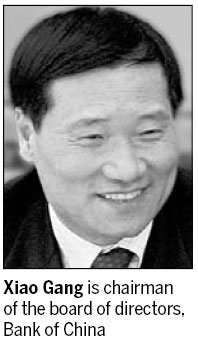
By Xiao Gang (China Daily)
|
|||||||||||


The contagion fears of the European debt crisis have kept the euro close to a nine-month low against the US dollar, despite the fact that Europe's finance ministers met in Luxembourg on Oct 4, and agreed to shore up eurozone banks being shut out of the markets and relying on the European Central Bank (ECB) for liquidity.
For now, few people deny that the renewed anxiety in the United States and Europe is a big risk weighing on sentiments about recession and unemployment. On a higher level, the bigger risk is the time-consuming arguments and the disturbing lack of global policy coordination.
Unlike in 2008, when world leaders from advanced and developing nations alike swiftly launched stimulus packages of fiscal and monetary measures, in 2011 the landscape is very different. The spirit of cooperation has been replaced with a climate lacking urgency and coherence in policy coordination and joint action has been replaced with a lot of criticism and quarrels among countries.
It is very important and urgent for politicians, regulators and bankers to return to the cooperative days of 2008, further raising the level of global policy collaboration to meet the newly emerging international challenges.
Admittedly, today's situation is different from the 2008 crisis. Four things must be dealt with in the US and Europe: growth, unemployment, the sovereign debt crisis and the banking crises. Moreover, these factors have materialized simultaneously and interact with each other, making the situation more complex.
It seems apparent that policymakers are reluctant to move forward quickly because of their domestic politics. The growing hostility of taxpayers, lawmakers, interest groups and the public to the bailout schemes and austerity measures has led to social instability in some countries, such as the ongoing anti-Wall Street demonstrations in the US and previous demonstrations in Greece. Therefore, some politicians are being forced to rethink what they have done over the past three years and have adopted a wait-and-see attitude.
Sadly, given that the bold fiscal and monetary stimulus used in responding to the 2008 crisis is approaching its limits, there is little policy room at present. From Washington to Athens, there are many heated debates about public debts. But the concern about the unsustainability of debt has overwhelmed the focus on immediate economic growth and banking rescues. Unsurprisingly, the policy priority has shifted toward building a credible fiscal consolidation over the medium to long term.
To achieve global policy collaboration, it is imperative to enhance policymakers' credibility and responsibility. Politicians should make clear what must be done immediately to save the euro and what can be done in the long term. The most imperative requirement is to stop the debates as soon as possible and act decisively to expand the firepower of Europe's rescue fund, ensuring that eurozone countries can continue to borrow at affordable rates and that governments always stand firmly behind their banking systems.
Big, advanced countries in Europe play an important role in policy coordination. These countries are the biggest beneficiaries of the currency union and they have an obligation to take the lead in seeking concrete steps for drastically increasing the European Financial Stability Facility. Obviously, they will have much more to lose if the eurozone disintegrates than putting more money into rescues. Creating the political conditions and acting decisively to maintain the monetary union will not only benefit themselves, but also the future of the European Union and the health of the world economy.
Global collaboration requires strong leadership on reforms. Leaders in Europe now draw on lessons from the sovereign debt crisis, acknowledging that they need to make dramatic changes in how the eurozone will operate in the future. There must be a fiscal union and some other form of transfer mechanism, joint bank supervision and sovereign debt default procedures if the single currency is to survive.
Overcoming a number of theoretical and practical problems, the ECB needs to expand its role from the narrower mission of controlling inflation to, during the worst of a crisis, playing the role of a last-resort lender to eurozone governments and banks. Without strong backing from the central bank, the crisis could further deteriorate.
International bodies, such as the IMF, the Financial Stability Board and the Bank for International Settlements, should work together, taking a more coordinated, creative approach to finding solutions to the crisis, reinforcing a leading role in cooperative policymaking.
There will be opportunities in the coming months for international bodies to take a more active attitude in reaching consensus. Eurozone finance ministers could meet again, and G20 finance ministers will meet later this month. There is a G20 summit in early November and the EU summit in December. The world is looking forward to seeing encouraging results.
For the emerging market economies, the global financial crisis will continue to have negative impacts on their growth momentum and financial stability if the current global problems are not resolved. They will face a different, complex dilemma in policy choices.
In recent weeks, India raised interest rates, Brazil and Turkey cut rates, while China and other Asian countries kept their rates unchanged. Although the emerging economies should not take a one-size-fit-all approach due to their different domestic situations, no individual country can be decoupled from the integrations, so international conditions must still be taken into account when making decisions. Therefore, emerging economies must actively join in the global policy cooperation with their counterparts in the developed world.
The problems are well known, and the solutions are on the table.
There has never been a more urgent need to strengthen global cooperation, and the world looks forward to seeing a new cohesiveness in policymaking, because we are rapidly running out of time.
- Investigators to look at Gucci's management
- China to expand import for balanced growth
- Airbus delivers Chinese carrier's 1st A380
- Premier Wen warns of decreased openness
- EU should remove barriers: Official
- Policy shift unlikely despite ease in inflation
- SOEs to declare overseas assets
- Sales of expired food fined