Debate: Gutter oil
Updated: 2011-10-31 13:45
(China Daily)
|
|||||||||||


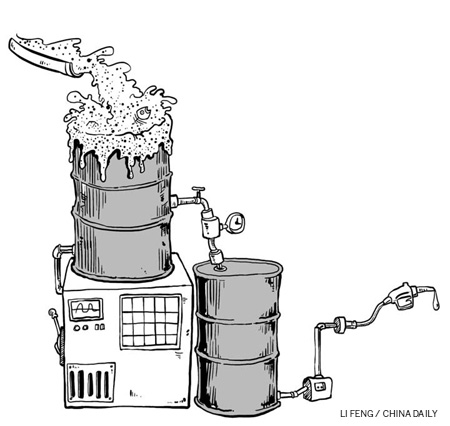
Recycled cooking oil is proliferating because illegal companies make money at every stage of the process. Two experts have opposing views on a waste-to-energy solution.
Wang Jinfu
Better for engines than the table
Recent news about the food on our table has been somewhat sickening. A series of police crackdowns since July on factories that recycle used kitchen oil, or "gutter oil", illegally reflects how vicious the food-producing chain has become. To make matters worse, the illegal food-producing chain is armed with ultra-modern equipment.
"Gutter oil" is made from discarded cooking oil and kitchen waste, which come mainly from restaurants and other eateries such as cafeterias and canteens, but also from sewers.
The crackdown has helped net many an illegal operator, but an estimated 2 to 3 million tons of waste cooking oil is produced every year and part of it is certain to return to our dining tables.
We cannot and should not rely on police to prevent "gutter oil" from contaminating the food on our tables. Therefore, it would be better to turn waste oil into energy.
That waste cooking oil is toxic is beyond doubt. After being used many times in restaurants and other eateries, cooking oil produces harmful substances like fatty and trans fatty-acids, and even strong carcinogens like flavacol. Combined with the large quantities of bacteria and other dirty elements that accumulate in sewage, it is impossible to turn waste cooking oil into a non-toxic medium of cooking.
But the harmful substances that "gutter oil" carry are good material for the chemical industry. The two main ingredients of cooking oil, that is, fatty acid and grease, can be used to make fatty acid methyl ester, or environmentally friendly biodiesel - fuel made from natural, renewable sources such as new and used vegetable oil and animal fat - which can be used to power vehicles. As much as 90 percent of "gutter oil" can be recycled into biodiesel.
Biodiesel contains more oxygen and burns more thoroughly. Combustion using ordinary diesel produces 90 percent more carbon emissions compared to biodiesel. Tests show that even simple engines emit less smoke when powered by biodiesel.
Besides, biodiesel contains little sulphur, and therefore does not cause any acid rain. In fact, biodiesel is considered so precious by many developed countries like Germany and the UK that they have passed laws to mix it with petrochemical diesel and collect waste cooking oil for the industry.
But a big problem is that biodiesel producers can hardly get enough supply of gutter oil in China, because there are few qualified enterprises in the waste oil collection market. For example, there are only four in Beijing, far from enough to collect all the waste oil from sewage across the city.
An estimated 80 percent "gutter oil" in China is collected by unqualified enterprises or people, because unlike developed countries, China doesn't have many supporting policies for the biodiesel industry. This increases the cost and thus makes it hard for companies to make profit.
Biodiesel is sold at the same price as fossil diesel, that is, about 7,000 ($1,100) yuan a ton. The processing cost for biodiesel producers is about 1,000 yuan a ton, on top of which they have to pay 17 percent value-added tax as well as consumption tax of 0.8 yuan per liter. So the highest purchasing price they can afford is 6,000 yuan a ton, minimizing their chances of making profit.
In contrast, illegal waste oil factories pay no more than 300 yuan a ton for processing and don't have to pay any tax at all. Besides, they can sell the "gutter oil" as cooking oil for about 8,000 yuan a ton and, hence, can offer a price higher than 6,000 yuan a ton when collecting.
No wonder, illegal factories get the lion's share of the cooking oil waste. That's why they have become part of a vicious circle as a healthy industry withers and food scandals continue to keep us wary.
The government has to intervene to prevent the situation from worsening. It should intensify its supervision over restaurants and ensure that they sell cooking oil waste only to qualified collecting agencies, a common practice in developed countries. And considering the difficulty of cracking down on all illegal "gutter oil" collectors in China, it should subsidize the biodiesel industry to help the companies in the sector offer higher purchasing prices.
The government has indeed taken a good first step by exempting biodiesel producers from consumption tax since July. But it should exempt them from paying value-added tax, too, if it wants them to become more competitive than the illegal "gutter oil" factories in the waste oil market.
After all, the best way to suppress the illegal "gutter oil" industry is to replace it with a healthy one, especially an environmentally friendly one.
The author is a professor of chemistry at Tsinghua University and specializes in clean energy studies. These are excerpts from his interview with China Daily's Zhang Zhouxiang.
Related Stories
Tests for gutter oil prove to be a failure 2011-10-14 13:18
Biodiesel made of 'gutter oil' 2011-10-12 15:25
Crackdown on "gutter oil" 2011-09-15 09:37
32 held in 'gutter oil' crackdown 2011-09-14 10:26
- Restructure 'urgent' as population benefit ebbs
- Top financial officials changed in major reshuffle
- Small businesses seek less room to maneuver
- FAW reports $7.88m net loss in Q3
- Wrangle over auto warranty rules
- Beijing's free Wi-Fi will be safe
- It's quality not quantity for Dell
- China train makers' profits slump