A degree that means business
Updated: 2011-11-04 13:10
By Yu Ran and Wang Hongyi (China Daily)
|
|||||||||||


|
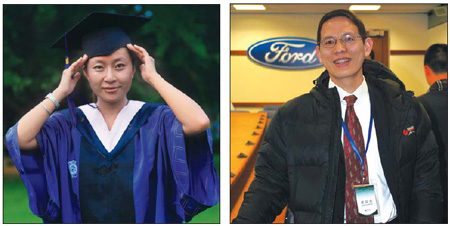
Eva Li (left) was awarded her MBA in July by Guanghua School of Management at Peking University. Zheng Guanhua visited Ford Motor Co in Detroit as part of his part-time MBA course in Shanghai. [Photo/China Daily] |
'Quite valuable'
Eva Li, who is 30 and from Lanzhou, Gansu province, was awarded her MBA in July by Guanghua School of Management at Peking University. She enrolled in 2009 knowing what she needed to learn.
"I tried to run the family business by myself in Lanzhou for six years after I graduated from university in 2003, and I had to face a series of problems on how to deal with employment management and the financial accounts," she said.
Tuition for the two-year program cost 98,000 yuan ($15,400).
"Studying was very tough for me, and I only had about four to five hours' sleep every day, but what I learned was quite valuable compared to the hard work," Li said.
Like many other Chinese MBA students, she was primarily interested in courses involving methods and best practices that can be applied to immediate business needs. "I obtained practical knowledge on leadership and management of the business by taking part in teamwork projects and overseas training opportunities step by step."
Li spent a month in the US, working on business plans with others in an entrepreneurship program at the University of Maryland. Business angels - who provide financial backing for startups - gave guidance and suggestions to the students.
"I chose to study in an MBA course in China instead of going abroad because I wanted to know more successful local entrepreneurs from different industries to expand my network, which definitely will benefit me in the future," she said.
Li plans to open a retail business in Beijing, selling luxury goods, in two years.
Making connections
Making friends and adding business contacts is a focus of many students who enroll in executive MBA programs, which were introduced to China in 2002 and in 2009 were offered by 62 universities.
The programs are designed for working managers and executives. Many of the students are already successful in business, and wealthy.
"EMBA students typically have a higher level of work experience, often 10 years or more, compared with normal MBA students and have an average age of 40 or so," said Shen Jia, who completed his two-year course at China Europe International Business School (CEIBS) in Shanghai in 2005.
"I aimed to learn more practical management abilities from the EMBA course and other classmates to run my own business in a more organized way, but I didn't learn as much as I expected," Shen said. At the time, he ran a computer training organization in Wenzhou. He isn't working now.
What it costs
MBA students often expect their degrees to pay off in higher salaries later. Meanwhile, the cost of earning them has been going up.
Last month, Shanghai Advanced Institute of Finance at Shanghai Jiao Tong University announced it would increase tuition for its two-year, part-time MBA course by 32 percent - going from 180,000 yuan to 238,000 yuan - starting in 2012. That will put its tuition at the top for MBA courses among universities in China.
Shanghai Tongji and Peking universities have raised their tuition more than 60 percent in the past three years.
The cost is still lower than the 400,000 or more yuan required at two top-rated schools that offer only MBA courses, said Paul Sun, 30, a part-time MBA student at Guanghua School, Peking University.
He referred to Shen's school, CEIBS, which is a joint venture of the European Union and China's Ministry of Foreign Trade and Economic Cooperation, and Cheung Kong Graduate School of Business, which entrepreneur Li Ka-shing started as China's first private, nonprofit independent business school.
Compared with those schools, Sun said, "MBA courses in most universities are not that expensive." If tuition keeps going up, though, he said fewer people will be able to afford to enroll.
Time to mature
MBA studies originated in the United States in the early 1900s as the country became more industrialized and companies sought scientific approaches to management - not unlike China in recent decades. Their proliferation in China, then, is no surprise.
"The MBA certificates seem to be very essential in China as criteria when employers try to recruit talented management staff members, so more people take the courses for the high-salary positions," said Xiong Bingqi, deputy director of 21st Century Education Research Institute.
Xiong said the rapid growth of MBA programs is a sign that society shows an interest in high-quality practical education. However, Xiong and others said the quality and design of the courses need improvement and time to mature.
"Even though 20 years have passed, China's MBA education still has a long way to go, especially compared with prestigious MBA programs in the US and Europe," said Wang, the AEMBA director in Shanghai.
"Strained by the current education system, business education curriculums are still academic-oriented and lack experiential learning. That cannot bring practical skills for students," he said.
Tsinghua, Fudan, Jiao Tong and other top universities with MBA programs started to improve them in 2008 with better application systems, course design and training methods.
"The future development of China's MBA education needs to focus on the development of leadership, entrepreneurship and experiential learning," Qian Yingyi, dean of School of Economics and Management at Tsinghua University, said in May when Tsinghua celebrated the 20th anniversary of its MBA program.
Deans of other business schools also mentioned the need for increased focus on corporate social responsibility to help cultivate comprehensive business education.
Wu Xiaobo, dean of the School of Management at Zhejiang University, stressed that MBA education should catch up with China's economic development and meet the increasing demand for talented business people who are familiar with both the global prospective and Chinese practice.