Business climate 'tougher'
Updated: 2011-11-26 09:12
By Wei Tian and Yu Ran (China Daily)
|
|||||||||||


|
|
Conditions have worsened for entrepreneurs since 2008, says regional report
BEIJING/SHANGHAI - Chinese companies are facing even tougher business conditions now than during the 2008 global crisis, according to a survey of more than 4,000 companies. The findings resulted in experts calling for less government intervention and more support for the private sector to improve the business environment.
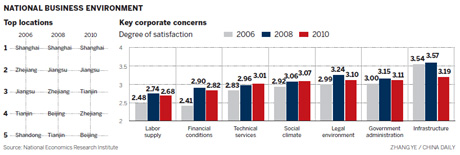
Among the seven sub-categories of the research, conditions for companies in the fields of human resources, financial services, the legal environment, government administration, and infrastructure have worsened.
However, progress has been made in intermediary services and the social environment, according to the Business Environment Index for China's Provinces 2011 Report.
The findings follow a three-part survey of businesses nationwide, conducted in 2006, 2008 and 2010. More than 90 percent of the 4,230 companies interviewed in 2010 were small and medium-sized enterprises (SMEs).
Non-State-owned enterprises contributed more than 90 percent of the sample, and more than 70 percent of the companies surveyed operate in the manufacturing sector.
The survey is based on both the operational data from companies and the opinions of business owners, who were asked to grade each category from one to five, with five being classified as "very good". The average score improved significantly between 2006 and 2008, but declined in 2010.
Some of the problems highlighted include supplementary levies charged by local governments, regional protectionism and difficulty in obtaining support for financing, said Fan Gang, director of the National Economics Research Institute at the China Reform Foundation, which helped compile the report.
"The competitiveness of Chinese companies is highly related to the policy environment thus, less government intervention in the market and a better relationship between businesses and the authorities will be the direction of our next step in economic reform," Fan said at a forum to introduce the findings earlier this week.
The report ranked the country's regional business climate on a provincial basis, with Shanghai topping all three of the surveys. Provinces in the Yangtze River Delta and coastal areas also ranked high in the table.
"Shanghai provides a more regulated environment for companies, especially for smaller businesses. There is an evolving support system which will be hard for many other cities to catch up with," said Song Xiaohui, an officer with the Shanghai SME Development and Service Center.
However, the opinions of small business owners in Zhejiang province, where the private sector is the most vibrant in China, reflect the poor conditions faced by SMEs, including a challenging external environment and inadequate government support.
"The situation for the traditional manufacturing sector allows no optimism, because we are facing the dilemma of shrinking loans and increasing costs. And we are in an inferior position to State-owned enterprises," said Ye Mingchun, the owner of a shoe factory in Zhejiang.
The local government may have adopted some policies to support SMEs but it will take time for them to become effective, Ye said.
"SMEs now have to face the challenges of providing higher quality goods in the domestic market and weak demand overseas, so an upgrading of the product is the only way to go," said Wang Shibin, who manages a company that produces household goods.
But it's difficult for small businesses to carry out technical innovation on their own, and Wang hopes the government will offer more support in this area while adopting stricter policies on the protection of intellectual property.
Liu Shijin, deputy director of the Development Research Center of the State Council, said the development of small business will be an essential element in helping China emulate the high incomes and living standards seen in developed economies.
"In countries like Brazil and Mexico, where monopolies still have a strong foothold, per capita GDP still lags behind the levels in high-income countries, whereas people in Japan and South Korea enjoy a higher level of personal income because of a boom in private enterprises," Liu said.
He suggested that the government should encourage more competition, especially in basic industries and the service sectors.
Chen Jia contributed to this story.
?