Bitter medicine for sick people
Updated: 2011-12-19 09:29
By Liu Jie (China Daily)
|
|||||||||||


Benefit gainers
The public is also left wondering who's making the money from the price gap.
With relation to the commission paid to hospitals, Zhuang said that many State-owned non-profit hospitals simply don't get sufficient fiscal investment from the government. Therefore, the 15 percent commission from the purchase of medicines is mainly used to support infrastructure renovation, technological upgrades and academic training.
However, Zhuang also said that the hospitals have to toe the line with the NDRL and EDL and are not allowed to decide which medicines to buy. Even though the hospitals may know of high-quality, affordable medicines, if they're not included in the lists, the hospitals are simply not allowed to purchase them.
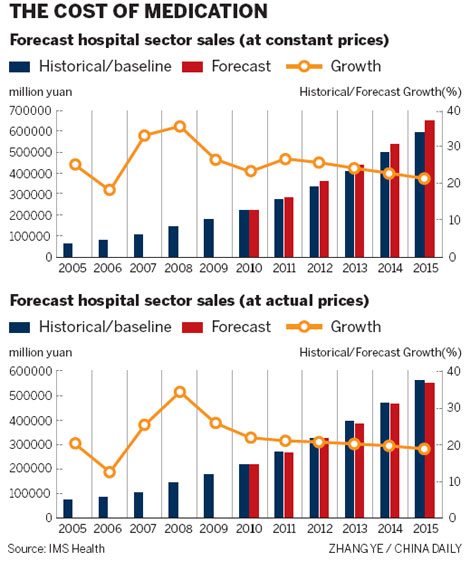
China's hospital sector has seen strong sales growth since 2003, with growth constantly boosting sales, calculated by dividing the actual sales in any given year by the price index of that year.
Sales in hospitals jumped to 211.77 billion yuan last year from 49.15 billion yuan in 2003, an average annual increase of around 20 percent, according to a report from IMS Health, an international healthcare researcher.
The IMS report said that sales growth in hospitals has been driven by the buoyant economy, the rapidly rising standard of living in urban areas, and the high prescription levels in hospitals dependent on income from pharmaceutical sales.
That growth was given additional impetus by the government's program of healthcare reform launched in 2009. Additional funding of 12.3 billion yuan in support of the local healthcare reform initiative was allocated in late 2010, on top of the 850 billion yuan allocated to finance the reforms between 2009 and 2011.
The report forecast that the robust growth of the hospital sector is expected to continue. However, it is expected to slow gradually, given that there will be a new NRDL and price reductions for the drugs included in it, and a reduction of the price differential between off-patent originators and local generic products.
Liu is one of 2 million-plus doctors in China. After an eight-year university education, she began working at a State-owned hospital in 2009. "Compared with my education costs and what I do I treat about 50 patients every day and have little time to do anything else I believe the salary is too low. However, I don't want to give up my career," she said.
The young doctor, who at 27 looks as though she's in her 30s, was dressed simply and worn no make-up. She ate the contents of her lunch box - egg-fried rice with vegetables - during her one-hour noon break as she read her micro blog. She can only do this at lunchtime or at the weekends, because she attends training courses every evening from Monday to Friday. Meanwhile, she's also preparing for further study overseas.
"Being a doctor is a very tough job in China. I plan to continue my career overseas, hoping for at least a decent income and reasonable working pressure," Liu said, taking a sip of tea from a stainless steel vacuum mug bearing the name of a medical treatment and the logo of the drug maker, while playing with a pen adorned with the name of a different drug and company, despite a card on her desk that read: "No pharmaceutical sales."
After lunching with the director of a cardiovascular unit, Feng went home for a short rest. "If you could take the heat and enjoy the bonuses offered by most good companies, the job (medicine sales) could be really flexible and offer many opportunities," he said.
Feng admitted that when looking for jobs prior to graduation, income was one of the key elements he took into consideration. Meanwhile, he believed that a job in medicine sales would help overworked doctors and save their time by keeping them up to date with the latest industry developments. "However, I don't think that is what I am doing now, except for some professional lectures - and they are mainly aimed at promoting a medicine," he said.
What makes him most frustrated and depressed is people's attitudes, especially those of doctors and patients. "I have a sound educational background, I have undergone strict and tough training in medication and sales skills, and I am serving a global top-500 company, but I still feel humble," said Feng. "Anyway, the money is good compensation and a nice recognition of my work."
Feng's company has hundreds of representatives like him and plans to double its sales staff in China within a few years, eyeing the nation's huge market potential. Speaking under condition of anonymity, a senior communications executive of a multinational drug enterprise said providing a small remuneration to doctors is a common principle in the industry around the world, including China, and the skills employed by medicine representatives are universal.
"Have you ever seen the Hollywood movie Love and Other Drugs? (describing the relationship between a woman suffering from Parkinson's disease and a drug representative working for Pfizer). Some see it as a romance, but we find many common characteristics of the lives of drug representatives in it," said the executive.
She also said that the role of head of drug pricing, registration and approval is the most important position in any pharmaceutical company and expenditure on this sector "is not a small amount of money".
On Nov 23, Sun Zhigang, director of the medical reform office under the State Council, said that China is to further reform its medical distribution system, break down hospitals' dependence on big prescriptions and crack down effectively on bribery and corrupt practices, such as rebates to doctors.
Calls to Beijing's local pharmaceutical purchasing and bidding department were not immediately answered.
In China, consumption of medicines in hospitals and retailing pharmacies amounted to 755.6 billion yuan last year, compared with 1.572 billion yuan in 2001, according to statistics from the China Medicine Economic Institute affiliated to the State Food and Drug Administration. The institute predicts that the figure will reach 3.3 trillion yuan by 2020.
Jiang said he knows that there are many corrupt practices in the pharmaceutical industry. "They have the distributors and medicine representatives. The hospitals and doctors depend on drug purchases and prescriptions to earn extra money. Why doesn't the government shorten the distribution chain and let the drug makers and hospitals buy and sell directly? Why doesn't the government set up a strict supervision system to punish bribery and corruption severely?" he said.
"In the end, I cannot understand, if the prices are set by the NDRC and the local departments, why do they still have supervision rights? They are supervising policies formulated by themselves."
Government efforts
The Chinese government has recently taken a series of measures to reduce the price of medication.
On Nov 14, the NDRC announced it had imposed large fines on two domestic drug companies for monopoly pricing, signaling that the government plans to standardize the pricing system for drugs.
The fines were set at more than 7 million yuan and the companies' illegal gains will be confiscated in line with the anti-monopoly law. An investigation by the NDRC found that the companies controlled the supply of raw materials for Compound Reserpine tablets - a treatment for high blood pressure that is on the NDRL - and forced the manufacturers to increase the price of the final product by up to fivefold.
On Aug 5, the NDRC announced that it will lower the maximum retail prices of 82 medicines for the hormonal, endocrinal and nervous systems with an average reduction rate of 14 percent.
In March, the commission announced cuts in retail prices averaging 21 percent and affecting 162 antibiotics and cardiovascular system drugs expecting to help patients save nearly 10 billion yuan every year.
Related Stories
Medical ignorance a problem 2010-12-03 07:58
Authorities tighten control of medication 2007-10-09 07:37
Medical reform calls for combined efforts 2005-08-01 09:12
- Property prices in big cities declining
- Trade frictions to challenge economic diplomacy
- Bitter medicine for sick people
- Club Med opens 2nd resort in China
- Liquor exchange platform opens
- Long-term mechanism for real economy urged
- Growth moderation not 'bad thing' for China
- China upgrades 1st UHV transmission system