Moller-Maersk staying afloat
Updated: 2011-12-22 09:36
By Zhou Siyu (China Daily)
|
|||||||||||


According to the group's annual report in 2009, the savings were mainly achieved through "restructurings, reducing fuel consumption, optimizing networks and renegotiating supplier contracts".
But when translated into reality, the figures represented slashed jobs across the world. In the beginning of 2008, Maersk announced its plan to cut 3,000 to 4,000 jobs by the end of April, and would consolidate its 14 administrative regions across the world into 11.
Six months later, the company transferred its global service center from China's coastal city Guangzhou to the southwestern city of Chengdu, with a total of 700 employees transferred to other business units or dismissed. Maersk only had six global service centers in the world at that time. The financial crisis resulted in more tough decisions in the company's business structure. In 2009, the group decided to pull out of the ship-building business and shut down its Odense Steel Shipyard in Denmark.
In the same year, Maersk also announced plans to sell Norfolkline, the European ferry operator and logistics company it acquired in 1985, to Det Forenede Dampskibs-Selskab, a Danish shipping company. The takeover was accomplished in July 2010.
"During the financial crisis, we did a lot of work on the cost side. The good thing is that the financial position of the company is strong enough, so we can continue investments in ports and oil assets," Andersen said. "It was a lot of hard work."
In trimming the bulky business group, the hard work lies also in internal communications. "Since Andersen joined Maersk, the company has put more emphasis on communications than before," said a senior communications partner at Maersk.
According to employees at Maersk, Andersen would arrange opportunities in his tight schedule to meet frontline workers whenever he visited one of the company's sites. At every assembly he would give a short speech and encourage employees to ask him questions concerning the company.
"He is the kind of man who likes to take tough questions upfront," said one employee at Maersk.
In 2010, as the world trade and economy warmed up, AP Moller-Maersk reported a historical profit of $5 billion.
China on the chart
For the current difficult market, he said: "We will concentrate on continuing to expand in the growth markets, and we have a strong balance sheet to invest in oil assets and port areas."
In February, Maersk Line, the group's shipping division, announced an order for 20 of the largest container vessels. Designed to carry 18,000 containers, each of the new vessels costs approximately $190 million. A larger vessel means lower costs for each container, which is likely to strengthen the company's competitiveness in a subdued market.
In September, Maersk Line launched a daily cut-off service it called "Daily Maersk". The service connects four major Asian ports (three in China) with three European container ports, promising daily cargo delivery to the terminals, with fixed transportation times. Scheduled for delivery in 2013, the fleet of 18,000 containers will also be deployed on the daily service and ply the China-Europe route.
Customers of "Daily Maersk" can save money on warehouses by up to 50 percent, according to the company. But, more importantly, the daily shipment may enable exporters to reschedule their production plans more swiftly for the market.
"Historically, China is a major exporter - 35 percent of the world's containers come to or from China. And now we see Chinese consumers getting interested in foreign goods, which drives up China's imports," Andersen said.
As the debt crisis rages on in developed economies, he confirmed China's increasing importance in world trade.
He said: "We have also seen trade increases between China and other Asian countries and southern Africa countries. But we should also remember Asia-Europe trade is still the biggest in the world. And weak demand in Western markets will affect China in a negative way."
The group employs more than 9,000 people in China and has so far invested in nine Chinese ports and 100 vessels and built two container production factories.
Regarding oil-related business, Andersen said: "We are continually scanning the market and talking with people. But so far we have not seen the opportunity to enter China's oil market in a profitable way."
Sailing out of the dangerous whirls of the world financial crisis, Maersk once again heads for rough waters. But with the largest-ever vessels and a focused service, the company's ambitions to reshape the world container shipping industry might be achieved, and end up altering the dynamics in global trade, according to many analysts. Shifting from beer to the sea, Andersen was introduced into the shipping conglomerate as an element of change. He turned out to be just that.
|
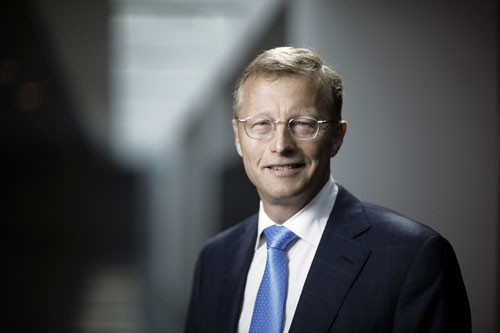 Nils S.Andersen, partner and group chief executive officer, AP Moller-Maersk Group. [Photo/China Daily] |