Europe's debt crisis to affect China
Updated: 2011-07-21 13:15
By Duncan Freeman (China Daily)
|
|||||||||||


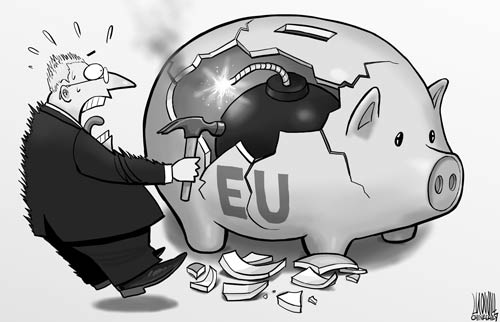 |
For more than a year the European Union has been faced with a sovereign debt crisis, which its leaders have failed to resolve so far. The impacts of this crisis are being felt in economies across Europe, and China cannot count on escaping its influence.
Underlying the current crisis is the huge level of government debt built up over many years in several EU countries. A key element of the cure being adopted in the eurozone is austerity. Above all this involves reductions in government deficits by spending cuts, which may be also accompanied by increased taxation.
The most obvious example of this approach is in Greece, but it has also been followed in Ireland and Portugal, the other bail-out countries. They are not alone, Italy has also been forced to adopt an austerity budget, as has Spain. The approach has also been adopted outside the eurozone in the UK, which has sought to pre-empt any crisis by introducing its own austerity measures.
The cure has real costs. Austerity measures are having an impact on living standards in the countries where they are adopted. Government debt is not the only problem. Excessive borrowing has created very high household debt, notably in the UK. For this the only solution is the same, consumers must reduce their spending. In recent weeks hardly a day has gone by without a retail chain in the UK announcing lower profits or shop closures.
The EU is China's largest export market. The current stage of the European crisis will have a significant impact on China's export trade and there are signs that this is already happening.
When the financial crisis first struck the US and Europe in 2008, China's exports to the EU remained unaffected. It was only in 2009 that exports to the EU suffered a large fall. This was followed by a strong recovery in 2010, which brought exports to the EU back up close to their pre-crisis levels. It appeared that the EU and Chinese exports there had returned to normal. This has turned out to be an illusion. The failure of the EU to deal with the problems it faced merely delayed the day of reckoning.
This strong growth in imports from China was sustained in the first few months of this year, but more recently it has slowed sharply. According to EU statistics, imports from China grew by only 8.4 percent in May.
This figure hides sharp differences across the member states of the EU. China's exports to several EU countries have experienced falls in recent months. Imports from China by Portugal fell 11.6 percent in May. In March and April imports by Spain fell, although they managed a small increase in May. The countries worst hit by the crisis are relatively small importers of Chinese goods. Of greater significance is the UK, one of the biggest markets for China, whose imports also went into a decline in May.
It is not only the crisis-hit countries where import growth has been weakening. Imports from China by Denmark also fell in May. Import growth in France and the Netherlands has also slowed sharply. Even more significant is that the growth in imports by Germany has also decelerated rapidly, and in March experienced a decline for the first time since January 2010, although this was followed by two months of weak growth.
While some countries in Europe, like Italy, have maintained strong import growth from China, this may not last much longer and the signs are multiplying that China's exports to the EU are facing severe difficulties. China's exports to the EU are highly cyclical. There is normally a trough in monthly exports early in the year, followed by a steady rise to a peak in about October. The main exporting season of 2011 is still ahead of us, but the most recent signs are not positive, especially in those countries in severe economic difficulties.
Even if it manages to finally adopt policies to solve the crisis, many markets in the EU will not return to strong growth any time soon. The policies required to solve the crisis will impose severe economic hardship over a number of years. This will have a long-term effect on China's exports to the EU.
Chinese exporters may have to face the prospect that unlike in 2008, there may be no quick return to strong growth across many markets in the EU.
The author is a senior researcher with Brussels Institute of Contemporary China Studies.
Related Stories
China hails WTO ruling against EU duties 2011-07-16 17:25
China, EU to start investment talks 2011-07-15 09:11
Why China needs a strong EU 2011-06-24 07:52
China backing nations' battle against debt crisis 2011-06-27 11:03
- Substandard mooncakes found
- Oil spills trigger environmental concerns
- China probes into steel tubes from EU, Japan
- PBOC may launch RMB QFII trials soon
- China to further facilitate investment
- Apple closer to offering 3G iPad 2 in mainland
- Call for stronger trade ties
- Provinces to face winter power shortages