The area has experienced a long process to form the Old Town of Lijiang. According to archaeological discoveries, long before the Qin and Han dynasties, Lijiang had traces of ancient human activities. The Naxi nationality is the major nationality that lives in Lijiang County and even in Lijiang City. As for the origins of the Naxi nationality, experts have different views. Currently, most experts agree on the "viewpoint of integration," namely that the Naxi nationality living in Lijiang was formed by the combination of aboriginals and the descendants of the Qiang ethnic minority who moved southwards from the northwest Hehuang District in ancient times. Lijiang has a long history.
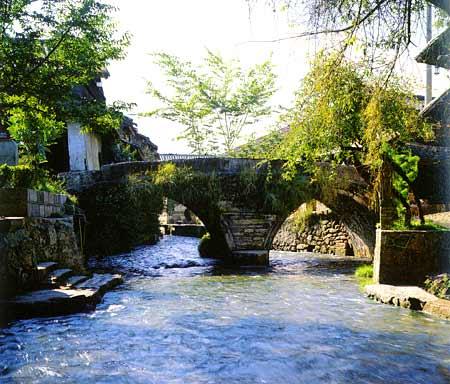 |
| The Old Town of Lijiang |
However, it is still unknown when the Old Town of Lijiang was established. There are two views about the origin of the old town—one is that it appeared in late Song Dynasty and early Yuan Dynasty with 700 to 800 years of history, and the other is that it was established in the early Tang Dynasty with 1,200 to 1,300 years of history. The old town is located in the vital transportation line between Yunnan, Sichuan and Tibet. It was the hub of national culture and economic exchanges between the Han, Tibetan, Bai and Naxi ethnic groups since ancient times, and an important military strategic center of the southern Silk Road and the Ancient Tea Horse Road, playing a key role in the long history.
In the Ming and Qing dynasties, the old town became the prefectural city of Lijiang. In the Hongwu Year of the Ming Dynasty, an official whose surname was Mu had largely constructed and extended the old town according to the construction model of the Forbidden City in Beijing. However, it suffered great damage during the uprising led by Du Wenxiu from the Hui ethnic group during the Xianfeng and Tongzhi Year of the Qing Dynasty. After restoration in the periods of the late Qing Dynasty, the Republic of China period and the founding of the People's Republic of China, the layout of the old town still retains the construction layout of the Ming and Qing dynasties up to today. The south of the town had an old government office in feudal China and palaces and gardens were established around it. The northern part of the town has a commercial street, with Sifang Street as the center and four main streets extending to the distance in a radiation-shape. The commercial shops are all on the streets. The east town is where the liquid officials handled the public affairs in ancient times and has preserved the Civilization Gateway, the Confucius Temple and the temple enshrining and worshipping Guan Yu.