Toward a more secure energy sector
Updated: 2012-01-06 09:21
By Pierre Gadonneix (China Daily)
|
|||||||||


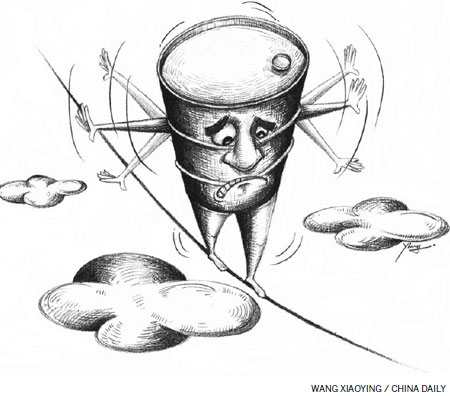
The year 2011 was a year of tremendous ups and downs in the energy sector. The accident at Fukushima Daiichi nuclear power plant in Japan, the economic crises in Europe and the United States, the "Arab Spring" and the resulting volatility of oil prices kept policymakers busy throughout 2011.
The year has also seen warnings that we might be trapped in the "lock-in effect" if we do not take concrete steps toward greenhouse gas (GHG) emissions mitigation by 2017, especially after we saw how difficult it was for the Durban climate change conference to reach a consensus.
Therefore, we should now focus on pragmatic and practical ways to address GHG emissions. It is possible - it is an unprecedented opportunity - to move the sector forward faster both technologically and in terms of social governance. This will be challenging because we have to do this and at the same time encourage economic growth. However, the challenge is not only to maintain and support growth in developed and emerging economies, but also to support and empower the more than 1.3 billion people who still do not have access to energy.
We have seen great volatility in oil prices because of events such as the "Arab Spring", but as the oil price has increased we saw renewed interest in "unconventionals". In Brazil we see the opportunities in the pre-salt offshore fields and in Canada we see the development of the oil sands.
The year 2011 also saw the consolidation of new developments in shale gas, which many say can be a "game changer". The result of these new developments has led some countries to decouple oil and gas prices, which in turn resulted in increased use of gas to meet energy demands. The International Energy Agency released its oil reserves in earlier 2011 this year in response to the situation in Libya showing that the world could adapt to a crisis in the short term.
Despite the past decade's doomsday predictions on global oil reserves, the good news is that the world's endowment of energy resources, both conventional and unconventional, is enormous.
If we work together to provide a good mix of energies we will ensure that supply can continue to meet demand. It is now for policymakers to address the challenge to ensure that their plans enable rather than hinder this process and simultaneously guarantee that the world moves toward decarbonization.
As seen in our newly completed scenarios study into the future of the transport sector up to 2050, the variations in meeting the demands can be marked depending on the policy choices adopted. The studies show that countries like China will see the largest growth in the transport sector. In fact, the demands of developing countries are expected to surpass that of the developed ones by 2025.
The way the global market adapts to these new opportunities will have a huge impact on the world. In the longer term, we see that such demands will begin to put strain on the energy, water and food sectors. Biofuel production will peak by 2050 and is expected to be about four times the current level but restrictions on water and land use will prevent further growth in this area.
As the world continues to battle the economic crisis the energy sector has the capacity to provide affordable energy to create and retain jobs regionally and foster fair competition. This will be crucial if we want to prevent trade protectionism.
We (World Energy Council) presented our principles on Rules of Trade and Investment to the Durban climate change conference and the World Trade Organization. In our view, the elimination of government-imposed barriers on trade in environmental goods and services will significantly help the reduction of GHG emissions. In an increasingly interconnected world this has to be the way forward.
We must not isolate trade in environmental goods and services after the Fukushima Daiichi accident in 2011 and the oil spill in the Gulf of Mexico in 2010. We must reconsider sharing and controlling better international safety standards. This calls for a renewed international governance of safety for all energy sources and technologies.
If we are to provide a sustainable energy mix that encourages and at the same time keeps pace with growth, policymakers have to focus on the "energy trilemma", that is, balancing energy security, social equity and environmental impact mitigation.
As chairman of the World Energy Council, a locally rooted international organization, I can see that all countries participate in these endeavours. I am optimistic about 2012, yet realistic. The best of the world's finances, intellect and skills, and goodwill will be required to help us meet one of the greatest challenges we have ever faced: securing today tomorrow's energy for the world's development.
The author is chairman of the energy leaders' organisation, the World Energy Council and honorary chairman of Electricit de France.
- Bond issues up 52% in 2011 as market develops
- China Telecom to start UK service
- Officials weighing green benefits of carbon tax
- Net buyers required to register names, ID numbers
- Lifting consumption top priority for 2012
- Weak export hits 2011 trade surplus
- Yuan expected to rise more this year
- 'Time to diversify' crude sources