 |
|
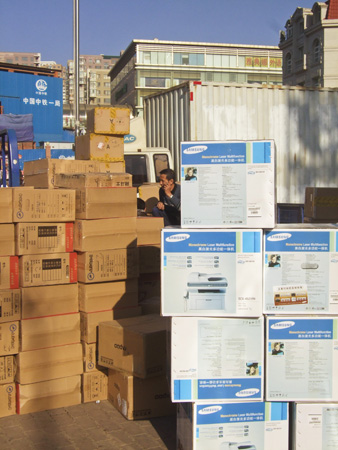
An express package delivery hub in Dalian, Liaoning province. DHL Express currently leads the market with 35 percent of China's international business. [Photo /?China Daily] |
But life at DHL does not deliver a diet of fun and games all the time
BEIJING - Playful, charismatic and energetic, Ken Allen can often be found cheering up a roomful of people with a song. You will hear him sing Ain't No Mountain High Enough, the theme song for DHL's latest promotion campaign if you ask about business confidence amid a largely flat world economy, and I Will Be a Billionaire, a popular song within the company, when he is quizzed about his business targets for the next five years.
And, if you can wait, you will hear him launch into jokes about competitors, which lightens the atmosphere at every staff meeting.
Dubbed the "singing CEO" by his employees, the 56-year-old English businessman has worked for half of his life in the empire of Deutsche Post AG, the world's largest logistics group. He managed offices in small Middle East countries such as Yemen, opened Libya's market for the company and then ran divisions in big countries including the United States and Canada before he reached the top position in 2009 in DHL Express, the group's express division.
One thing about the company he learned from his global experience is that it is "the most international company in the world", he said.
His motto as the CEO in such a company is simple: "It is my firm belief that all you need to do is send one simple message right throughout the organization."
But given the multicultural nature of the company, he said words cannot be trusted. "I broke the messages into songs," he said, with a proud smile.
The message was about the people. "To motivate people is the most important matter. Every frontline guy is an ambassador for the brand. And we will make them proud of working for DHL," he said
Despite the huge investments in networks and facilities, the express business, Allen said, depends on attitude. It matters whether the frontline staff keep the yellow vans clean, wear nice-looking uniforms, crack a smile for clients and maintain the proud speed of the dashing yellow light (the company's symbol, shown in its latest advertisements).
But a CEO's lot is not always a happy one. He or she has to be decisive and practical. For Allen, one of the latest tough decisions he made was to give up China's domestic express business.
Total withdrawal
In July 2011, DHL sold three Chinese express companies it acquired in 2009 to a domestic company, which means a total withdrawal of DHL from the domestic express business on the Chinese mainland.
The major reason for DHL to leave was "the fierce competition in the domestic market" which led to financial losses, said the company. The three Chinese domestic express companies DHL acquired in 2009 reported losses of 99.2 million yuan ($15.5 million) by the end of 2010, according to the company.
In a bid to stop the hemorrhaging of cash, the three companies, bought two years ago for 300 million yuan, were sold in July for just 100 million yuan, according to domestic reports.
For Allen, the withdrawal strategy was not new. In November 2008, DHL announced plans to shut down the domestic business in the US because of "fluctuating fuel costs, the downturn in the US economy and the continued contraction of the US domestic air express business", the company said.
In making this move, the company was able to cut its business budget by 80 percent from $5.4 billion to $1 billion, but had to close all of its ground hubs in the US and reduce the number of US logistics stations from 412 to 103. Of all the approximately 17,000 jobs in the US, only 3,000 to 4,000 remained, according to the company.
One thing about the tough decisions, although important and difficult, Allen said, was not to take them as a personal issue.
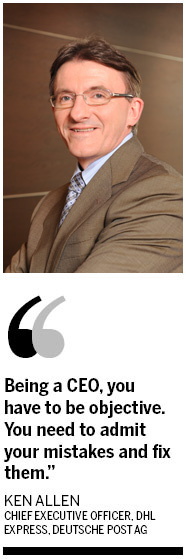
"Being a CEO, you have to be objective. You need to admit your mistakes and fix them," he said.
"And you should not hang on too long. Make the decision quickly as in China and maybe you can find someone to buy it. If you wait too long, as we did in the US, the impact can be dramatic on people's lives," he added.
Doomed battle
DHL's withdrawal also raised the question whether foreign express companies are bound to fail in competition with domestic ones. The four largest logistics companies worldwide - DHL, Federal Express Corporation (FedEx), TNT Express NV and United Parcel Service (UPS) - entered China's market during the 1980s but none have managed to claim predominance in the domestic business.
Analysts said one of the reasons is that China's domestic express companies are very competitive in price. With cheap labor and management costs, they have an advantage in local business. Their levels of service may be low but this is more than compensated for by their low prices.
The government seems eager to bring order into the market. In July, the State Post Bureau issued a guideline aiming to boost the development of a number of major domestic companies through consolidation while shutting down 56 small express companies because their services failed to meet the national standard.
Another difficulty for foreign companies might have stemmed from the government's regulation, analysts said. China revised its Post Law in 2009, which forbids foreign companies from participating in the domestic mail express business. The revised regulation, industry insiders said, may have hurt DHL's business.
Coming to China in 1986, DHL formed a joint venture with a major domestic logistics company in charge of its business in China. But according to the revised Post Law, the joint venture, DHL-Sinotrans International Air Courier Ltd and its subsidiaries, were regarded as a foreign company and therefore barred from the mail express business in China.
The mail express business accounted for 35 percent of the three express companies DHL-Sinotrans acquired, Jerry Hsu, CEO of DHL Express Asia Pacific, told Chinese domestic media.
Gene Huang, chief economist and vice-president of FedEx, said the government should enhance the stability and transparency of its regulations and policies to spur the development of the express industry.
Yet despite all the difficulties, foreign companies still have reasons to stay and hope, said Tina Wang, partner and vice-president of Roland Berger Strategy Consultants, Greater China.
"China's express market has been developing rapidly, which will generate demand for different services. Foreign express companies, with a better service, could cater to the high-end clients," she said.
Wang said there is a need for the government to further elucidate its regulations. But she also agreed that "the regulation has been improving during recent years".
"Always be in China"
Pulling out of the domestic business does not mean DHL has left China, Allen said. "My whole strategy is to focus on the international business, where we can have a lot of value."
DHL currently leads the market with 35 percent of China's international business, compared with a "small market share in the domestic business", Allen said.
China's importance has developed rapidly during the last decade, according to Allen.
"China is already the biggest revenue country in DHL's network. But 10 years ago it was not in the top 10," he said. "The development reflected the importance and development of China itself."
China's business is on the increase. "The year 2011 was a strong year of growth in China, which had been expected. We will be cautiously optimistic about the next two or three years and expect the business growth to continue," he added.
For business in the future, besides continuous investment and staff training, DHL will focus on "helping the world enter China", he said.
"We have seen a growing middle class and wealth in China. The next decade will see more and more small- and medium-sized companies in the US and Europe trying to come to China. And we will help them."
In the meantime, China's booming domestic business will remain tempting. According to an industry report, by 2015, China's domestic express business market will expand by four times from now to 129.2 billion yuan while the international business will double to 32.3 billion yuan.
"China's domestic express business will maintain its robust dynamism, while its international business may be subject to international trade growth and remain stable," Wang from Roland Berger said.
But Allen insisted that DHL is unlikely to return to China's domestic business, which "is not our specialty". "But we will always be in China," he said.
"Ain't no mountain high enough ... If You Need Me, Call Me, No Matter Where You Are, No Matter How Faaaaaar..." he was induced to sing in his own inimitable way.


Copyright 1995 - . All rights reserved. The content (including but not limited to text, photo, multimedia information, etc) published in this site belongs to China Daily Information Co (CDIC). Without written authorization from CDIC, such content shall not be republished or used in any form. Note: Browsers with 1024*768 or higher resolution are suggested for this site.
License for publishing multimedia online 0108263 Registration Number: 130349