China curbing overcapacity helps GM set goal
Updated: 2012-02-21 10:12
(chinadaily.com.cn/Agencies)
|
|||||||||||


China is clamping down on overcapacity in the world's biggest automobile market, benefiting companies with entrenched production and sales, such as General Motors Co (GM), while hurting newcomers to the market.
Foreign automakers received preferential treatment for seven years on their Chinese plants as the country sought foreign investment. Now, the carmakers will only be eligible for incentives on factories approved by the government before Jan 30, the nation's top economic planner said on its website Dec 29. More important, the rules signal that China will be less inclined to sign off on new applications, according to research firm LMC Automotive.
"The message is that you're not welcome here anymore; we have enough guests," said John Zeng, Shanghai-based director of Asian forecasting at LMC Automotive.
The push may result in China shutting its doors to new foreign carmakers, benefiting earlier entrants including GM and Volkswagen AG (VOW), as their future expansion plans were probably approved by the government already, according to consulting firm Booz & Co.
"For existing players, it's helpful because you slow down the excess competition you have here in China, which is ferocious," said Ivo Naumann, Shanghai-based managing director at AlixPartners.
GM, the top foreign automaker in China, on Feb 16 reported record net income of $9.19 billion for 2011. Its market share in the country climbed above 13 percent last year, more than triple the 4.1 percent it held in 2001, according to the company.
Room for growth
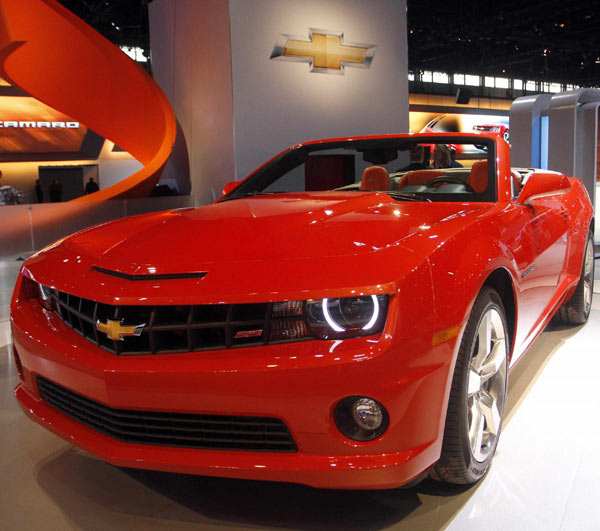
The 2011 Chevrolet Camaro convertible is displayed during the first media preview day at the 2011 Chicago Auto Show in Chicago, Illinois in this file photo taken Feb 9, 2011. [Photo/Agencies] |
GM is betting demand will accelerate in China. Vehicle ownership in China was equivalent to 4.7 percent of the population, compared with about 51 percent in Japan and 81 percent in the US, according to 2009 figures from the Japan Automobile Manufacturers Association.
The Detroit-based company plans to double deliveries in the country to 5 million by 2015. It is close to receiving approval to build a 7 billion yuan ($1.1 billion) factory, the Hubei Environmental Protection Bureau said on its website this month.
China's policy change comes as the government looks to move external investment into different industries, said Kevin Wale, GM's China president, on Feb 15.
"In the near term, I don't see a dramatic change in the way the Chinese government wants to run the automotive industry," he said in Shanghai.
China absentees
Volkswagen said on Jan 6 the company will add a seventh car plant in China as it expands production capacity to 3 million vehicles a year.
Those who haven't begun manufacturing cars in the country may be the most hurt by China's move to control capacity, according to Tzeshen Cheam, a Hong Kong-based analyst at CIMB Securities HK. Tata Motors Ltd's Jaguar Land Rover, Subaru- maker Fuji Heavy Industries Ltd, Renault SA (RNO) and Fiat SpA's Chrysler Group LLC don't make vehicles in China.
While Renault and Chrysler have expressed interest in building cars in the country, Jaguar may be first to test the government's resolve to limit capacity in a country where foreign carmakers are required to partner with a domestic company before making vehicles.
Jaguar is in talks with Wuhu, China-based Chery Automobile Co to form a venture to jointly build vehicles there, two people with direct knowledge of the matter said Feb 3. Del Sehmar, a Jaguar spokesman in Mumbai, declined to comment on the company's China plans.
Partner limits
Fuji Heavy has failed to win regulatory approval to build in China because the government considers the company part of Toyota, which already has the limit of two manufacturing partners, three people familiar with the matter said in September. President Yasuyuki Yoshinaga said this month the Subaru maker, which is 16 percent owned by Toyota, will keep pursuing its China plans until the end of the fiscal year in March.
"Foreign automakers need China more than the country needs them," said CIMB Securities' Cheam.
China has reason to be concerned about overcapacity. Passenger-vehicle sales slowed last year, trailing growth in the US for the first time in at least 14 years. The market is crowded with more than 70 producers, some of which failed to sell a single car last year. The market share of Chinese brands in January fell almost 4 percentage points from a year earlier, according to the China Association of Automobile Manufacturers, even as German and US carmakers increased their share by at least 1.5 percentage points.
Overcapacity looms
Mizuho Financial Group Inc, a Tokyo-based financial services firm, estimated in December that overcapacity in the nation's auto industry began emerging last year and the glut will worsen every year through 2015.
The incentives including exemptions of import duties on plant equipment and lower taxes expired Jan 30, the first business day of the Chinese lunar year, after the National Development and Reform Commission removed auto manufacturing from catalog of industries in which external investment is "encouraged." A fax to the NDRC's press office for comment was unanswered.
"Inclusion in an encouraged foreign investment category is a signal to officials throughout the government to green-light a project," said Lester Ross, a Beijing-based partner at Wilmer Cutler Pickering Hale & Dorr LLP. "A project which is not listed in the catalog is merely deemed to be 'permitted,' so the relevant officials have to be persuaded to approve the project, effectively slowing it down as well as reducing its eligibility for preferences, like driving through a series of yellow lights."
Longer waits
Bill Russo, a senior adviser at Booz & Co who was formerly Chrysler Group LLC's China head, said the rule changes mean carmakers may lose out on cost savings of about $20 million to build a factory and wait longer than the average one to two years needed to receive approvals and business licenses.
Russo said projects that focus on hybrid or electric cars, invest in the lesser-developed regions of China or bring in key technologies may have an easier time obtaining approvals after the NDRC kept low-emission vehicles on the "encouraged" list.
The policy shift doesn't mean China is cutting off the flow of foreign investment into the automotive industry, LMC's Zeng said. Premier Wen Jiabao's government wants to divert investment into other areas such as into auto components and nurturing local research and development capability, especially in hybrid and electric vehicles, he said.
"China is still encouraging development of the auto industry in China," Zeng said. "The government focus has just shifted from made-in-China to create-in-China."
- Consumers seek accident, health insurance
- MOC tops central government transparency list
- Very little sweet news for sugar producers
- Sing, dance and buy for New Year
- Avon appoints new head of China business
- Banks have record year amid economic troubles
- Bank of China moves closer to LME membership
- CSRC tightens rules on acquisitions