Comments()
  Print
Print  Mail
Mail  Large Medium Small
|
 |
|
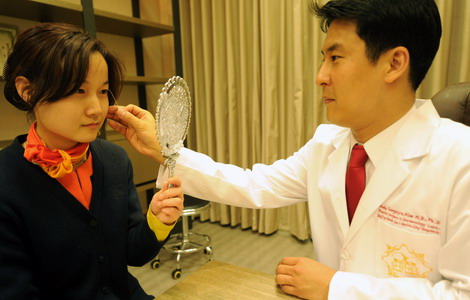
A South Korean doctor at Yanda International Hospital in Sanhe city of Hebei province examines a patient's condition before a double-eyelid operation in May last year. [Photo / Xinhua] |
"We will continue to strengthen our efforts in this industry in the coming three to five years, given the ever-increasing social demand for health and higher standards of living, allied to the government's support for the medical care sector," said Xu Hang, a partner at SAIF.
"At present, we have six teams working on related projects, from pharmaceuticals to medical care institutions," he said, adding that SAIF is a long-term investor and the money available for each of the investments ranges from $10 million to $100 million.
The fund has invested in six medical projects, including Direct Digital Imaging Technology (Beijing) Inc, a domestic medical device company, and the Beijing-based drugmaker, Sinovac Biotec Ltd.
However, when it comes to the hospital sector, SAIF is adopting a cautious approach.
"The central government is encouraging private capital to invest in the industry, but the details of some polices are not very clear yet," said Xu.
An increasing number of Chinese and overseas venture capitalists and private equity firms are seeking opportunities in China's medical care industry.
"Over recent years, the majority of the investment has gone into the pharmaceutical and medical-equipment sectors. But since last year, the central government has reiterated that it is encouraging the introduction of private funds to the nation's medical care institutions. We believe that more funds will be invested in the construction of hospitals and clinics in the coming years," said Wang Guochang, director of the Tsinghua Cambridge Investment Management Center.
At the end of 2010, a number of Chinese government agencies, including the National Development and Reform Commission and the Ministry of Health, issued policies to encourage the flow of private investment into the hospital industry, which has traditionally been dominated by State-owned institutions.
At an executive meeting of the State Council, China's cabinet, on Feb 22, Premier Wen Jiabao said that China will broaden access for private funds to invest in the construction of medical institutions, in a bid to expand and diversify the resources available for social and medical care.
The nation is encouraging enterprises with capital strength, charities, foundations, commercial insurance institutions and overseas investors to help build hospitals and clinics. The central government will improve the administration environment and give priority status to the investments during the registration and approval procedures.
"Venture capital and private equity institutions can take the opportunity to speed up their business expansion in the reform and improvement of medical care institutions," said Wang.
Statistics from Wang's center show that the investment in the industry amounted to 25 billion yuan in 2011, and each of the past three years registered annual compound growth rate of 20 percent.
According to the Ministry of Health, by the end of October, the nation had 21,415 hospitals, 889 more than a year earlier. Meanwhile, the number of State-owned hospitals fell by 255. The number of private hospitals rose by 1,144, implying surging momentum in private investment.
"So far, around one-third of medical institutions in China are privately owned, but they only provide one-tenth of the medical services, implying huge growth potential for private hospitals and clinics," said Wang.
Li Kaijun, a partner at the Chinese private equity firm DT Capital Partners, said his company is keeping a close eye on the medical-care industry. The company, based in Shanghai, now manages two separate funds - one with capital of $570 million and the other with 2.2 billion yuan - and has 10 offices nationally.
"We have already done many deals in the biopharmaceutical sector. Now we are carefully and thoroughly studying how to take part in market-oriented reform of State-owned hospitals and the construction of specialized private hospitals and community clinics," said Li.
So far, only a few local governments, such as those in the provinces of Guangdong, Zhejiang and Jiangsu as well as Beijing, have issued detailed policies on related investments. The lack of clear and practical policies may dampen investor enthusiasm, according to Xiao Bing, managing partner and president of Fortune Venture Co Ltd, a domestic venture capital firm that manages 10.5 billion yuan in funds.
"The government has promised to improve the market environment to aid the flow of private capital into the medical institutions industry. One of the most important things will be the setting up of a transparent and convenient entry and withdrawal system," said Wang.
Copyright 1995 - 2010 . All rights reserved. The content (including but not limited to text, photo, multimedia information, etc) published in this site belongs to China Daily Information Co (CDIC). Without written authorization from CDIC, such content shall not be republished or used in any form. Note: Browsers with 1024*768 or higher resolution are suggested for this site.
License for publishing multimedia online 0108263 Registration Number: 20100000002731