|
|
|
 |
|
|
|||||||||
Nutrition-related business, a core sector of life sciences, brought in nearly half of the company's overall revenue generated in 2010.
After several acquisitions designed to move the company into a higher margin sector, Sijbesma is confident the company's longer-term profits will originate from the second-generation of biofuels.
First-generation biofuel involves the extraction of ethanol from food components, such as corn and weeds. Enzymes are used to break the starch down into sugars, whose chemical structure resembles that of ethanol.
 |
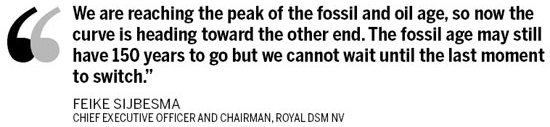 |
The second-generation, research into which the company has heavily invested, uses food waste, making it more sustainable and not competing with the food and feed chains. That has placed the company at an advantage, socially and commercially.
Sijbesma firmly believes in investing in the future. Even ethanol conversion won't be a mainstream profit source for the industry in five years, experts say.
"Currently biotech makes up only 5 to 6 percent of the chemical industry. But the figure will easily go to 20 percent or beyond in 20 years. That is hundreds of billions of dollars we are talking about," he said.
Sijbesma admits to not seeing China's potential 20 years ago.
The country had captured the interest of the European as long as he could remember. Before his first trip to Asia in the late 1980s, he pictured it as an ancient civilization or a cuisine republic, anything but a dynamic business hub.
"I was not so sure at that moment how fast China would grow. I thought India had a lot of potential and better chances. But, very soon, it turned out China would grow at a tremendous speed that outpaced India dramatically," he recalled.
After in-depth research he realized the per capita demand for chemical products in developed economies was five to six times greater than in high-growth economies, showing the latter's huge market potential.
This awareness propelled him to accelerate DSM's deployment in the world's fastest growing economy. It is no longer news that China has become the largest revenue-generator for most multinational companies. DSM tripled its sales in China from 2005 to 2010. Its sales in China exceeded $2 billion last year, accounting for 15 percent of its global business.
DSM intends to invest $1 billion in China from 2010 to 2015 and have three new large-scale plants to be fully operational by 2015. Expansion will not stop there, though. China is at the center of DSM's strategy, supported by two major drivers - local partnership and the formation of global research centers.
The joint venture with Sinochem Group is one of the first milestones it announced after formulating its new growth strategy. It combines DSM's anti-infective technology with the distribution network of Sinochem to expand in China and other high-growth countries.
Another major endeavor, to build research centers in Shanghai, the country's most robust business hub, has everything to do with Sijbesma's own "four-phase China" theory.
"It is a country with four different development phases. The first phase was to show the world how big a market it is. The second phase was flexing its muscles to become a productive manufacturer and a strong competitor. In the third phase, China was home to the industrial bases of Western companies," he said.
Now the fourth phase is coming with the Chinese realizing they can no longer survive on low-cost manufacturing and need to create a base for innovation and global brands.
Sijbesma not only has strong business acumen but has also developed an ethical dimension to the work of his company that has attracted global attention. He initiated a partnership with the United Nations' World Food Program in 2007, providing it with micronutrient packets for food aid packages, expertise in nutrition and logistics and direct financial assistance.
The program grew out of Sijbesma's participation at the Davos Forum, where he learned about "hidden hunger" - a condition in which people have enough food to stay alive but not enough vitamins and mineral input to be fully physically and mentally healthy.
To this day, the five-year program has lifted 10 million people out of the condition. Sijbesma was proud to relate that 2,300 of his employees participated in the WFP "Walk the World" fundraiser and 10 employees undertook volunteer assignments in Zambia and Mozambique.
"Dying people are no business model," Sijbesma said, explaining the rationale behind his actions. "We offer our knowledge and patent for free to this group because we can't be successful in a society that fails."
Similar programs are carried out in China, where DSM's micronutrient packages fed infants with anemia in 11 of the least developed counties.
Talking about the business value of philanthropy, he said: "It helps shareholders to have more motivated people - and if the world economy grows and those countries are doing better, it helps DSM."
hewei@chinadaily.com.cn