|
|
|
 |
|
|
|||||||||
East meets West
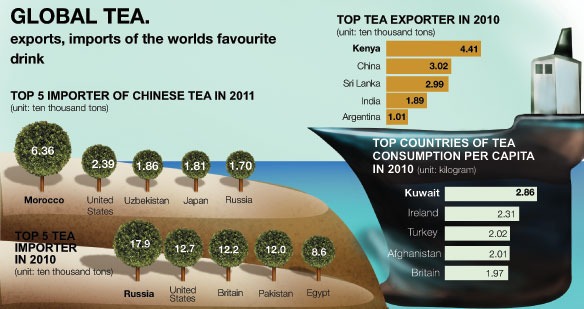
As the cradle of tea, China was the world's sole provider for centuries. However, the British, who formed the habit of drinking black tea in the 17th century, introduced tea trees to India and Sri Lanka in the late 19th century and then to Kenya in the early part of last century.
Partly because of their long connection with Europe, those three countries still dominate the global market for black tea, which accounts for 60 percent of all tea in the global trade. "Unlike the Chinese, Europeans and people in the US prefer black tea to green, and prefer teabags to loose-leaf teas," said Li.
|
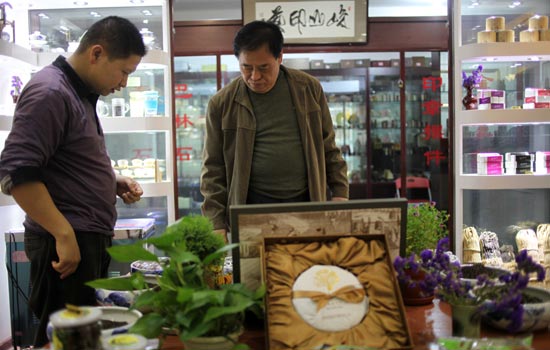
A man examines Pu'er tea in a market in southern Beijing. More people are drinking Pu'er for its health benefits. [Photo/China Daily] |
"That's why we are now focusing on the development of teabags, fruit-flavored teas, and instant teas (tea in granulated form, like instant coffee)," he said, adding that the company is preparing to open its first shop in the US.
And while Chinese companies are attempting to meet the needs of the Western customers, those customers also seem to be changing their habits.
Data from the London-based International Tea Committee, which compiles and publishes statistics on the industry, show that between 2001 and 2010, the global market share of black tea fell by 10 percent to 60 percent, while green and oolong teas combined saw an increase of 8 percent to 31 percent.
"A lot of people drink tea because it's healthy, and green tea can provide lots of benefits. Increasingly, people are beginning to realize that now," said Wu Xiduan, secretary-general of the China Tea Marketing Association.
He explained that studies in the US and China suggest that green tea can help to lower the risk of contracting certain types of cancer and also illnesses such as strokes that can cause cognitive impairment, and osteoporosis in the elderly.
And it's not just the health benefits that are prompting consumers to change their habits, it's also the taste. Loose-leaf teas are now beginning to take root in places where tea bags were previously the most popular form of the beverage.
"We believe there is no comparison between premium loose-leaf teas and tea made from bags," said Diane Walden, co-founder of California Tea & Coffee Brewery in Los Angeles, which opened in 2008.

"Studies have shown that the maximum antioxidant benefits are derived from freshly brewed loose leaf tea and that tea from bags loses much of its antioxidant value once it's steeped," she said in an e-mail interview.
"The tea in bags is usually the 'dust' or 'fannings', the lowest grade of tea. Our customers are amazed at the difference in the taste of loose-leaf tea when compared with tea bags. "
More than business
But, despite the rise of tea shops and related centers across the US and Europe during the past decade, no company from the Chinese mainland has yet opened an overseas outlet.
"We should be open-minded and take it (the rise of tea shops overseas) as positive news," said Sun Danwei, general manager of Beijing Wuyutai Tea, a 125-year-old brand that owns 270 shops in China.
"They are promoting knowledge of tea all over the world and preparing customers for quality tea," said Sun, whose company is planning to open a store in Hong Kong as a first step to entering the market outside the mainland.
Recognizing the growing demand, the US-based coffee giant Starbucks has launched a variety of tea-related products in recent years. In response, Chinese companies such as Wuyutai are also attempting to broaden their appeal to younger consumers by producing tea-flavored ice cream and also developing applications for Apple electronic products providing subscribers with the latest news from the industry, and instructions on how to brew the perfect cup. It has also opened a restaurant in Beijing that serves a range of dishes in which tea is used as a flavoring or major ingredient.
"It is not only about selling tea. It's about everything to do with tea: The drink itself, the history, even the pots used in its preparation. The Japanese are doing a better job than us," Sun said, referring to the vast numbers of tea shops and centers on the streets of China's neighbor to the east.
She admitted that it can be something of an effort to explain the cultural significance of tea to foreigners, but once they become interested, she said, many find it fascinating.
"The government should take full advantage of existing networks such as the Confucius Institutes (government-backed organizations that promote the Chinese language and culture overseas) to push China's tea culture across the world. The task is too difficult for individual companies to undertake at the present time."
Song Heng, an enthusiast who has published four books on China's tea culture, is upbeat about the future. He believes that the country's increasing economic power means that the eyes of the world are increasingly drawn to all things Chinese.
"I often drink tea with foreigners, but I rarely see them drink it slowly and savor it wholeheartedly as the Chinese do. They can't understand why Chinese people like to spend so much (time and money) on quality tea.
"But I believe it will change, things always do: At one point, Chinese people didn't drink coffee, but white-collar workers are drinking it a lot nowadays, and historically the Chinese didn't drink wine, but now they are willing to pay good money for a decent bottle," said Song.
"Chinese tea is set to regain its popularity overseas, because more people are becoming interested in the country and tea is an integral part of our culture."
Contact the reporters at tangyue@chinadaily.com.cn and zhangyuchen@chinadaily.com.cn