|
|
|
 |
|
|
|||||||||
|
 |
In the 1980s it became fashionable in the United States to explain Americans' behaviors in terms of addiction. Not only were there alcoholics and drug addicts but people labeled excessive eating, gambling, and even shopping as pathologies. In the 1990s, Internet and video addictions were added to the list. A popular book written 25 years ago, When Society Becomes an Addict by Anne Wilson Schaef suggested that the West's dysfunctional culture had created a nation of relationship addicts.
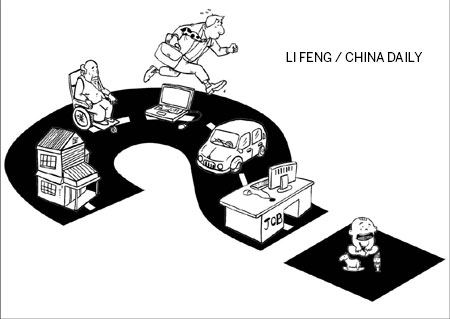
In China today there is a parallel to this addicted nation fable: the widespread belief in a generalized anxiety disorder among the Chinese middle class.
The argument goes something like this: society in China is competitive, producing pressures to keep up with one's neighbors, which makes people anxious.
Urban Chinese worry for many reasons, about housing prices, over work, and the best way to raise kids. Middle class anxiety seriously influences people's quality of life, but, although it exists, is it a real phenomenon?
But putting middle class anxiety alongside other irrational fears may help us feel, well, less anxious.
The Barnum Effect is the name given to a type of subjective validation in which a person finds personal meaning in statements that could apply to many people. For example: You have a need for people to like you but you sometimes keep people at a distance.
When people read or hear such vague statements, they generally see the statements as applying specifically to them. The problem is that such statements don't really tell us anything except that we are like most people. Taken alone the statements are harmless but when we attempt to extract personal life messages and alter our behaviors based upon such "individual" personality profiles we succumb to irrational and uncritical beliefs.
The notion of generalized middle class anxiety has the same superficial allure as the Barnum Effect but like that shibboleth can't be tested in any scientifically meaningful way.
A second applicable psychological principle is that once we form beliefs about people or phenomenon those beliefs are resistant to change even in the face of conflicting evidence. With regard to beliefs about generalized anxiety among the middle class, we ignore all the instances of people who apparently don't feel anxious or tense about life's circumstances and exaggerate and overemphasize examples of people who do.
Unwittingly, the media buy into the notion of a generalized societal anxiety without testing the underpinnings on which the supposition relies. Thereby the media uncritically accept the postulate that the Chinese middle class are generally anxious.
"For China's emerging middle class, this is an age of aspiration - but also a time of anxiety," wrote Leslie Chang in a National Geographic article several years ago. Chang supported her thesis with various anecdotes from anxious Chinese.
Asked to explain Chinese society earlier this year Li Chunling, a researcher at the Chinese Academy of Social Sciences in Beijing said that, "These people have what I call middle class anxiety." Li attributed the anxiety to pressures and lack of social mobility.
Anecdotes and ad hoc explanations of phenomenon are hardly compelling evidence justifying our faith in the veracity of the supposition of middle-class anxiety.
Psychologists would also fault our tendency to reach conclusions about a generalized anxiety culture because we have so many cues that readily pop to mind reminding us that we are supposed to be anxious. Advertisements for drugs to alleviate our stresses are a good example.
There's a relatively simple antidote to the Chinese middle class anxiety "problem." Consider the opposite: The middle class in China today is really less anxious about the future than their parents and grandparents were. That may not be as headline grabbing as middleclass anxiety reaches new heights, but it probably has the advantage of being true.
The author teaches psychology at TOPU, an education organization in Beijing and is a fellow at the Institute for Analytic Journalism.