|
|
|
 |
|
|
|||||||||
|
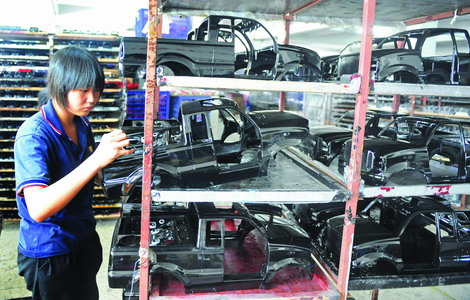 A worker in Guangzhou, Guangdong province, puts the final touches on a toy car produced for export. China achieved a trade surplus of $5.35 billion in March after running a trade deficit for the months of January and February. [Photo / Xinhua] |
Nation had a surplus of $5.35b in March after a deficit in Jan and Feb
China's foreign trade posted a slower growth rate in March, and imports witnessed lower-than-expected growth, indicating weakening demand and backing up calls for more measures to boost imports.
China's year-on year export growth slowed from 18.4 percent in February to 8.9 percent in March, according to statistics released on Tuesday by the General Administration of Customs.
Imports saw a deeper slump, with growth slowing from 39.6 percent in February to 5.3 percent in March.
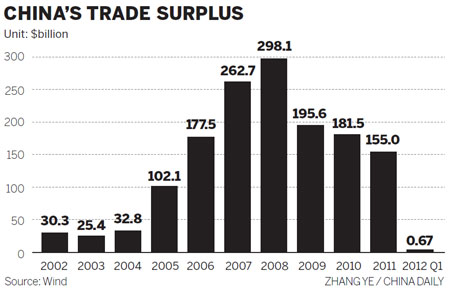
But the relatively faster growth in exports than imports resulted in a trade surplus for the first time this year, with a $5.35 billion surplus in March and a cumulative surplus of $670 million.
Some domestic trade experts said February's surge in imports and exports did not mean too much as the resumption of business after the Lunar New Year usually results in a rebound in imports and exports.
But the 5.3 percent growth in imports is still far below the 9 percent median estimate in a Bloomberg News survey. It has pushed international copper and oil lower on worries about a weakening demand outlook for the leading importer of raw materials.
"The slowdown in imports reflects the slowdown in China's economy. And we have to be alert on the index in the coming months," said Zhou Shijian, a senior trade expert at Tsinghua University.
"The sluggish import growth shows weakening domestic demand and investment growth while exports are stabilizing," Chang Jian, an economist at Barclays Capital in Hong Kong was quoted by Bloomberg as saying.
But Song Hong, director of the international trade office of the Chinese Academy of Social Sciences, said the slowdown in imports may be partly attributed to the slump in major commodity prices such as iron ore and soy, which offset the increase in the trade volume.
And considering sluggish economic growth in external markets such as Europe and Japan, the 8.9 percent export growth is "pretty good", said Song.
Exports to the European Union, China's largest trading partner, fell 1.8 percent in the first quarter. But exports to the United States rose 12.8 percent, showing that a recovery is underway in the US economy.
Zhang Yansheng, secretary-general of the Academy Committee of the National Development and Reform Commission, said the emerging markets of Russia, India and Brazil are what China could focus on in the future. China's trade with Russia rose 33 percent and there was a gain of 11.5 percent with Brazil in the first quarter, customs data show.
But most experts expect the gloomy situation in exports to continue and are calling for measures to stabilize the situation.
"The Chinese government needs to stabilize exports through measures such as raising tax rebates for traditional manufacturing industries and high-tech, and providing more financial support to exporters," Zhou said.
There is speculation that China will promote export tax rebates to ensure steady growth, but Commerce Minister Chen Deming said earlier that the tax rebate policy will be "kept stable".
And the latest data has led to increased calls for China to further cut import duties.
"What I am strongly suggesting is to implement the guidelines launched by the State Council recently on expanding China's imports as quickly as possible," said Zhou.
On March 30, the State Council announced cuts in import duties on selected energy products and raw materials, as well as daily necessities.
Some trading companies contacted by China Daily said they were more likely to buy domestically manufactured goods, which may have contributed to slower import growth.
Ru Xueyu, a marketing manager at Guangzhou Ruidong Import and Export Co, said the company had stopped importing auto parts from overseas manufacturers.
"There are many auto companies in China. The increased production capacity of auto parts on the domestic market has lowered demand for those imported from overseas producers," she said.
But Song said this would make little difference to China's overall imports, which mainly consist of high-end products and low-end raw materials.
First-quarter GDP data and other economic indicators are due to be released on Friday, which will give more evidence to ascertain whether internal demand has weakened.
Contact the writers through zhengyangpeng@chinadaily.com.cn