 |
|
|
 |
|
|
|||||||||
|
 |
|
A woman in Shanghai is attracted by a poster for the 3D version of the movie Titanic. China's box-office revenues hit 13.15 billion yuan ($2.08 billion) last year. [Photo/ China Daily] |
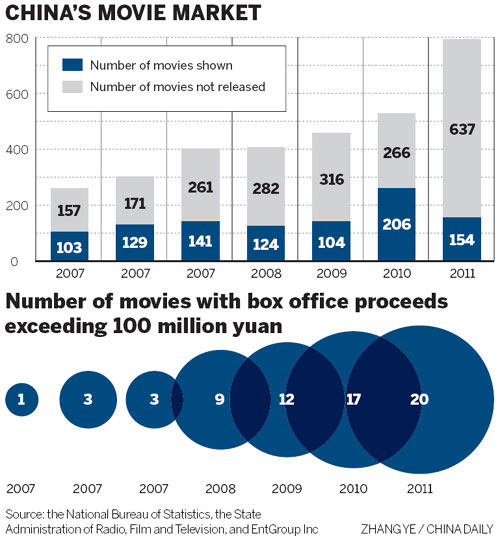
Last year, China's box-office receipts grew 33.3 percent to 13.15 billion yuan ($2.08 billion) and the industry's market value reached 17.25 billion yuan.
Continued growth in the first quarter of this year made China surpass Japan in box-office receipts, said Mike Ellis, Asia-Pacific president of the Motion Picture Association of America, at a conference on Thursday, without elaborating.
The number of China's cinema screens has increased from 4,753 in 2006 to 10,700 in 2011, according to Ellis.
"Last year, China added on average eight screens in a single day. No nation in the world grew at that fast pace," said Ellis.
The US film industry "is not growing, but internationally the market is doing terrifically well, here and throughout other nations", Ellis told China Daily.
Box-office receipts in the United States and Canada totaled $10.2 billion in 2011, down 4 percent compared with 2010, according to MPAA statistics.
But the US share of the global market grew from 57.3 percent in 2010 to 58.4 percent in 2011.
During Vice-President Xi Jinping's February visit to the US, China agreed to allow 14 more foreign films into the domestic market annually. Foreign film companies will also be permitted to take a 25 percent cut of the box office, compared with 13 percent previously.
Ellis said this presented an "exciting picture" for the US film industry.
He has also noted despite its rapid growth, China's film industry is still largely untapped as the average Chinese person only goes to cinema 0.3 times per year, compared with over five times annually in Iceland, the top movie-going country.
However, despite the rosy prospects for China's film industry, a perennial problem remains, its overwhelming dependence on the box office.
Ellis said that in China, box-office receipts account for 90 percent of the total return on investment, while it is just 30 percent in the US. The other 70 percent came from sales of copyrights to DVD companies, cable television firms and national TV networks.
"There is a huge revenue loss for Chinese films due to content theft, which has prevented China from developing a film industry value chain based on copyright trade," Ellis said.
"If you don't protect what you own, you own nothing," Ellis added.
If reliance on the box office can be reduced to the same level as the US, China's film market could almost quadruple to $6.66 billion.
Speaking at the same event, Charles Zhang, founder and CEO of Sohu.com, a major Web portal in China, said China's television industry experienced an explosive boom as video websites boosted demand for professionally produced TV serials.
According to Zhang, three years ago, a TV drama producer would be excited if a single episode could be sold for 1,000 yuan, while a popular TV drama can now be sold for 1 million yuan per episode.
But unlike TV, Zhang said film's cost per unit is too high for advertisers to support.
The flourishing video websites have so far yet to reduce the Chinese movie industry's reliance on the box office.
Film fans in China still find it easy to download a pirated version of a new movie, a reality that industry insiders said they have to learn to cope with, though unwillingly.
"We have to develop ourselves on the assumption that piracy will exist and will exist for a long time," said Hu Ming, vice-president of Huayi Brothers, China's largest private TV and film producer.
She said negotiations were always "awkward and hurt relationships" when it came to copyrights.
The incomplete development of the value chain, according to Hu, is one of the major differences between the movie industries in China and the US. And how to address this remains a challenge for Chinese filmmakers.
zhengyangpeng@chinadaily.com.cn