|
|
|
 |
|
|
|||||||||
|
 |
|
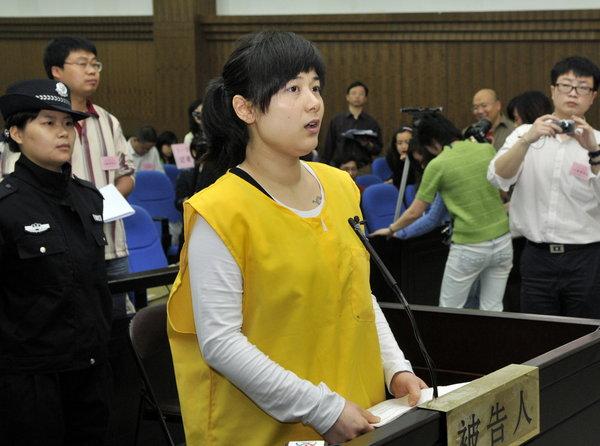
Wu Ying, a 31-year-old businesswoman, stands trials at the Jinhua City Intermediate People's Court in East China's Zhejiang province, April 16, 2009 file photo. [Photo/CFP]? |
Move seen as change in China's attitude toward private lending
The Supreme People's Court on Friday rejected the death sentence for millionaire Wu Ying, in what experts described as a possible turnaround in the Chinese justice system's attitude toward private fundraising.
While upholding the conviction and the legitimacy of previous judicial proceedings, the top court declined to approve the sentence and referred the case back to the high court of Zhejiang province.
"Finally I can breathe," said Wu Yongzheng, Wu's father. "But it's still not time to totally relax since it's not the final verdict."
Wu, once considered one of the richest women in China, was sentenced to death in 2009 by the local court in Jinhua, Zhejiang province, for illegally fundraising 770 million yuan ($122 million), more than half of which she lost in failed investments.
Wu's case attracted widespread attention because it showed the inadequacy of the nation's financial system to support small and medium-sized enterprises, which left room for fundraising initiatives by private individuals.
Zhang Yanfeng, one of Wu's lawyers, said she did not swindle funds from the public, but raised money from friends and did not use it for illegal purposes or personal indulgence.
Wu was involved in what is known as shadow banking - financial transactions outside regulated institutions in which money is raised privately, often with promises of high returns.
Such extralegal activities have flourished as large State banks have tightened the reins on lending to small firms.
China's law stipulates that such financial initiatives are punishable by death when the money involved is "especially huge", as it was in Wu's case.
Wu was born into a farming family in Zhejiang province. She dropped out of a technical school as a teenager, worked at her aunt's beauty salon and later opened two of her own.
She then opened a foot massage parlor and bought 10 cars, which she rented out. An entertainment center and a boutique featuring Korean clothes followed, as did investments in real estate and copper futures.
In 2007 she was arrested in a Beijing airport during a business trip and later charged with illegal fundraising.
According to the court, Wu could not return 380 million yuan, and large amounts of other debts were unpaid.
The flourishing of shadow banking is partly a result of a two-year credit squeeze to rein in rising inflation and cool down a bullish property market.
It is especially rampant in Wenzhou, and many entrepreneurs have fled the city after being unable or unwilling to pay back money borrowed from underground banks, threatening the country's financial stability.
Accounting and consulting firm Deloitte Touche Tohmatsu estimated China's shadow banking system was worth 11.5 trillion yuan, one-fifth the size of the country's official loan market.
But experts believe things are about to change after the developments in Wu's case and after a pilot project was approved by the central government in Wenzhou allowing private lenders to register as private institutions that can operate with the blessing of the State.
Liu Renwen, a scholar on criminal law from the Chinese Academy of Social Sciences, said the top court's review of Wu's case could serve as a legal precedent for other cases of illegal fundraising, at least in reducing the use of death sentences in such cases.
"The court's decision marks a turnaround for the nation's underground lending," said Yao Minglong, a professor with Zhejiang University school of management.
He believes the country will start making new financial rules to help shadow banking come out of the shadows.
Earlier this month, Premier Wen Jiabao declared that the State-owned banks' monopoly must be broken, and hinted that the reforms in Wenzhou would be expanded nationally if successful.
Contact the writers at gaochangxin@chinadaily.com.cn and zhaoyinan@chinadaily.com.cn