|
|
|
 |
|
|
|||||||||

Company now likely China's largest formula provider after Wyeth purchase
Nestle SA's purchase of Pfizer Inc's infant nutrition unit is expected to fundamentally change the Chinese baby-food market and strengthen the Swiss company's food operations in emerging markets in Asia, experts said.
|
 |
The acquisition of Pfizer's Wyeth milk powder is likely to make Nestle the largest formula provider in China, surpassing Mead Johnson & Co LLC, Dumex - a part of Groupe Danone - and other rivals, industry analysts said.
"The purchase will greatly expand Nestle's presence in the middle- to high-end formula market in China," said Zhou Siran, a researcher with the industry research institution CIConsulting.
Infant and toddler formula is a huge business in China, a place where Nestle does not hold a leading market position.
According to a CIConsulting analysis, Dumex held the largest proportion of China's formula market by July 2010, taking up 16.7 percent of it. Following the company was Mead Johnson, with 12 percent of the market, and Nestle, with 10.5 percent. In the fourth position was Abbott Laboratories, which had 7.2 percent of the market, and Wyeth, with 4.7 percent of the market, was in the fifth position.
On Monday, Nestle won a hotly contested bidding battle to take control of Pfizer's nutrition business, which it will officially do by next year.
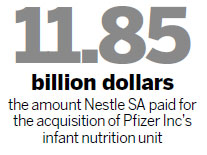
Nestle's $11.85 billion deal indicated its will to expand in emerging markets.
Paul Bulcke, chief executive of Nestle, said: "Infant nutrition has been at the heart of our company since it was founded in 1866. Pfizer Nutrition is an excellent strategic fit and this acquisition underlines our commitment to be the world's leading nutrition, health and wellness company."
Bulcke said the deal will give the company a more widespread presence, noting that 85 percent of the acquired unit's sales are in emerging markets.
The acquisition is also expected to improve the company's dairy production lines and give it more say in pricing, Zhou said. Foreign brands of milk formula, faced with greater competition, are likely to become more cautious about raising their prices.
Domestic companies, meanwhile, are likely to come under greater pressure as their foreign rivals become stronger, he said.
Following the deal, the five big foreign brands of infant and toddler formulas will go from holding 60 percent of the Chinese market for such products to holding 85 percent, said Song Liang, a researcher with the Distribution Productivity Promotion Center of China Commerce.
"It is a smart move," Song said of the purchase.
The European market for infant and toddler foods has become saturated, leaving the best opportunities for the nutrition business in emerging economies such as China and India, where birth rates are high.
Euromonitor figures predict that 45 percent of the growth in the market for infant nutrition products will come from China in the next five years. The country was the source of roughly a third of the $2.1 billion in sales the Pfizer unit had in 2011.
Song said the purchase will prevent Nestle from having to develop its own middle- and high-end formula products, saving it at least 10 years of work as it tries to take a lead in the Asia-Pacific markets.
Earlier this year, Nestle said it will spend about 2.5 billion yuan ($396.3 million) in five years to build the largest dairy-farming institute in China in the northeastern city of Shuangcheng, Heilongjiang province.
Nestle's food business in China has taken form through several rounds of acquisitions. The company came to hold more than 80 percent of the Chinese market for chicken essence after it bought a majority stake in Shanghai Totole Food Co Ltd, the leading domestic maker of that product, in 1999 and a stake in Sichuan Haoji Food Ltd in 2001.
And the acquisition of 60 percent of the Singapore-listed candy producer, Hsu Fu Chi International Ltd, in 2011, gave Nestle a large percentage of the Chinese confectionary market, putting it in a position just behind its rival, Mars Inc.
In April 2011, it also bought a 60 percent stake in Yinlu Food Groups Co, a maker of drinks and canned rice porridge.
wangzhuoqiong@chinadaily.com.cn