|
 |
|
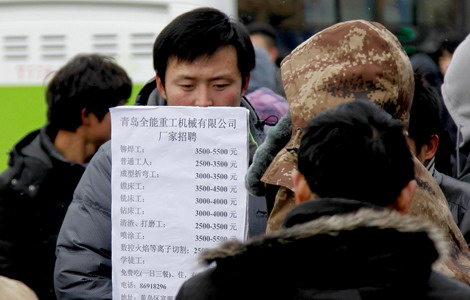
A man holding a sign with monthly wages offered recruits workers at a job fair in Qingdao, Shandong province, in February. Shang Jun / for China Daily |
Recent figures differ over average incomes of Chinese workers, and there's no easy answer to which is nearest the truth, Chen Xin reports.
What's the average wage in China and how does it compare with that in other countries? It seems a straightforward question, and the answer is always officially presented as such. But the answers will vary depending on the source and factors used in calculating the figures. There are no lies, just statistics. China's National Bureau of Statistics will tell you that the average monthly income in the country last year was about 2,000 yuan. That is for urban residents only. At the current exchange rate, that would be $317.
According to the International Labour Organization - a United Nations body set up to "promote rights at work" and "encourage decent employment opportunities" a worker in China earns around 4,100 yuan a month on average.
Converted to US dollars, that is around $656, more than twice what the Chinese bureau of statistics calculated for the nation's main wage earners. Does this mean Chinese workers are better off than they think they are?
Yes and no. First, the ILO estimates the average monthly wage throughout the entire working world is $1,480. China's doesn't look too good set against that. But more important, all amounts are calculated on the basis of purchasing power parity.
PPP is the "currency conversion" device used by the ILO, and other bodies when comparing international incomes, rather than market exchange rates. Currency rates fluctuate and can be misleading when reflecting the standard of living in poorer countries.
In other words, the equivalent of 5 yuan won't buy you much in Western nations, but you can get a large bottle of good beer or a decent snack with it in China.
PPP, the purchasing power rate, is determined by how much money is needed to buy the same goods and services in different countries. If the same basket of goods is bought for $100 in the US and 400 yuan in China, then the parity of the dollar to yuan is 1 to 4, as opposed to the current market exchange rate of 1 to 6.3.
Officially, according to Patrick Belser, a Geneva-based ILO economist, the Chinese worker who earns 1,500 yuan per month can be said to have a purchasing power of 2,520 yuan, or the equivalent of $400 if he spent it in the US.
Unfortunately, the reality is the worker will not be spending it outside China, and the PPP does not take into account price rises within the country.
So how do workers regard the level of their income and its purchasing power, and what do economists and experts in labor studies think?
Although they have seen a steady increase in their wages in recent years, there has also been an accompanying rise in the cost of goods, with the consumer price index showing a year-on-year rise of 5.4 percent last year. More significantly, the cost of food rose by 11.8 percent in 2011.
"The price of everything is going up. Seven or eight years ago, 10 yuan could buy 5 kg of rice. Two years ago, the same amount of money could buy 2.5 kg. Now, it can only buy a few scallions," said Li Yinping, a Beijing resident.
Wu Xin, who works at an insurance company in Chongqing in Southwest China, and earns a little more than 3,000 yuan a month, also didn't think his purchasing power was as high as the ILO figures suggest.
"I have to buy cheaper clothes and cheaper versions of other necessary items in order to make ends meet," said the 26-year-old.
Zhang Yi, an expert in labor economics at the Chinese Academy of Social Sciences, says that the incomes of 60 to 70 percent of workers fall below the national average, because that average wage figure, whether calculated by the ILO or NBS, will be boosted by the much higher incomes of individuals who run their own businesses, and of company management.
"And low-wage earners would spend most of their money on food and medicine, which means the less they earn, the lower their purchasing power would be," he said.
Zhang said people felt that the 11.8 percent rise in food prices limited their purchasing power, and noted that PPP conversion does not take fluctuation of consumer prices into account.
This is reflected in the actual sales figures. The total retail sales of consumer goods grew by 11.6 percent in 2011, but this was the lowest rate of growth in the past six years, and a drop of 3.2 percent on 2010, according to the National Commercial Information Center.
The People's Daily reported that in 2011, retail sales of consumer goods amounted to 13,400 yuan per person, one-seventh the amount spent per capita in the US.
What's more, the goods and services purchased by households in China, calculated as part of GDP, had declined from 48.8 percent in 1978 to 35.3 percent by 2008, with the world average at about 60 percent.
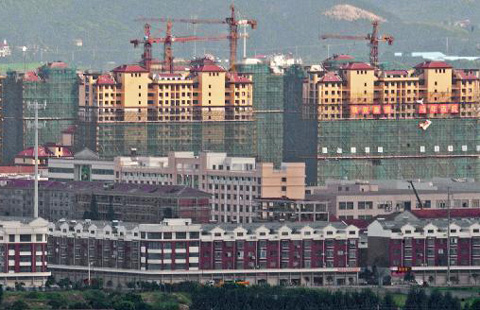
Experts blame this partly on the massive increase in house prices.

Copyright 1995 - . All rights reserved. The content (including but not limited to text, photo, multimedia information, etc) published in this site belongs to China Daily Information Co (CDIC). Without written authorization from CDIC, such content shall not be republished or used in any form. Note: Browsers with 1024*768 or higher resolution are suggested for this site.
License for publishing multimedia online 0108263 Registration Number: 20100000002731