Comments()
  Print
Print  Mail
Mail  Large Medium Small
State Council set to approve move to narrow gap between rich and poor
A new income-distribution framework is set for approval to redress the growing gap between rich and poor, government officials said.
The framework comes at a time when the most affluent 10 percent of the population make 23 times more than the poorest 10 percent.
In 1988 it was seven times.
The framework, eight years in the making, has been tabled for approval by the State Council and is likely to be introduced in the second half of this year.
"If low-income families cannot afford a decent standard of living, rich families will not enjoy any sense of security. That is a problem for the world, not just China," Yang Yiyong, director of the Social Development Research Institute under the National Development and Reform Commission, said in an interview with China Daily.
Yang has been closely involved in the framework's planning. Its overarching guideline, he said, is "for the government to give up a little tax revenue, for companies to give up a little profit and for rich people to give up a little interest."
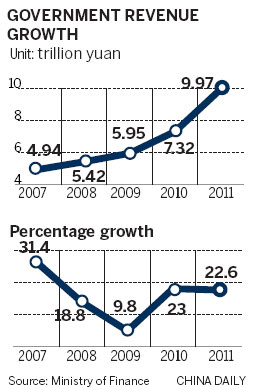
Tax revenue grew from 7.3 trillion yuan ($1.12 trillion) in 2010 to nearly 9 trillion yuan in 2011, a 22.6 percent increase. It greatly outpaced urban income growth, 8.4 percent, and rural income growth, 11.4 percent.
Per capita income in China has just exceeded $4,000.
As part of income-distribution reform, government agencies, at both central and local levels, will be urged to pass legislation to cut taxes and regulate executive pay in high-profit monopoly industries and private companies, Yang said.
The framework will see an enlarged middle-income group and high earners will pay more in tax.
It is time for common prosperity, Yang declared, although one government plan is not going to provide all the answers to the thorny issue of income distribution in a society of 1.3 billion people.
This is not just about individual tastes or lifestyle, economists point out. It reflects a yawning gap between rich and poor that is hindering the world's second-largest economy from making further progress and perhaps eroding its very social fabric, Yang said.
Gini coefficient
The framework may use the Gini coefficient, an internationally accepted gauge of income inequality, or adopt a mix of indicators, such as urban-rural income disparity or wage differences among various industries.
Targets would almost certainly be more powerful than persuasion, he said.
The country's Gini coefficient has already reached a high, if not dangerous level. It is close to 0.5, he said, a point that "is threatening" social security. Little room is left for the index to grow.
The last time the government reported the Gini coefficient was in 2000, when it stood at 0.412.
The National Bureau of Statistics said 2011's Gini coefficient was "a little higher than 2010," without specifying either number. In January, the NBS said the main reason that China did not release the figure because data about high-income groups was still incomplete.
Adjusting interests
Chi Fulin, president of the China Institute for Reform and Development, called for the immediate release of the framework.
"A crucial question is whether government agencies are willing to reorient their own interests and surrender their privileges," he said.
Chi said the state capital and revenue should be a major source of social welfare and state-owned operations should contribute more to public welfare.
More revenue should be taken from state-owned companies, from the current 10 to 15 percent to about 25 percent in five years, he suggested.
"After 30 years of reform and opening up, the country is facing a second round of market reform driven by fairness and sustainability, which is more challenging," Chi said.
"Consumption will be a major force to keep rapid economic growth in the coming 10 to 20 years, and narrowing the income gap is a precondition to release the great consumption potential," Chi said.
Equal opportunities
Solutions provided by policymakers must "get to the root of the problem", said Chen Shaohua, a Washington-based senior statistician at the World Bank's Economic Research Group.
The country needs to provide an ascending corridor for the less well-off to prevent poverty passing from generation to generation, Chen said.
She cited a cash transfer program in Brazil as an example. The government pays about $120 per month, on average, to low-income families if they send their children to school. This has boosted school attendance.
Income inequality has gradually decreased in many Latin American countries due to continuous investment in education.
"The root solution lies in improving the equality of opportunity," Chen said.
lanlan@chinadaily.com.cn
Copyright 1995 - 2010 . All rights reserved. The content (including but not limited to text, photo, multimedia information, etc) published in this site belongs to China Daily Information Co (CDIC). Without written authorization from CDIC, such content shall not be republished or used in any form. Note: Browsers with 1024*768 or higher resolution are suggested for this site.
License for publishing multimedia online 0108263 Registration Number: 20100000002731