Mary Meeker, a former Morgan Stanley analyst, predicted as early as 2009 that more users would access the Internet via mobile devices than desktop personal computers within five years.
|
|
|
|
 |
 |
That may probably create opportunities for Xiaomi. Lei hopes his company will become a Fortune 500 consumer electronics company someday, competing with the likes of Apple and Samsung Electronics Co Ltd.
China, a country with the world's biggest mobile population of more than 1 billion, has naturally become the birthplace of world-class smartphone companies because of its huge market.
China overtook the United States to become the world's largest smartphone market by volume in the third quarter of last year, according to the research firm Strategy Analytics. "China is now at the forefront of the worldwide mobile computing boom," said Neil Mawston, executive director at Strategy Analytics.
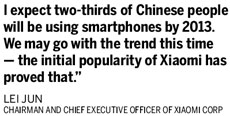
Lei expressed similar optimism about the Chinese smartphone market. Volumes are high now but the country still has even bigger potential, he said. "I expect two-thirds of Chinese people will be using smartphones by 2013," Lei said.
"We may go with the trend this time - the initial popularity of Xiaomi has proved that," Lei added.
Why Xiaomi?
The overnight success of Xiaomi almost caught Lei off guard. Limiting the supply of Xiaomi handsets led to media accusations of "hungry marketing". It's a practice that seeks to work up a fever for a product that becomes contagious.
Although everything is still under control and is going forward step by step, Lei admitted Xiaomi moved much faster than he expected. "We had a four-year plan but we finished it in two years," he said.
The success of Xiaomi phones is down to three things, Lei added. First, one-third of Xiaomi device-design ideas come from what users want. Second, Xiaomi sells handsets mainly through e-commerce websites, which cuts costs and helps lower the selling price. The third reason may be the most important - Xiaomi doesn't expect to make money from selling handsets but hopes to realize profits by providing software and related services, Lei said.
Xiaomi drew ideas from the Internet, gaining a reputation through word-of-mouth and sold handsets using e-commerce channels.
Roger Sheng, a Shanghai-based analyst with Gartner Inc, said one of the most important reasons why Xiaomi experienced success is because of the word-of-mouth effect promoted by millions of Xiaomi fans.
"There is no other way to purchase Xiaomi handsets except through online channels, which resulted in more people rushing to join the line-up because they're afraid of failing to get one," Sheng said.
Xiaomi's targeted customers are hardcore mobile device users. Most of them are fanatical about mobile devices, tend to be opinion leaders and like to suggest to their friends what handsets to buy.
It is true that Xiaomi paid attention to nurturing a close relationship with its customers. In addition to making smartphones, the company launched a cartoon character, the rabbit Mi-Tu, made promotional mini movies and designed special souvenirs, such as T-shirts, to attract and retain users.
Lei named April 6, the day when Xiaomi was established, as the annual carnival for Xiaomi fans. During the first event this year, hundreds of fans, invited from across the country, gathered in a small hall in Beijing's 798 art district, and chatted as if they were old friends at a reunion.
Some followers have made special music videos and add-ons for Xiaomi smartphones. Others said they had collected almost all the mobile phone cases of different colors produced by Xiaomi. "Xiaomi is the only smartphone brand that really captures my heart," said Liu Cheng, a Xiaomi user.
The 1,999-yuan classic model, together with its 1,499-yuan youth version smartphone, surprised the market at first, said Ji Chengdong, an analyst with research firm Frost & Sullivan. "Xiaomi became the first company to sell high-end smartphones at a relatively affordable price, which definitely drew the most market attention."
Shen Sui, an Internet analyst at consultancy firm iResearch, said: "Xiaomi has essentially imitated Apple's marketing strategy." Likewise, it aims to make a profit by combining the sales of hardware with its software, such as Miliao.
"The phone is clearly targeted at people on lower incomes who want a smartphone but cannot afford those priced at 4,000 yuan or more. This is a niche market that is largely ignored in the smartphone sector," Shen said.


Copyright 1995 - . All rights reserved. The content (including but not limited to text, photo, multimedia information, etc) published in this site belongs to China Daily Information Co (CDIC). Without written authorization from CDIC, such content shall not be republished or used in any form. Note: Browsers with 1024*768 or higher resolution are suggested for this site.
License for publishing multimedia online 0108263 Registration Number: 130349