|
 |
|
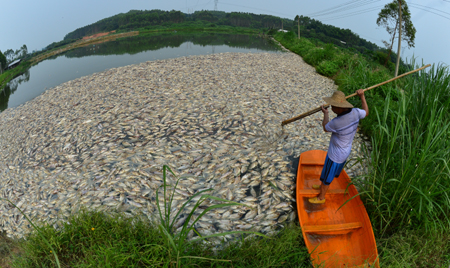
A farmer removes dead fish from a pond in Shitan township of Guangzhou, capital of Guangdong province, on Saturday. The farmer found traces of poison at the site on Thursday. About 40 tons of fish died. Police have launched an investigation. [Photo/China Daily] |
Nation struggles with shortage made worse by inefficient usage
By the end of 2012, a water resource allocation plan for 25 rivers that flow through more than one province will be put into use, limiting the amount of water that can be taken from the rivers by each of the provinces.
"We are doing our best to accelerate the process," said Chen Ming, deputy head of the Water Resources Department at the Ministry of Water Resources. "Hopefully, the plan will come out by August."
The water resource allocation plan is one of the moves the ministry has taken to promote the implementation of the most stringent regulations in Chinese water resource management.
Announced in January by the State Council, the regulation set four "must-complete" targets by 2030, including limiting the country's annual total water consumption to less than 700 billion cubic meters.
The regulation also asks the entire country to limit the scale of water exploitation, improve the efficiency of water usage and curb water pollution.
"There are no other countries that have set such detailed targets to restrict their own development by limiting usage of water resources," Chen said.
China's average per capita water capacity is 2,100 cu m, only 28 percent of the world's per capita level. The annual average water shortfall is 50 billion cu m, according to the ministry.
In contrast with the severe water shortage, the efficiency of water usage is far below the world's leading level.
"If we don't change the way we use water resources, by 2030 the country's average per capita water capacity will be only 1,730 cu m," said Chen.
Anything below 1,700 cu m is deemed as "falling short with water", according to the standard set by the United Nations Educational, Scientific and Cultural Organization.
According to international common practices, the exploitable water resources of a country must be less than 40 percent of its total water resources, otherwise the ecosystem will be largely damaged.
Chen said the first target in the regulation - the figure of 700 billion cu m annual total water consumption - was calculated after considering the necessary amount needed for development, the exploitable amount that the environment can afford and the principle of a properly tightened budget. The current figure is about 600 billion cu m.
Many cities rely heavily on water-consuming industries to boost the local economy. The central government has come up with several policies to deal with this situation.
The core is a plan called water resources assessment, which is completed in some cities before the environmental impact assessment. Newly built water-consuming projects must use recycled water or seawater during production to receive approval from the National Development and Reform Commission, Chen said.
He said the enterprises should also improve their production line to reduce the water consumption of each product. Those who do well will receive subsidies from government at various levels.
"If the enterprises were cows, there are both policies to lead and to force them to run," said Chen. "But in the long run, they are sure to benefit from the policies."
Chen emphasized that once the water quota is allocated to all provinces, it cannot be traded in the market, because the law system to explain the notion of water rights is still inadequate in China.
"Administrative measures and market mechanisms are now working in parallel in China," he said. "The former one is currently in the lead because it hasn't played enough of a role in the past. But the trend in the future is the latter one."
A policy featuring the principle of water rights is undergoing a test run in Zhangye, Gansu province. Farmers there are given a water quota based on the scale of the land they are cultivating and the types of plants they grow. If they use less water than they are given, they can trade the quota left for money.
"Directly linking the concept of saving water and the farmers' revenue together is probably the best way to promote this concept in this group of people," Chen said.
Another part of work that is developing quickly is the construction of a nationwide monitoring system, Chen said.
The ministry currently only directly monitors about 30 percent of all the important rivers and reservoirs and relies on provincial governments for information about the rest of the bodies of water.
Within three years, a nationwide monitoring system will cover all major water-consuming enterprises, interprovincial river cross sections and important lakes and reservoirs, with more than 10,000 monitoring points transferring real-time data of water pumped from the water bodies.
"When reaching all the targets in 2030, changes in the mode we use water resources to boost economic development should also be finished," said Chen.
"Then the country will start a whole new page in the way it consumes its water resources, with the growth in the annual water consumption stopping. Thus, a more stringent regulation is unnecessary in future if we can successfully implement this one."
wuwencong@chinadaily.com.cn

Copyright 1995 - . All rights reserved. The content (including but not limited to text, photo, multimedia information, etc) published in this site belongs to China Daily Information Co (CDIC). Without written authorization from CDIC, such content shall not be republished or used in any form. Note: Browsers with 1024*768 or higher resolution are suggested for this site.
License for publishing multimedia online 0108263 Registration Number: 130349