Comments()
  Print
Print  Mail
Mail  Large Medium Small
 |
|
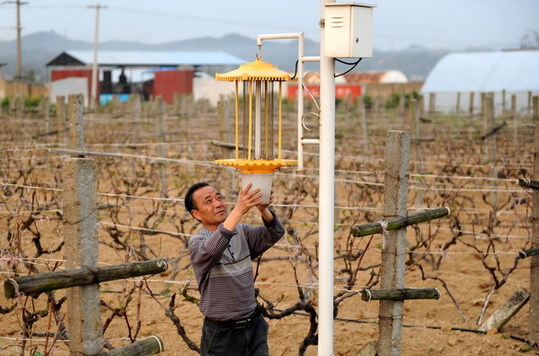
Zeng Jiquan, a vegetable expert in Ganxian county, Jiangxi province, has helped local farmers to kill insects with solar-powered device instead of using pesticides. [Photo/Xinhua] |
Countries in the region examine ways to lead a greener lifestyle, reports Karl Wilson in Sydney.
The carbon tax has become one of the most politically divisive and bitterly fought tax reforms of this century and governments around the world, and in particular Asia, are debating the issue.
In an attempt to cut carbon emissions and reduce the effects of global warming, many countries are implementing green growth policies and introducing reforms to reduce dependence on fossil fuels
On July 1, Australia will introduce a carbon tax. India already has a nationwide carbon tax of 50 rupees (90 US cents) per metric ton on coal.
Since the devastating earthquake and tsunami that hit Japan in March 2011 and the subsequent environmental disaster at the Fukushima nuclear power plant, Tokyo has been reassessing its entire energy policy.
South Korea has made low carbon, green growth a national priority while countries such as Malaysia, Singapore, Vietnam and Thailand are all pursuing their own policy objectives.
A new report by the United Nations Economic and Social Commission (ESCAP) for Asia and the Pacific is recommending that developing Asia-Pacific countries introduce a $10 a ton carbon dioxide tax on major greenhouse emission polluters, such as coal-fired power stations.
It is expected that many governments will wait and see what impact Australia's carbon tax has before making any firm decision.
The controversial tax has divided Australia since its proposal. When it comes into effect next month, around 500 of the country's biggest emitters of carbon pollution (carbon dioxide, methane, nitrous oxide and fluorocarbons from aluminum smelting) will be required to pay, via a permit system, a tax of A$23 ($22.60) on every ton of carbon dioxide released into the atmosphere.
The tax is believed to be the highest in the world - much higher than Europe, where it ranges from $8.70 to $12.60, according to a BBC report.
Industries that will be most affected by the Australian tax include electricity generation, stationary energy production, mining, business transport, waste and industrial processing.
Increasing power bills
Australia's federal opposition leader, Tony Abbott, has said repeatedly that the tax will increase consumers' power bills and cost jobs, especially in the coal mining and electricity industries.
Abbot has called the tax "economic madness" and has vowed to repeal the legislation if elected in polls due next year.
"It's a tax increase pretending to be an environmental policy," he said.
Business groups and the mining industry also believe the tax is flawed. They argue it will cost Australia valuable resource contracts, which will go instead to emerging resource states in Africa and South America.
"Australia has lost its manufacturing, all but lost its agriculture, tourism is gone and pretty soon, we will lose our mining industry. The carbon tax is the final nail in the coffin," said Bob Katter, an independent member of parliament from north Queensland.
Prime Minister Julia Gillard has dismissed the critics, saying the tax will be "good for Australia and Australians", while Tony Wood, energy program director with the Grattan Institute, an independent Melbourne-based public policy think tank, believes much of the criticism against the carbon tax is "overstated".
A carbon tax will have only a minor impact on costs and competitiveness - much smaller than other factors, such as exchange rates, labor market costs and fuel prices, said Wood, arguing that "Many industries will pass on their costs to their customers".
And some businesses have already signaled higher prices. The Australian national carrier Qantas has said it will charge passengers between $1.82 and $6.86 extra on a one-way ticket to cover the cost of the carbon tax.
Shane Oliver, chief economist at the investment company AMP Capital, also believed the economic impact of the tax is unlikely to be large. "Over time, with a price put on carbon pollution, investment in clean energy and growth in clean industries will likely offset reduced investment and slower growth in dirty-energy sectors.
"Businesses and households will use the price signal from the carbon price to reduce energy consumption," he said.
The government will spend half the revenue earned by the tax to compensate households for higher electricity and other living costs that polluters pass on. Another 40 percent of the revenue will be used to help industries lower their costs by switching to cleaner forms of energy, if they face competition from untaxed foreign competitors.
About A$10 billion will be invested over five years in wind, solar and other renewable energy sources and Australia aims by 2050 to cut its emissions by 80 percent from the levels recorded in 2000.
A study by the Tokyo-based Asian Development Bank Institute estimates that Asia currently accounts for 27 percent of the world's energy-related emissions, a figure that is likely to increase to 40 percent by 2030.
The ADBI said that Asia's urban population is expected to double by 2050 from the current 1.6 billion people living in urban centers.
Asia is now at a crossroads in its development, concluded ESCAP in its Low Carbon Green Growth Road Map for Asia and the Pacific report. It said that while high levels of economic growth have lifted millions out of poverty in recent years, the region's political leaders will need to rethink their strategies if growth is to be maintained.
New strategy
"The region has to embrace a new growth strategy that can turn the trade-off between economic development and environmental protection into a win-win synergy in which going green drives economic growth," the report stated.
Meanwhile, "the Asia-Pacific region cannot achieve its development goals fully by following conventional growth strategies," according to Lorenzo Santucci, economic affairs officer (environment and development) with UN-ESCAP in Bangkok. "We think a carbon tax of $10 a ton is reasonable as there would be trade-offs," he said. "Where our proposal differs from the Australian model is that we recommend that a carbon tax be introduced while at the same time reducing other taxes."
Based on models used in countries such as the United Kingdom and Denmark, Santucci said, such a move will not only increase gross domestic product but also employment. "Our modeling has shown that a $10 a ton carbon dioxide tax in Asia, if accompanied by reductions in other taxes such as corporate tax, would help reduce global carbon emissions by 8 percent by 2020, while boosting economic growth by up to 2.8 percent," he pointed out.
According to Santucci, in European countries where environmental tax reforms have been introduced, there have been positive gains in GDP of as much as 0.5 percent, while fuel demand has fallen by 2.6 percent on average and emissions have decreased by 2 to 6 percent.
"The resource-intensive growth patterns of the region which have propelled the economic boom over the last decade cannot be sustained as they now stand," he said.
Meanwhile, the International Atomic Energy Agency has predicted that in spite of the uncertain short-term global economic outlook, demand for energy is expected to increase by more than 30 percent from 2010 to 2030.
The World Economic Forum has said that "business as usual is no longer an option".
"Unless we break the present link between growth and consumption of resources, some $2 trillion of global economic output could be lost by 2030," the WEF said earlier this year.
Global demand for metals such as copper and aluminum has doubled over the last 20 years, said the UN's International Panel for Sustainable Resource Management and has cautioned that unless future end-of-life recycling rates are dramatically increased, critical specialty and rare earth metals (such as lithium, neodymium and gallium) will become unavailable for use in modern technology.
According to ESCAP, the days of abundant resources and falling prices are over and has warned that resource constraints, price volatility and the climate crisis have removed business as usual as an option and urged governments to seriously re-examine resource- and carbon-intensive growth strategies.
"If our region is to sustain the high economic growth that we need to achieve our development goals, we must shift to a different growth trajectory," ESCAP said. "Regionally, we must improve resource efficiency and urgently set in motion a new economy in which improving efficiencies and investing in natural capital become the drivers of economic growth."
Contact the reporter at karlwilson@chinadailyapac.com

 Michelle Obama addresses at Democratic National Convention
 Slides of Yanbian: place, people and prosperity
 Washington to remain focused on Asia-Pacific
 RQFII target blue chips amid bear market
 Australian recall for top two exporters
 China fears new car restrictions
Copyright 1995 - 2010 . All rights reserved. The content (including but not limited to text, photo, multimedia information, etc) published in this site belongs to China Daily Information Co (CDIC). Without written authorization from CDIC, such content shall not be republished or used in any form. Note: Browsers with 1024*768 or higher resolution are suggested for this site.
License for publishing multimedia online 0108263 Registration Number: 20100000002731