|
 |
|
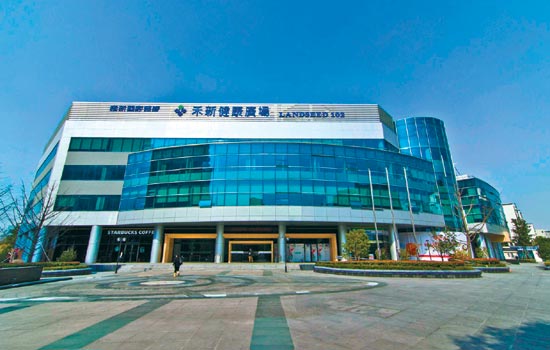
Shanghai Landseed International Hospital, the first wholly Taiwan-funded hospital in Shanghai. Compared with Shanghai Chenxin Hospital, which mainly serves people from Taiwan, Shanghai Landseed International Hospital will cater more for local Chinese mainland residents. It opened for business last month. [Photo/China Daily]? |
New policies, relaxed rules make healthcare sector more attractive
The opening of the first wholly Taiwan-funded hospital in Shanghai sent a positive signal about overseas investment in medical institutions on the Chinese mainland but industry insiders still have concerns.
Shanghai Landseed International Hospital, which is also the first totally Taiwan invested hospital on the mainland, opened for business in Shanghai on June 26.
It was the first Taiwan hospital to benefit from the signing of the Economic Cooperation Framework Agreement in 2010 and the first wholly externally funded hospital on the mainland
The hospital was built with 150 million yuan ($24 million) from the Taoyuan-based Landseed International Medical Group, which entered a joint-venture to build Shanghai Chenxin Hospital in 2002.
Compared with Shanghai Chenxin Hospital, which mainly serves people from Taiwan, Shanghai Landseed International Hospital will cater more for local Chinese mainland residents.
"We have sensed that residents on the mainland, especially those in first-tier cities such as Shanghai, Guangzhou and Beijing, now have a big demand for high-end medical services on the mainland," said Victor Chang, founder and president of Landseed.
Victor Chang said he had great confidence in the development of new hospitals on the mainland market. He also said the number of patients from the mainland expected to be treated at Landseed hospitals will in three years grow more than 50 percent annually, up from the current 20 to 30 percent.
Such high expectations are not held just by Chang: Many investors are keeping a close watch on the huge potential in Chinese healthcare with the gradual loosening of policies and growing demand for high-end medical services.
The signing of an economic cooperation agreement allows investors from Taiwan to set up wholly owned hospitals in Shanghai as well as Fujian, Jiangsu, Guangdong and Hainan provinces. Investors from Hong Kong and Macao are welcomed under a similar pact known as the Closer Economic Partnership Arrangement to set up wholly owned hospitals in Shanghai, Chongqing, Fujian, Guangdong and Hainan.
"Investors from Hong Kong, Taiwan and Macao are welcome to develop the medical industry on the mainland. They can hopefully form good interaction with public hospitals," said Liu Zhenqiu, deputy director of the healthcare reform office under the State Council.
An implementation plan for deepening the reform of the medical and healthcare system during the 12th Five-Year Plan period (2011-15) was issued by the State Council this April. The plan encourages qualified individuals to open private medical establishments by further loosening the entry policy.
By 2015, the beds and medical treatment provided by non-public hospitals will account for 20 percent of total medical services, according to the Ministry of Health.
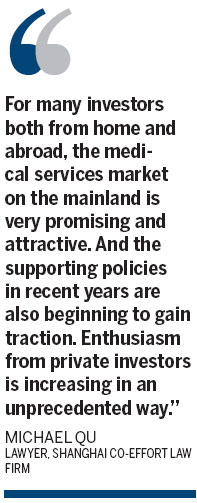
"For many investors, both from home and abroad, the medical services market on the mainland is very promising and attractive. And the supporting policies in recent years are also beginning to gain traction. Enthusiasm from private investors is increasing in an unprecedented way," said Michael Qu, a lawyer from Shanghai Co-Effort Law Firm, who has provided legal service for investors.
In recent three years, Qu has kept in touch with many investors who have shown an interest in investing in the medical services industry on the mainland.
"Although content with the encouraging policies, many of them still have to face other problems, which cause them to dither and be cautious," he added.
Up until now, overseas funding of medical institutions accounts for a tiny proportion of the mainland's total investment in the medical services industry. Most of it is in the economically more developed areas such as Shanghai and Guangdong and mainly targets overseas people working or traveling on the mainland and the newly wealthy Chinese.
According to the Ministry of Health, 13,519 public hospitals and 8,864 privately run hospitals were operating on the mainland as of March.
"Foreign investors may feel uncomfortable or a bit out of place when they entered this market. They have to continue to adjust to the local market," said an industry insider surnamed Li, who declined to give his full name.
Chang said Landseed hospital made many adjustments to adapt to policies on the mainland.
"For example, if we want to open some departments, we are required to have a certain amount of space and a number of personnel working in them, which may not be reasonable," he said.
"Besides, patients' recognition and trust of private hospitals is not high," he said.
But in Qu's eyes, the biggest hurdle for investment in the medical services industry is the shortage of qualified personnel and an immature social insurance policy.
"Although physicians are now encouraged by the government to practice at several sites, many are still working in limited places for various reasons. In addition, there is still a need for the reform of the qualifications for private hospitals in order to reimburse expenses from social insurance," Qu said. "With these concerns, many overseas investors may have less motivation to move into the sector any time soon."
With the ceiling for private capital entering into the medical services industry on the mainland gradually being removed, more real opportunities will be seen for specialist services such as dentistry, ophthalmology and pediatrics, according to a report by ChinaVenture Group, a research and consulting firm focusing on venture capital and private equity investment.
Medical services in these niche areas are in very short supply and have a higher technical barrier, which means they have more opportunities, the report said.
"Specialist hospitals are often operated on a small scale where there is higher profit and lower risk," Qu said.
Another report, by Zero2IPO, research center showed that there were 158 investment deals in the medical and healthcare sector in 2011, worth $4.14 billion - around the same amount as the total deals in the sector from 2006 to 2010. Most of them are in niche areas, such as dentistry, maternity care, health examinations and elderly care.
Taiwan Landseed International Medical Group is also investing in a specialist children's hospital in Changning district in Shanghai. The construction of the hospital is expected to be finished in 2013.
"Now Chinese parents want to spend more on their only child. There is huge potential in this niche market. In this hospital, we will provide a quality service for them," Chang said.
wanghongyi@chinadaily.com.cn


Copyright 1995 - . All rights reserved. The content (including but not limited to text, photo, multimedia information, etc) published in this site belongs to China Daily Information Co (CDIC). Without written authorization from CDIC, such content shall not be republished or used in any form. Note: Browsers with 1024*768 or higher resolution are suggested for this site.
License for publishing multimedia online 0108263 Registration Number: 130349