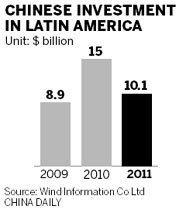
TEQSA is only one of a wave of Chinese investments that has flowed to Latin American countries in recent years.
In 2011, the outflow of Chinese investments in the region stood at $10.1 billion, accounting for 16.8 percent of the country's total overseas investment volume, according to official data.
The Latin American region has now emerged as China's second-largest overseas investment destination, second only to Europe.
The headline figures might look like a massive success story on paper, but for many companies the reality is very different.
China is currently the region's third-largest trading partner - but there has been growing criticism in recent years of what is now a growing imbalance in trade between the two parties.
In 2011, total trade volume between China and Latin America jumped 31.5 percent from the previous year to $242 billion, according to official Chinese data.
Some 60 percent of China's imports from Latin American countries are made up of natural resources, while its exports to the region are dominated by processed or manufactured products.
Latin American producers have reacted badly to the influx of cheaper Chinese goods.
The Brazilian National Confederation of Industry, an industrial lobby, for instance, announced in January the establishment of a bilateral body with its counterparts in Argentina, as a way to combat import competition.
Several big names in Brazilian business have taken an active part, including Mafrig, the third-biggest Brazilian food processing company.
According to information from the Economist Intelligence Unit, participants in the body have prioritized the need to urgently tackle growing imports from China.
But growing investments being made in South America might be the key to helping ease the situation, and the imbalance, suggested economists and trade experts.
"One of the main reasons for the trade imbalance is that the manufacturing sector in Latin America is not very competitive," said Yue Yunxia, a Latin America specialist from the Institute of Latin American Studies at the Chinese Academy of Social Sciences.
Investments, especially to help improve the industrial infrastructure in certain sectors and upgrade the quality of products and their manufacturing efficiency, are seen as especially favorable, Yue said.
Yet, there remains a strong reluctance toward foreign investments in many Latin American countries, said analysts and experts.
And even those who do manage to get a foothold, including an increasing number of Chinese companies, complained of various issues affecting success, such as political instability, government inefficiency, complicated legal and tax structures, and even problems with visa applications.

Copyright 1995 - . All rights reserved. The content (including but not limited to text, photo, multimedia information, etc) published in this site belongs to China Daily Information Co (CDIC). Without written authorization from CDIC, such content shall not be republished or used in any form. Note: Browsers with 1024*768 or higher resolution are suggested for this site.
License for publishing multimedia online 0108263 Registration Number: 130349