
 Comments()
  Print
Print  Mail
Mail  Large Medium Small
ICBC adapts itself to different practices in southeastern Asian country and still finds success
There's an old Chinese expression for someone who is considered a pioneer willing to make a bold move into the unknown: "The first one to eat crab".
And Yuan Bin started eating his after being appointed as a team leader for the first overseas acquisition by a Chinese lender.
In December 2004, the Industrial and Commercial Bank of China - the world's largest bank by market value - decided to enter Indonesia by acquiring a local lender. Its plan is to use the new, combined operation as a bridging post for further expansion in what is the biggest economy in Southeast Asia.
The reason for the acquisition was simple, said Yuan, now the president director and CEO of P.T. ICBC (Indonesia) Co Ltd.
There were huge investment opportunities for Chinese enterprises in industries including energy, mining, infrastructure, transportation, communication and property, he said.
Trade between China and Indonesia has been increasing in recent years, going up to $61 billion last year from $23 billion in 2009. The figure is expected to hit $80 billion by 2015.
While planning its move into Indonesia, Yuan said it had always preferred a purchase rather than building its own operation from scratch through "organic growth". The cost for setting up a new branch network was much higher than making an acquisition and would have required $300 million in registered capital, according to Indonesian regulations.
After targeting banks that have net asset values of about $50 million, ICBC finally closed the deal with shareholders of P.T. Bank Halim Indonesia at $22 million on Dec 30, 2006 - its first cross-border purchase, bringing with it more than 1,000 clients and 12 outlets.
Nine months later, ICBC had completed the transfer of 90 percent of the shares from Halim shareholders.
The following November a debut ceremony for the subsidiary was held in Jakarta and Surabaya, signaling the completion of the acquisition. Yuan said he didn't expect it would take so long to complete. But he then realized that integration and running a business in a fully competitive market was much more difficult.
Looking back, Yuan said he has found some stark differences between operating in China and Indonesia. In Indonesia, there has been much greater pressure, for instance, to remain agile to currency and interest rate fluctuations and maintain liquidity levels.
In China, the government fixes the ceiling of deposit interest rates and the reference rate of the renminbi's exchange rate. Overseas, lenders must be responsive to the fluctuation of interest rates and currency exchange rates, he explained. "Every day we must think about pricing, which is quite different from our domestic operations."
Yuan also faces greater pressure from liquidity, which he never experienced at home.
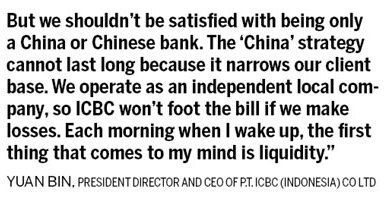
"We operate as an independent local company, so ICBC won't foot the bill if we make losses. Each morning when I wake up, the first thing that comes to my mind is liquidity," he said.
To secure enough capital and guarantee sufficient liquidity, Yuan said ICBC Indonesia sacrifices up to $1 million in income a month as it gives priority to liquidity, meaning lending levels are lower than he might hope. Given its ambition in the local market, ICBC Indonesia has employed as much local talent as possible. Five out of seven senior executives on the management board are Indonesian with abundant experience with other foreign banks. Adopting local work practices has also been an important priority throughout the early years of the business. The change in culture was a challenge for Yuan in the beginning, especially in a country with a large Muslim population.
He and his Chinese colleagues had to adjust meeting schedules, for instance, to accommodate local prayer times. A prayer room was set up on each floor of its headquarters and branches, allowing employees to pray on time, five times a day, and they are excused from meetings or other work when they worship.
To help Chinese employees better communicate with their Indonesian colleagues, executives encouraged them to study Indonesian and adopt sign language for common financial terms. Chinese employees are required to have meals with locals, which helps forge strong working relationships.
Such efforts have paid off, Yuan said. With more than 700 employees, ICBC Indonesia made a profit of more than $10 million last year and its total assets reached $1.8 billion by the end of 2011.
It maintained a rate of return on investment at 20-30 percent by the end of last year, with its non-performing loan ratio at about 1 percent.
The operation was ranked 37th among lenders in Indonesia by assets in June 2011, up from 107th in September 2007. ICBC has set a target of getting into the top 10.
ICBC Indonesia plans to expand its network of branches from 18 to 26 within the year. Besides lending, which accounts for 50 percent of its business, it also runs intermediate deals, which make up about 30 percent.
|
|
 |
 |
The bank targets a wide range of clients, including Indo-Sino investors and traders, financial institutions and private clients among the country's increasing number of high net-worth individuals.
"We must stay focused on what we are good at. Our greatest advantage, clearly, is our focus on business related to China.
"But we shouldn't be satisfied with being only a China or Chinese bank. The 'China' strategy cannot last long because it narrows our client base."
Given its strong Chinese links compared with many other foreign banks operating in Indonesia, Yuan said the rapid growth of renminbi-linked business will be to increasing future profits. ICBC Indonesia processed the world's first yuan cross-border trade settlement business in July 2009.
The global use of yuan will become significant for Chinese banks aiming to explore the international market, said Thomas Chan, head of financial services for Northern China at KPMG Huazhen. "Banks should seize the valuable opportunities brought by the currency's internationalization, learn from foreign banks, and play bigger roles as both promoters and participants of the renminbi's internationalization," he said.
Yuan's plan for the Indonesian operation is clear and ambitious: "We want to be a foreign exchange trading market maker that can form the exchange rate of the renminbi."
wangxiaotian@chinadaily.com.cn
Copyright 1995 - 2010 . All rights reserved. The content (including but not limited to text, photo, multimedia information, etc) published in this site belongs to China Daily Information Co (CDIC). Without written authorization from CDIC, such content shall not be republished or used in any form. Note: Browsers with 1024*768 or higher resolution are suggested for this site.
License for publishing multimedia online 0108263 Registration Number: 20100000002731