Comments()
  Print
Print  Mail
Mail  Large Medium Small
|
 |
|
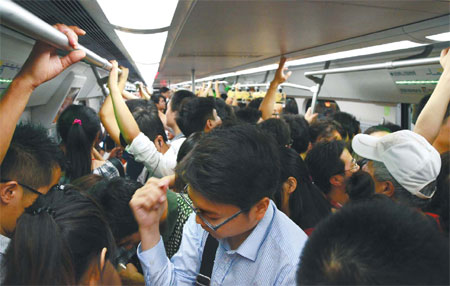
Subway Line 1 in Beijing is one of the busiest in the city. Many Chinese cities are planning to build subways, but some ignore the cost and safety aspects. [Photo/China Daily] |
Cities may struggle to fund and maintain ever-expanding underground systems, report Xin Dingding and Wang Xiaodong in Beijing and Shi Yingying in Shanghai.
China has spent 39 billion yuan ($6.1 billion) in the past 20 years on its manned space program, which has sent 10 craft into orbit and achieved several notable breakthroughs.
However, even that vast sum would only fund construction of 78 kilometers of subway given the current average cost of 500 million yuan for each kilometer. And for most big cities with a subway, or planning a subway, 78 km is a mere fraction of a network.
So far, 28 cities have had their plans approved by the National Development and Reform Commission. According to those plans, 2,500 km of subway will be built between 2010 and 2015.
"Construction will cost at least 1 trillion yuan in total," said Chen Xunru, a member of the Chinese People's Political Consultative Conference, who conducted research into subway construction and delivered a speech on his findings to the CPPCC's annual meeting in March.
Experts are concerned that the construction could strain the resources of some city governments and plunge them heavily into debt.
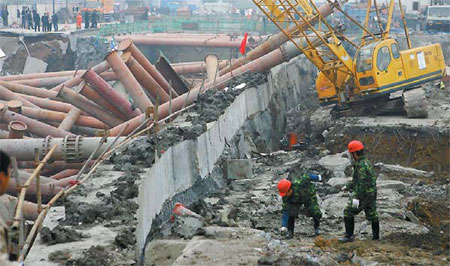
They are also worried that the cities may not have taken account of the possible long-term costs of operating and maintaining the network. Moreover, there are concerns that the large-scale move toward construction has resulted in a shortage of trained professionals, which in turn could lead to reduced safety levels.
China's first subway went into operation in Beijing in 1969. Three of the country's biggest cities - Tianjin, Shanghai and Guangzhou soon followed suit and opened their own systems in the 1980s and '90s.
"Subways have many advantages, including large-volume transport capacity, high efficiency levels and low energy consumption. They can also save land and boost economic development along the line. Big cities regard subways as an important means of reducing traffic congestion and upgrading their image," said Chen.
However, the belief that a subway system is a symbol of a modern metropolis means smaller cities are also keen to build. "They see subways as their chance to polish their civic image and look like a modern city," he said.
Amid the raging competition between many similar-scale cities, some lost their ability to think rationally. "Some cities are mapping subway networks that will cost their entire combined income for five years," he said.
According to Chen, a large proportion of the funds come from the government - usually around 40 percent - and bank loans. "Subways can barely attract investors, because the (low) ticket prices are set by the government to benefit the public," he said.
Local governments are likely to shoulder a heavy financial burden if they build subways, said Chen, citing figures indicating that provincial, city and county government debt had risen to more than 10 trillion yuan by 2010. "Large-scale construction of subways will pile more debt onto local governments, increasing the financial risks."
The NDRC imposed minimum requirements to prevent financially weak cities from building subways: A city must have an urban population more than 3 million, annual GDP must exceed 100 billion yuan, the local government budget must be at least 10 billion yuan, and the one-way traffic flow must reach 38,000 at peak time.
But, caught in the grip of subway fever, some cities have acted inappropriately.
In 2008, the State Council eased its grip on subway construction in the hope that infrastructure construction would further boost the economy. Zhang Yan, secretary general of the China Association of Civil Engineers, said that some cities manipulated the figures to meet the minimum requirement and obtain the green light: "Except for those in the first-tier, most other applicant cities submitted exaggerated figures for local one-way traffic flow."
|
 |
|
A scene of a collapse at a subway construction site that killed 21 workers in Hangzhou, Zhejiang province, in November 2008.[Photo/China Daily] |

 Michelle Obama addresses at Democratic National Convention
 Slides of Yanbian: place, people and prosperity
 Washington to remain focused on Asia-Pacific
 RQFII target blue chips amid bear market
 Australian recall for top two exporters
 China fears new car restrictions
Copyright 1995 - 2010 . All rights reserved. The content (including but not limited to text, photo, multimedia information, etc) published in this site belongs to China Daily Information Co (CDIC). Without written authorization from CDIC, such content shall not be republished or used in any form. Note: Browsers with 1024*768 or higher resolution are suggested for this site.
License for publishing multimedia online 0108263 Registration Number: 20100000002731