Comments()
  Print
Print  Mail
Mail  Large Medium Small
Adding to the problems, enthusiastic cities tend to overlook the huge construction costs and overestimate the potential operating income. The heavy financial burden on local governments has crushed some underprepared cities.
"We're not just talking about the huge amounts of money involved in building the infrastructure. There are also annual operating and maintenance costs," said Yang Di, a manager at Shanghai Shentong Metro Group Co, which owns the Shanghai Metro and is the parent company of the listed Shanghai Shentong Metro Co.
"It's just not going to be sustainable for cities such as Nanchang, capital of Jiangxi province, or Kunming, capital of Yunnan province, given their average GDP performance," said Yang.
The fact is that it's difficult to make money from subway operations, and only Hong Kong's metro system is profitable, he added.
Dragged into debt
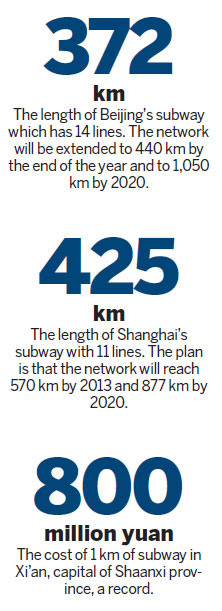
Even Shanghai, with a population of 23 million and GDP of 1.9 trillion yuan in 2011, has been dragged into debt. It has China's longest subway network, with 11 lines totaling 425 km by January. That's longer than New York (370 km) and catching up with London (439 km). The network is set to reach 570 km by 2013 and 877 km by 2020.
The city has the globe's fifth-busiest metro network - following Tokyo, Seoul, Moscow and Beijing - with 2.1 billion passengers in 2011, but the annual income it generates is insufficient to support itself.
Ying Minghong, board airman of Shanghai Shentong Metro Group Co, said that only Line 1 is profitable. The income from ticket sales and advertising covers its daily operating costs, but is not enough to pay for maintenance or the interest on its loans. The city's other lines are in debt.
|
 |
Shanghai Shentong Metro Co had gross liabilities of 609.7 million yuan by the end of 2011, according to its annual report. The figure was 262.8 million yuan in 2009.
However, Yang Di warned that the report did not reflect the overall situation, since only what are deemed "optimal resources" are listed as a part of Shanghai Shentong Metro Co.
"I doubt there are more than five people in our company and the local government who know how much money the Shanghai metro loses every year. The problem is that it's not a simple mathematical question of adding the government's yearly subsidy and subtracting the metro's annual operating costs," said Yang.
A slew of State-owned enterprises are responsible for financing, construction, management and operation, according to Yang. For example, Shanghai Shentong Metro Group owns the system and is responsible for maintenance. Meanwhile, Shanghai Shentong Metro Co operates and manages the system, while Shanghai Jiushi Corp and Shanghai Chengtou Corp are in charge of financing.
"With their individual account books hidden in the dark, it is impossible to know the exact scale of the losses," said Yang.
According to a Xinhua News Agency analyst, who spoke on condition of anonymity, the total liabilities of the Shanghai metro exceed 100 billion yuan.
However, the situation is far from unique.
Beijing, with a population of 20 million, has 372 km of subway, which will be extended to 440 km by the end of the year and to 1,050 km by 2020, according to the Mirror Evening News in Beijing.
The local government donates around 10 billion yuan for subway construction annually and allocates another 2 billion yuan to subsidize operations and maintain the low ticket price, according to Wu Lishun, financing manager at Beijing Infrastructure Investment Co, which is responsible for financing subway construction.
It's estimated that in 2015, when the network reaches 581 km, the system will have an operating loss of 4.3 billion yuan, despite the huge traffic volume, Wu said. If depreciation and accounting costs are included, the loss will hit at least 17 billion yuan.

 Michelle Obama addresses at Democratic National Convention
 Slides of Yanbian: place, people and prosperity
 Washington to remain focused on Asia-Pacific
 RQFII target blue chips amid bear market
 Australian recall for top two exporters
 China fears new car restrictions
Copyright 1995 - 2010 . All rights reserved. The content (including but not limited to text, photo, multimedia information, etc) published in this site belongs to China Daily Information Co (CDIC). Without written authorization from CDIC, such content shall not be republished or used in any form. Note: Browsers with 1024*768 or higher resolution are suggested for this site.
License for publishing multimedia online 0108263 Registration Number: 20100000002731