

 Comments()
  Print
Print  Mail
Mail  Large Medium Small
Technology helps save arable land, increase food safety and yields
Countries in East Asia, including China, with limited resources, are looking at "plant factories" - a kind of artificial farm that doesn't use arable land - as a way to provide adequate food supplies for rising populations.
|
 |
|
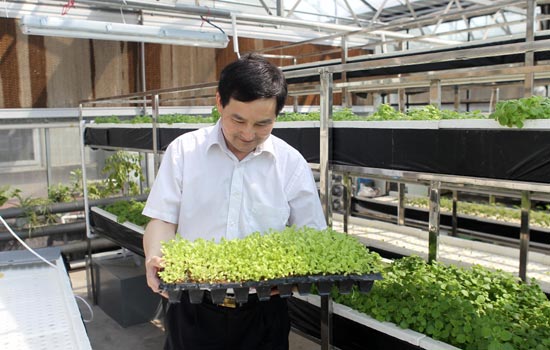
Yang Qichang, a leading agricultural technology scientist at the Chinese Academy of Agricultural Sciences, checks vegetables growing in a plant factory in Beijing. [Photo/China Daily] |
Yang Qichang, a leading agricultural technology scientist at the Chinese Academy of Agricultural Sciences, said plant technology that doesn't need soil is expected to help countries like China, Japan, and South Korea achieve their ambitious targets of food self-sufficiency in the coming decades.
Plant factories, which originated in Japan in the 1970s, are considered a successful way to get high yields via control of growing conditions, such as light, temperature and moisture, in a closed space.
Yang, director of the Center for Protected Agriculture and Environmental Engineering at the CAAS, said the advantages of plant factories include their limited demands on the environment and limited need for quality land. Those traits help countries that face shrinking arable land and frequent natural disasters.
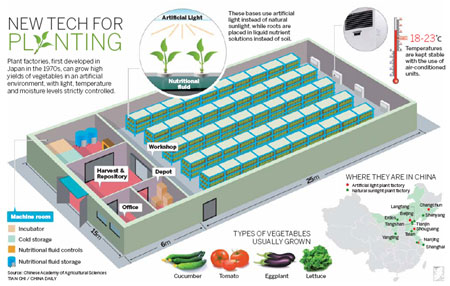
In a 10,000-square-meter plant factory in the CAAS, vegetables such as lettuce, tomatoes, eggplants and cucumbers - common in a Chinese diet - have been planted in a special nutrient solution.
Because they are not grown in soil, the vegetables are beautiful and clean.
"Because there is almost no need for agrochemicals, such as pesticides and fertilizers, the vegetables are attractive to people who are concerned about food safety," Yang said.
He said growing vegetables in plant factories is a physical process, and the seeds are the same as those sowed in the field, so there is no need to worry about food safety.
Yang said vegetables from plant factories now follow the same food safety standards as plants from the field, but generally speaking, they are of higher quality because they contain fewer nitrates and more vitamins.
"In China, scientists have gone about as far as they can go with conventional ways on agricultural production," he said.
For instance, wheat yield is 4.61 metric tons per hectare compared to the world average of 2.76 tons. Per-hectare rice and corn yields are 6.38 tons and 5.28 tons, compared to the global average of 3.38 tons and 3.41 tons, according to the CAAS statistics.
"The room for increasing production seems limited, but not for plants in plant factories," he said.
Such an advantage would certainly help China.
Agriculture experts warn that China may have a difficult time feeding its growing population - expected to peak at about 1.5 billion by 2030 - if natural disasters increase in frequency.

 Michelle Obama addresses at Democratic National Convention
 Slides of Yanbian: place, people and prosperity
 Washington to remain focused on Asia-Pacific
 RQFII target blue chips amid bear market
 Australian recall for top two exporters
 China fears new car restrictions
Copyright 1995 - 2010 . All rights reserved. The content (including but not limited to text, photo, multimedia information, etc) published in this site belongs to China Daily Information Co (CDIC). Without written authorization from CDIC, such content shall not be republished or used in any form. Note: Browsers with 1024*768 or higher resolution are suggested for this site.
License for publishing multimedia online 0108263 Registration Number: 20100000002731