It is not just Europe, but the entire world that stands at a precipice. But because of the acuteness of the eurozone crisis, it is old Europe that is going to become a laboratory for the world economy.
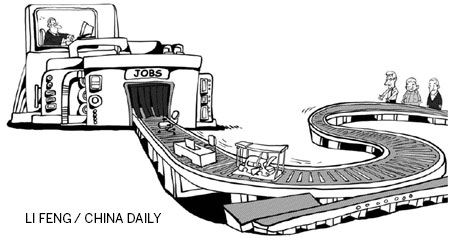
But even beyond its shores, the question that is faced with the same degree of trepidation, from North Africa and the United States to Japan and China, is this: Can we create jobs fast enough? Fast enough not only to facilitate a productive labor market entry for what is the best-trained and largest generation of young people ever. Fast enough also to ensure that the rising degree of social protest and dismay does not boil over.
The demonstrations in Spain, in particular, make plain how high the pressure is. The country's leadership has made a courageous and determined attempt to reshape labor market policies quite radically. It has dismantled the remnants of corporatist welfare structures built under the Francisco Franco regime. Such courage ought to be rewarded, and rewarded promptly. But it is one thing to leave behind an unfortunate political and historical legacy and quite another to transition smoothly to a better-functioning national economy.
For that transformation to be socially palatable, jobs must be created, and fast. That, however, is not the nature of structural reforms. As valuable as they are over the medium and long term, over the short-term horizon they offer little consolation in terms of job creation. While we in the developed world spent a lot of time a decade or two ago worrying about the "J curve effect", the time delay before changed exchange rates would have an impact on a nation's trade balance, now we better get accustomed to the same kind of delay in today's field of battle, that is, the labor markets.
The turnaround takes place only slowly partly because of the fact that much time has been wasted. Governments in the past have always tended to shy away from tackling the necessary reform measures. But now, the markets, for all of their own confusion, don't leave the Spanish and other European governments any room for maneuver (even as they demand no further job losses as a sign of improving growth prospects).
The European Union as a whole is committed to increasing the employment ratio among 20-to-64-year-olds from the present level of 69 percent to 75 percent by 2020. That means a need to create about 17.6 million new jobs. One factor that may actually help the Europeans in their quest is that several of the areas slated for new job growth, from green growth and mobility solutions to healthcare, are decidedly not a matter of fierce partisan political dispute, as they are in the US.
At least equally important is a radical step forward inside Europe to learn from best practices. One such example is Germany's dual training system, which provides young people with valuable career skills below the level of entering the tertiary education sector.
Other countries have long hesitated to adopt this approach. They found it too complex to emulate or too long to bear fruition. The low numbers of unemployed youth that follow the apprenticeship model speak for themselves. Yes, setting up such a system will take quite a while to become effective. But delaying its introduction yet again is definitely no solution.
The story of an urgent focus on job creation is by no means limited to Europe, even if it seems more virulent there than elsewhere. That virulence, though, in good measure is a result of the European tradition of actively engaging in street protests, something that is done far more sparsely in the US and even less so in China.
China's leaders need to make deep reforms, especially in the State-owned enterprises, if they want to put the Chinese economy onto a sound jobs' footing.
Africa and India face a different challenge. They are experiencing tremendous population growth, which will increase the pressure on them to create more jobs over the next half century or so. The pain of transition there will probably be far more earthshaking than what Europe is undergoing.
For all the constant efforts to draw positive contrasts to the rest of the world, the situation is not much different in the US. To create the number of jobs to take unemployment back down to the customary US level of, say, 6 percent, requires the creation of more than 350,000 jobs a month for several years in a row.
Not only is the current economic recovery not yielding numbers anywhere near that range, but also even in the heyday of the US economic boom, jobs were never created at such a pace for any sustained period. That underscores the problems faced by the US reach far deeper than electing a new president, as the Republicans are fond of arguing.
What all of this shows is that global economic integration rather ruthlessly exposes whatever and wherever countries have failed to act with proper economic foresight, far beyond just Europe's borders. But there is no shrinking back from the challenge, whether in Europe or elsewhere.
The author is director of the Institute for the Study of Labor, Bonn, Germany.
(China Daily 08/28/2012 page9)

Copyright 1995 - . All rights reserved. The content (including but not limited to text, photo, multimedia information, etc) published in this site belongs to China Daily Information Co (CDIC). Without written authorization from CDIC, such content shall not be republished or used in any form. Note: Browsers with 1024*768 or higher resolution are suggested for this site.
License for publishing multimedia online 0108263 Registration Number: 130349