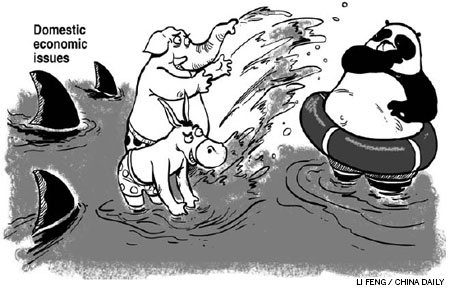
After the Republican and Democratic national conventions, Americans prepare to choose their next president on the basis of domestic economic issues. But China does matter, indirectly.
When US President Barack Obama assumed office, nine out of 10 Americans disapproved of the direction the country had taken during his predecessor George W. Bush's two terms. Even today, about 75 percent Americans disapprove the direction of the country.
Americans have been split by Obama's policies since the summer of 2008, despite high initial hopes. According to daily tracking polls, most Americans would have voted for Obama until the summer of 2012. If the presidential election were held today, the race would be almost even.
In the United States, it is the fundraising that makes or breaks a presidential candidate. Obama raised more funds until this summer. But Republican candidate and former Massachusetts governor Mitt Romney has gained the cash advantage now.
According to polls, almost 90 percent Americans will choose the next US president on the basis of four priority issues: jobs, budget deficit, healthcare and social security. China does not figure on this list directly, but it does indirectly. Until recently, the two candidates' campaigns did not look that different in terms of foreign policy, national security and the policy toward China. But the situation has changed.
In this year's US election, China's continued growth amid the US and eurozone debt crises, and the issue of fair trade policies have raised concerns among US policymakers. Democrats and Republicans both support the Obama administration's 2011 "strategic pivot" toward the Asia-Pacific region, which has escalated military deployments and includes plans to sign a new regional trade pact that does not involve China.
Obama entered the White House seeking a competitive and cooperative relationship with China. In 2009, his administration started the US-China Strategic and Economic Dialogue for an expanded dialogue on trade, security and other issues. But he has criticized China's currency policies. Pirated and counterfeit goods have also been a source of contention.
During his 2012 State of the Union address, Obama announced the creation of a Trade Enforcement Unit to investigate "unfair trading practices in countries like China". The Obama administration has brought trade cases against China at nearly twice the rate of the Bush administration.
In the Republican camp, seven of Romney's 10 foreign policy advisers used to work for George W. Bush. Many are neo-conservatives and support the containment policy against China. Romney's stated policy approach toward China is not that different from Obama's in terms of US presence in the Pacific, cooperation with India and other allies, human rights and trade. However, he has pledged that he would declare China a currency manipulator on the first day of his presidency, unless Beijing "changes its ways".
In June, sharp policy disputes split Romney's foreign policy team, whose Asia-Pacific group is co-chaired by Evan A. Feigenbaum, a former US State Department official, and Aaron L. Friedberg, another co-chairman and national security aide of former US vice-president Dick Cheney. The former favored a "more calibrated approach", whereas the latter supported a hard line on China.
After the split, the moderates in the Romney team remain concerned that the old neo-conservative "Cheney-ites" will win against them. The Romney team also includes a number of neo-conservatives who continue to believe that just as the Iraq War was necessary so is the containment of China. They include a top official in Pentagon under Bush, Eric Edelman who has spoken forcefully for the AirSea Battle Plan in the South China Sea - a doctrine that former vice-chairman of the Joint Chiefs of Staff James Cartwright has criticized for "demonizing China".
In turn, Romney has vowed to increase the military budget by an astounding $2.1 trillion over the next decade, which contradicts the goals of his economic policy. The execution would contribute to the US' massive debt, which is now close to $16 trillion. After being branded as too liberal by conservative Grand Old Party activists during the 2008 campaign, Romney opted for an alignment with the neo-conservative hawks to protect his right flank. He may have been too successful.
Romney made Paul Ryan, the chairman of the House Budget Committee, his running mate because Ryan can deliver the conservatives and the Tea Party. But to win the presidency, Romney and Obama both will need the support of the independent voters, especially the so-called "Reagan Democrats" who are fiscally conservative but social moderates.
Both candidates know only too well that what may be good for the Republican right or the Democratic left may not be good for the middle-of-the-road American to vote for. According to the polls, Obama leads in social issues (abortion, women's issues, even energy policy) but Romney has an upper hand in economic issues (federal deficit, Medicare, economy, taxes).
Yet numbers do not tell the full story. Americans have not forgotten that it was the two terms of George W. Bush that insulated the US internationally and created much of the economic mess in the first place.
In the final analysis, it is the economy that will play the critical role in both candidates' campaigns over the next two months, unless the Israel-Iran friction escalates in the Middle East.
Since neither candidate is eager to speak in detail about the painful economic adjustments that loom on the horizon right after the election, both may resort to China-bashing, especially in the context of trade and employment.
It is true that Romney and Obama both are moderates. But it is also true that, in the past, the sharp rhetoric of the presidential campaigns has been replaced by practical policies after the election. But none of those post-1980 campaigns occurred against the background of global economic stagnation. Nor were those elections followed by difficult fiscal adjustment policies.
In the 2012 US election, nothing should be taken for granted.
The author is research director of international business at US-based India, China and America Institute, an independent think tank, and a visiting fellow at Shanghai Institutes for International Studies and Singapore EU Center.
(China Daily 09/05/2012 page9)

Copyright 1995 - . All rights reserved. The content (including but not limited to text, photo, multimedia information, etc) published in this site belongs to China Daily Information Co (CDIC). Without written authorization from CDIC, such content shall not be republished or used in any form. Note: Browsers with 1024*768 or higher resolution are suggested for this site.
License for publishing multimedia online 0108263 Registration Number: 130349