Macro policies could be readjusted to promote the country's sustainable development and avoid potential market risks
The gloomier economic indicators China has seen for August are giving rise to worries that the country's economic growth will further decelerate and to calls for further stimulus measures.
Amid such circumstances, no one doubts that something should be done to make growth more stable. The question is: what?
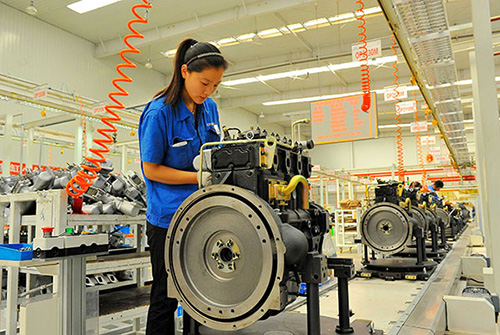
Lingering overproduction remains an underlying cause of China's economic troubles. The country began to have too much industrial capacity after it had made unprecedented investments in response to the world's financial troubles. The situation has only become worse, as internal and external demand continue to weaken amid economic troubles at home and abroad. However, some State-owned and private enterprises are still turning a blind eye to the country's gloomy economic prospects and continue to prefer making large investments.
China should be more patient with its moderate economic adjustments and not be excessively concerned about the economic slowdown. Instead, it should be more determined to rectify long-term structural imbalances.
A big difficulty now facing China is its failure to effectively handle some long-pending problems, such as imbalanced industrial and urban-rural structures.
In fact, a moderate economic slowdown over the past two years is a result of China's efforts to reduce its dependence on external demand. That work has helped balance the country's imports and exports and narrow its trade surplus. Economic deceleration is also largely the result of its pursuit of balanced development between coastal provinces and inland regions.
Excessively rapid increases in investment and insufficient consumption are a central economic structural difficulty for China. Retail revenues from the country's consumer goods increased by 17.1 percent in a nominal sense in 2011, but only by 11.1 percent in an actual sense, a decline of 3.5 percentage points year-on-year.
Despite its weakened growth, China should avoid adopting a new round of stimulus measures that are aimed at reaching a growth target that is set artificially high. Avoiding such policies will help forestall any possible side effects of reckless economic measures.
Any attempts to compensate for overproduction with the use of a new expansion of production will inevitably lead to more overcapacity. Stimulus packages may help struggling enterprises temporarily overcome difficulties but will also expose them to more risks stemming from ever-greater overproduction risks and price fluctuations.
Turning to overproduction to resolve the current insufficiency in demand will once again drive up the price of the global means of production, giving developed countries excuses to adopt a loose monetary policy and redirect the consequences of the current global troubles. This best explains why some international agencies have tried to persuade China to relax its macroeconomic policies.
Any rush to adopt a new stimulus package will possibly further delay China's long-overdue economic structural adjustments and exacerbate its overproduction. For example, China had the capacity to produce 880 million tons of steel a year at the end of 2011, an increase of 47 percent from 600 million tons in 2008. Its per capita steel consumption now exceeds 657 kilograms a year, far higher than the world's average of 400 kilograms.
Yet, such increases have come at the expense of the country's energy and resources. Also, residents have to spend more on housing, even though their incomes are increasing much more slowly than the country's economy growth rate. Besides, the adoption of investment-dominated stimulus measures will result in a loosened monetary policy, which will further fuel price rises in international commodities and domestic housing.
Despite the continued economic downturn, China should stick to its macroeconomic regulatory policies and adapt to the current darker prospects for economic growth. The country's monetary supply, credit volumes and interest rates all indicate China still finds itself in generally relaxed financial circumstances. It can moderately loosen its monetary policies, but that does not mean it should do so merely in pursuit of a specified growth target.
China should try to intervene less into microeconomic activities, encourage the merger and re-organization of some enterprises and try to eliminate those that can only succeed when the national economy maintains a growth rate of 9 percent or higher.
Adjusting the national economic growth rate will help promote substantial adjustments of the economic structure, something that China now needs greatly.
The country should also change its past development plans, which tended to concentrate on investment, and try to improve its consumption structure to boost long-slackened domestic demand. In addition, efforts should be made to accelerate the reform and development of the country's capital market and make domestic enterprises more capable of innovating.
The author is a research fellow with the Chinese Academy of Governance.

Copyright 1995 - . All rights reserved. The content (including but not limited to text, photo, multimedia information, etc) published in this site belongs to China Daily Information Co (CDIC). Without written authorization from CDIC, such content shall not be republished or used in any form. Note: Browsers with 1024*768 or higher resolution are suggested for this site.
License for publishing multimedia online 0108263 Registration Number: 130349