|
 |
|
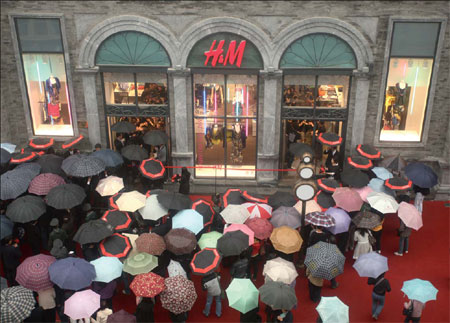
H&M opens its first Beijing shop in 2009. [Photo/China Daily] |
Sept 20 was a big day for Swedish retailer H&M as the company opened its 100th store in China at Nanning, the capital of the Guangxi Zhuang autonomous region, and entered Malaysian retail space with its first store in Kuala Lumpur.
Established in 1947, H&M Hennes & Mauritz AB (operating as H&M), is the world's second-largest fashion retailer, and known best for its fast-fashion clothing for men, women, teenagers and children. In terms of revenue, it is just behind the Spain-based Inditex, the parent company of clothing brand Zara, and is followed by US clothing brand Gap.
By the end of August, the company had a presence in more than 45 countries with its 2,629 stores. The Swedish brand has been expanding quickly since its entry into China in 2007. Karl-Johan Persson, CEO of H&M, indicates that China is the fastest growing market for the company in terms of store numbers.
According to its interim report released in July, during the first half of the fiscal year, revenue generated by H&M increased by 12 percent compared with the same period last year.
Persson is the son of current H&M Chairman Stefan Persson and the grandson of Erling Persson, the founder of H&M. Persson was said to have started H&M in 1947 after visiting the US, where he was inspired by a store selling low-priced fashion. Unlike the best-known European brands that usually identify themselves with the premium group, H&M sells a philosophy, as Persson puts it, the "democratic fashion" to Chinese people.
"We create democratic fashion, and we want to sell for all," he says.
This principle is reflected in the design and the style of the garments, ranging from basics to exaggerated designer series, and from plain shirts to colorful dresses.
Although the loose and oversized tops often give many Chinese shoppers the illusion that this is a typical European style, Persson says that "European element" is not the main selling point of H&M, at least not what the company intended.
"The company was founded in Sweden, so there is a certain amount of Swedishness in this brand, but we don't want to stress our nationality to customers," he says.
The brand does some local adaptations from time to time, but generally, 80 percent of the products are the same globally.
"Take the new Malaysian store for example. Of course we refer to our experiences in other hot countries like Singapore, and as you can see, there are not as many thick clothes or down coats in these places as in Sweden," Persson says. "But in terms of other adaptations, we make them along the way we operate the store."
Climates differ from country to country, but in terms of fashion, so far there is no major difference between customers from different countries, he says.
The "democratic fashion" is reflected in the price as well. While there is a small variation due to the exchange rate among countries, the price is globally flat.
"Many years of experience gives us knowledge of logistics, materials, supply chain, buying in huge volume without using any middlemen, all of which help keep the costs at a minimum," Persson says. "And compared with premium brands, we don't charge the enormous margin as well."
H&M, together with Spanish brand Zara, Japanese brand Uniqlo and US brand Gap, are often categorized as the "fast fashion" brands which all stress quick turnover of stocks and reasonable prices. These brands have new arrivals every week, or at least every month.
"The international brands have not only seized the premium market, but they are winning over local brands gradually," says Wang Yao from the Nation Commercial Information Center of China.
According to Japanese clothing company Uniqlo, the target audience for these fast fashion brands are customers in the 20-35 years age group.
The Japanese company is also ahead of H&M in terms of the number of stores in China. At the end of August, there were 145 Uniqlo stores in China, and the number is increasing by 100 every year. The company is expected to have 1,000 stores in China by 2020.
Unlike its other competitor Zara, which mainly designs black, white and gray garments, and generally attracts working women, H&M offers a wider variety of collections that Persson says makes it difficult to define a typical customer of H&M.
"We cater to all styles, as long as they are interested in fashion, and want great value for money," Persson says.
"Of course they are great competitors," he says. "But if you combine fashion, quality and price, I think we have the best offering in the market. We have a huge variety with so many styles, offering dresses for various personalities."
While keeping the H&M brand accessible to the public, the company is developing for different customer segments.
The company has decided to bring its upgraded line Cos to China by the end of this year. Also in the works is a casualwear brand Monki. Persson says H&M is also a design company, with more than 150 designers in Sweden. "We want to have our own designs. We don't take fashion so seriously, as we want to have fun with it. So we constantly surprise our customers with new designs."
Currently, H&M has more than 700 suppliers in the world, both in China and Europe.
Although it doesn't face the serious counterfeit problems in Asia, like some premium brands do, copies of H&M designs are constantly seen.
"This is something that good brands have to live with. If we do something well, there will be people who want to copy it. But at the end, if we do the right thing, customers will want the right thing rather than the copied item," Persson says.
"I think there is still huge potential in China, with many shopping malls slated to open and there is still much for us to do."
wangchao@chinadaily.com.cn

Copyright 1995 - . All rights reserved. The content (including but not limited to text, photo, multimedia information, etc) published in this site belongs to China Daily Information Co (CDIC). Without written authorization from CDIC, such content shall not be republished or used in any form. Note: Browsers with 1024*768 or higher resolution are suggested for this site.
License for publishing multimedia online 0108263 Registration Number: 20100000002731