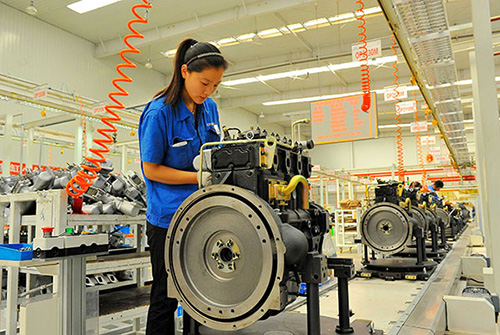
The sixth national population census of China conducted in 2011 showed the proportion of people aged 15-64 (a measure of the labor force) in 2000 was 70 percent and increased in 2010 to a peak high level of 74.5 percent. But in 2011, we saw the first decline in the labor force by 0.1 percent to 74.4 percent. The decline may appear insignificant but it marked the beginning of the almost irreversible trend - a declining labor force in China. The current pool of labor, therefore, cannot be sustained over the next two decades. Such a substantial decline in the labor force will pose a great threat to China's pension system.
In the early 1990s, the Chinese government shifted funding responsibility for a nationwide pension from the hands of State enterprises or work units, to employers and employees. This measure not only reduced the welfare burden of the State enterprises, but also opened the gate for people working in private or foreign companies to participate in the national pension scheme. The reform was envisioned as "pay-as-you-go", with funding from current workers paid to those retiring. Chinese officials characterized the pension scheme as "low protection, wide coverage".
With the size of the contributing population projected to shrink at an unprecedented pace in the next two decades, whether the current system can provide all Chinese citizens with the services it promises has come into question. According to a recent report entitled "Resolving Mid- and Long-term Risks in National Balance", co-sponsored by Bank of China and Deutsche Bank, the fund gap in China's pension system will be 18.3 trillion yuan in 2013. That gap will keep widening and will demand more than 20 percent of fiscal expenditures by 2050. As the ratio of working-aged Chinese to the country's retirees drops (from 10:1 in 2000 to 2.8:1 in 2050), the pressure on each working individual to support the elderly will significantly increase.
Many Chinese and foreign scholars are proposing solutions to prevent the pension gap from worsening. Some argue that the nation should give more freedom to the private financial sectors to manage individual pension accounts. Others urge that employers establish more enterprise funds to provide protection to their employees. Some argue that the State can more freely manage the pension funds, to improve its gains by increasing investments in either domestic or foreign business sectors. All these suggestions are helpful to some extent, but none can be effectively implemented in the short term.
In my view, the quickest, most effective and possibly most agreeable solution to the future pension gap, is to raise the retirement age in China from its current level of 60 for male employees, 55 for female officials, and 50 for female workers. The current mandatory retirement age was set in the 1970s, when life expectancy was only 70. Now the country's life expectancy has risen to 75. According to an analysis conducted by China Radio International, to raise the retirement age from the current level to five more years, can add 4 billion yuan to China's pension fund annually and cut expenditures by 16 billion yuan.
Thanks to the substantial improvements in China's medical services and standard of living, Chinese people in general are much healthier and certainly capable of working to a more advanced age than previously. It does not make any sense, whether from an economic, social or medical point of view, to adhere unquestioningly to a retirement age set 40 years ago, when conditions were so different.
Many people I know who retired from leadership posts and senior managerial positions continued to serve government and society with distinction in various capacities, sharing their invaluable experience. There is no reason why ordinary workers cannot remain at their work stations beyond 60, and keep adding to the productivity of our country, instead of becoming pensioners prematurely. By raising the retirement age, China can instantly turn what would be liabilities into assets.
A variant to this proposal would be to maintain the current system, but to give people who have reached their respective retirement age the option of carrying on working subject to medical approval. And I suspect a significant portion of them would choose to remain at their workplace, where many find job satisfaction and camaraderie. These are two precious elements that many retirees miss so much after leaving their employment.
Apart from creating an unnecessary burden on the country, forcing skilled and experienced people to retire, many having just reached their peak in their 50s and 60s, also meant an unconscionable loss of invaluable expertise from the workplace. It's time for a drastic re-thinking of our approach to retirement.
The author is former secretary for home affairs of the HKSAR government.
(HK Edition 10/05/2012 page3)


Copyright 1995 - . All rights reserved. The content (including but not limited to text, photo, multimedia information, etc) published in this site belongs to China Daily Information Co (CDIC). Without written authorization from CDIC, such content shall not be republished or used in any form. Note: Browsers with 1024*768 or higher resolution are suggested for this site.
License for publishing multimedia online 0108263 Registration Number: 130349