|
 |
|
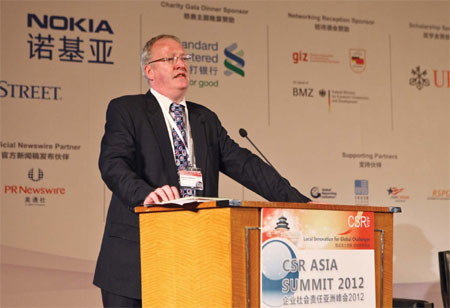
Richard Welford, chairman and founder of CSR Asia, during a recent corporate social responsibility summit held in Beijing. [Photo/China Daily] |
|
 |
|
From left: Evan Lewis, vice-president of communications for Accor Asia Pacific; Aurora Chen, director of sustainability for Coca-Cola in China; Zhang Yanming, deputy director of the Corporate Social Responsibility Office of Pudong New Area in Shanghai. |
Responsible actions
While labor standards in China have steadily improved since the early days of multinational outsourcing, pressure from Chinese consumers there is forcing companies to act even more responsibly.
"In China the growing middle-income consumer is starting to ask questions," Welford says.
"There is more concern now over how products are being made, especially in the area of sustainability."
Multinational corporations may have forged the foundations of China's modern CSR practices in the early 1990s, but the concept of businesses doing well by their communities is not new to China.
The country has a long history of companies providing for its own like family, built on the values of Confucianism focusing on loyalty and family before oneself.
In the early 1950s, companies were expected to provide basic living essentials such as housing and food for their employees, and many went as far as building schools and other essentials for local communities, says Wang Zhile, director of the Beijing New-Century Academy on Transnational Corporations.
Following the economic reform and opening-up of the late 1970s, when China's economic model shifted to the more profit-driven version in play today, companies hit the reset button on how they conducted social responsibility.
"In the past companies did everything," Wang says.
"After the reform and opening-up we built the modern corporation system. Now companies only do business focusing on maximum value for shareholders."
It was not until 2006 following the release of the new Company Law that Chinese companies began revitalizing their role as a source of community and environmental support.
The rule requires that corporations "abide by the laws, regulation, social and business morality and good faith rules, accept supervision by government and the public, and undertake social responsibilities".
While the mandate was a pivotal point for China's corporate social responsibility, it is a far cry from the Confucius-driven business practices of the past.
"The CSR we do today is different to what was done before the reform and opening-up," Wang says.
CSR got further impetus in China from the 12th Five-Year Plan (2011-15), which seeks to reduce the environmental impact of manufacturing and encourage more sustainable business practices.
Shanghai experiment
One area that has seen the strongest impact from the government push for corporate responsibility is Pudong New Area in Shanghai.
Housing offices for dozens of the country's largest companies as well as the Shanghai Stock Exchange, the economic development area was among the first established under modern CSR guidelines in 2009.
Ranging from regulations on employee rights to environmental protection, the 67 practical standards have since been adapted as the go-to-guide for companies operating beyond Shanghai's borders.
Companies, both foreign and domestic, operating in this area are held to some of the strictest CSR standards in China, says Zhang Yanming, deputy director of the Corporate Social Responsibility Office of the Shanghai Pudong New Area.
"We require a higher proportion of State-owned enterprises to take part in the higher standard system," Zhang says.
"They should be role models in the new system. They should have to perform better because of their stronger financial foundations."
The number of companies striving to meet international social responsibility standards is set to grow even faster as Chinese brands eye overseas markets.
"A lot of the bigger Chinese companies who have global ambitions realize that they have to do CSR," Welford from CSR Asia says.
"They are beginning to learn that if they want to move out of China, part of that license to operate is demonstrating that you are socially responsible. They are becoming aware that you have to take social responsibility with you, otherwise you can get into trouble."
This is exemplified in the Fortune China CSR Ranking 2012 report, which puts China's three largest international brands - Haier, Huawei and Lenovo - as the top three Chinese CSR contributors.


Copyright 1995 - . All rights reserved. The content (including but not limited to text, photo, multimedia information, etc) published in this site belongs to China Daily Information Co (CDIC). Without written authorization from CDIC, such content shall not be republished or used in any form. Note: Browsers with 1024*768 or higher resolution are suggested for this site.
License for publishing multimedia online 0108263 Registration Number: 130349