Comments()
  Print
Print  Mail
Mail  Large Medium Small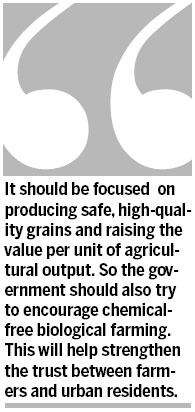
Efforts should focus on encouraging larger-scale farming and raising the quality and prices of agricultural products
The United Nations Food and Agriculture Organization awarded Premier Wen Jiabao its Agricola Medal on Oct 2, highlighting China's achievements in agriculture and rural development.
Yet, while being heartened by the FAO's action, we should also bear in mind that many agriculture-related problems still exist, and China has a long way to go to boost its agricultural and rural development, the crux of which is how to raise farmers' incomes as soon as possible.
China's current income ratio between urban and rural residents is 3.22 to 1, and the gap is expected to widen still further. The low incomes of farmers, who constitute a large proportion of the population, and their feeble purchasing power have not only been a drag on government efforts to boost domestic demand, but also an obstacle to the country's drive to build a harmonious society. However, the establishment of a market economy in China means that the incomes of any groups will be largely decided by supply-demand relations and the country's economic development stage, which means there is not much space to raise farmers' income levels in the near future under the current economic and labor market conditions. To raise rural incomes, the government should first work out practical ways to increase the incomes of migrant workers whose wages usually support their families left behind in rural areas, and boost the training provision for migrant workers. The minimum wage should be standardized and efforts should be made to establish better working conditions.
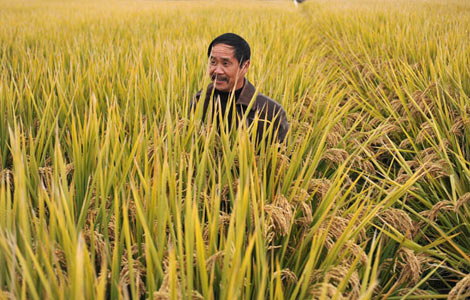
At the same time, efforts should be made to raise agricultural output and the prices of agricultural products, in order to raise the incomes of farmers.
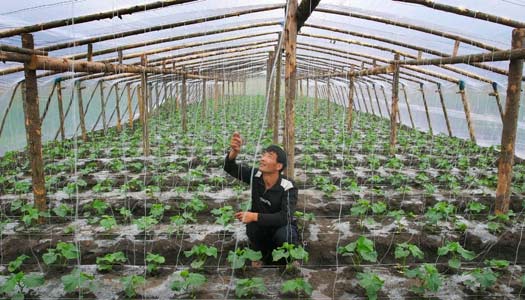
However, in view of the fact that farmers in China's southern regions have less than 0.14 hectares of arable land to farm on average, raising individual farmers' agricultural output will be difficult to achieve. Given that raising agricultural output requires establishing a large-scale agricultural production model and agricultural capitalization, there needs to be an accelerated movement of farmers to urban areas.
In a bid to promote larger-scale agricultural production, the government should advance the voluntary transfer of rural arable land, for instance in joint-stock form, to dismantle the restraints caused by the current household-based arable land division. However, large-scale agricultural production is dependent on how much of this liberated rural labor force can be absorbed by urban areas.
To encourage more people to migrate to urban areas, the rural land ownership system should be reformed so farmers can make more money through the sale of their land. At present farmers' contracted land, either on a private or collective basis, cannot be freely circulated on the market, as it is first requisitioned by the government and its ownership changed to State-owned before its sale on the market. In this process, governments at various levels usually first acquire land from farmers at a low price and then gain exorbitant profits from the final sale. Such a land ownership transfer in essence deprives farmers of the opportunity to benefit from the increase in land prices.
However, China's agricultural development should not be targeted at just achieving an output boost, the main goal pursued during the period of the extensive agricultural expansion. Instead, it should be focused on producing safe, high-quality grains and raising the value per unit of agricultural output. So the government should also try to encourage chemical-free biological farming. This will help strengthen the trust between farmers and urban residents, which has been damaged by fears of agricultural products being contaminated.
Despite the fact that it will raise the cost for urban residents, the gap between urban and rural resident's incomes will be narrowed if China restricts grain imports as a way to sustain farming. Data from the Ministry of Agriculture indicate that China imported 58 million tons of grain in 2011, more than 10 percent of the home-produced grain output, with the proportion expected to slightly increase this year.
The problems hampering a significant increase in farmers' incomes will not be easily solved, but more efforts must be made in order to reduce the income divide between rural and urban residents and ensure the supply of safe, homegrown agricultural products.
Zhao Xiao is a professor with the School of Economics and Management, Beijing University of Science and Technology, and Chen Jinbao is an economics PhD at the school.
Copyright 1995 - 2010 . All rights reserved. The content (including but not limited to text, photo, multimedia information, etc) published in this site belongs to China Daily Information Co (CDIC). Without written authorization from CDIC, such content shall not be republished or used in any form. Note: Browsers with 1024*768 or higher resolution are suggested for this site.
License for publishing multimedia online 0108263 Registration Number: 20100000002731