The team behind a system for storing electricity in the chemical bonds of a water-based sodium-ion battery won the top prize in a Massachusetts Institute of Technology competition designed to spur collaboration with China.
Among other applications, the storage technology could enable the use of aqueous sodium-ion batteries to stabilize an electric utility's grid and as a cheaper, cleaner alternative to the lithium-ion or lead-acid batteries that now power most electric and hybrid vehicles.
Last weekend's second MIT-China Innovation and Entrepreneurship Forum, or MIT-Chief, also provided a platform for Chinese student innovators in the United States to swap ideas with entrepreneurs from China.
Over 20 members of the tech cognoscenti representing either country spoke on panels and shared advice with team members in the competition, called Pitch to China, as well as the audience.
Sodium Energy, a team of students advised by MIT professor and energy entrepreneur Yet-Ming Chiang, won the $10,000 prize for its Pitch to China entry.
The team stressed advantages of its storage system: speed (a sodium-ion battery can be 70 percent charged in 36 seconds); longevity (at least 1,500 cycles, about the maximum for a lithium-ion battery); "environmental friendliness" (no toxic elements such as lead, cobalt or fluorine, and no organic solvents); safety (use of water rather than a flammable solvent to conduct electricity); relatively low cost; and "energy density", or storage per unit of mass, that could make a sodium-ion battery as light and portable as the lead-acid variety.
Xiang Kai, a member of Sodium Energy, told China Daily that the innovation forum pushed his team to work harder than usual. The students turned their lab-based idea into a marketable plan for a product that could work and fill a consumer niche - one that could grow significantly.
The battery storage system was one of six student-team projects selected as finalists from about 160 entries in the Pitch to China portion of MIT-Chief. Besides technical details, the finalist teams had to present a business plan for the assembled Chinese entrepreneurs.
Projects were judged based on degree of innovation and the feasibility of bringing them to market in China.
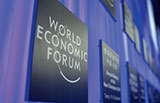
"Any conversation about innovation and entrepreneurship depends not only on one person's effort at the most micro level, but also on the system in which they operate," said Kevin Steinberg, chief operating officer at World Economic Forum USA, who gave a speech at the forum. (The Forum is known for its annual gathering in Davos, Switzerland, of business, government and civl-society leaders.)
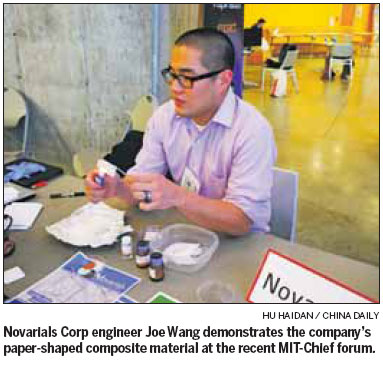
Another of the finalist teams, from Massachusetts nanotechnology startup Novarials Corp, produced a "ceramic paper" composite material for coating sodium-ion batteries.
The material, a rectangular sample of which was presented at the forum, can withstand very high temperatures while remaining bendable and flexible. It also has the potential to be used as a filtration or separation membrane in the chemical, petroleum, pharmaceutical and biotechnology industries, and for environmental remediation and protection.
"We appreciate the opportunity to show our products to the audience and to the experts," said Joe Wang, an engineer at Novarials.
During the three-day forum, participants and audience members spoke to invited tech experts, investors and entrepreneurs about venture capital, health care, alternative energy and other timely topics.
"We would like to create real opportunities for our audience, and we want to see real impact," said Zhang Xu, co-president of the forum and an MIT doctoral candidate in electrical engineering and computer science.
"Compared to other nations, economic growth in China is fast; the opportunities are huge. That's why I'm very confident for R&D in China going forward," said Yun Weijie, a senior adviser at California-based Northern Light Venture Capital, who served as a judge at the MIT forum.
Pointing out that big opportunities also involve big challenges, Yun said the biggest hurdle for innovators in China is identifying niches amid the hurly-burly of rapid growth.
Keeping research-and-development people in separate locations helps spur innovation, Victor Wang said in an interview. He's the president of Hanhai Investment Z-Park in San Jose, an incubator for US and Chinese tech firms that is backed by China's Hanhai Zhiye Investment Group and Zhongguancun Science Park.
"The Chinese team focuses on manufacturing, logistics and R&D assistance, while the American team focuses on core R&D and research," Wang explained.
With the two countries' economic success intertwined more than ever, innovation and collaboration carry the day, several experts told the MIT gathering.
"Cutting-edge technologies still come from the US, but the huge market is in China," said Northern Light's Yun. "If you come up with ideas and plans that leverage the two, it can give you a strong competitive advantage."
haidanhu12@chinadailyusa.com


Copyright 1995 - . All rights reserved. The content (including but not limited to text, photo, multimedia information, etc) published in this site belongs to China Daily Information Co (CDIC). Without written authorization from CDIC, such content shall not be republished or used in any form. Note: Browsers with 1024*768 or higher resolution are suggested for this site.
License for publishing multimedia online 0108263 Registration Number: 130349