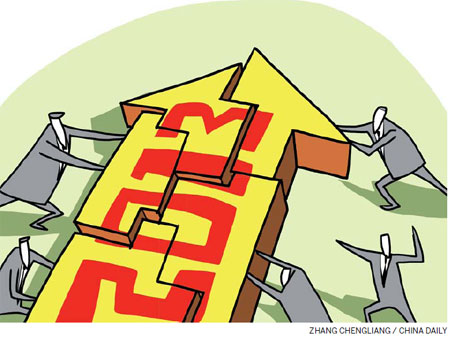
First meeting on economic policy signals new growth model and change in priorities
China's new leadership under Xi Jinping and Li Keqiang has set out its economic policies for the country, giving us a clearer idea of what lies ahead.
The two-day annual Central Economic Work Conference has just taken place, setting the tone for economic policy next year.
Many have argued that the new leadership has followed the footsteps of the old, inheriting proactive fiscal and prudent monetary policies. Also, along the general lines set by President Hu Jintao and Premier Wen Jiabao in 2011, this year's meeting highlighted keeping credit and currency stable.
That is a fair assessment, as we have not seen Xi's team show any major divergence on economic policies. And that is not surprising.
There are three reasons for the similarities. First, domestic and global economic fundamentals have not changed much. The recovery of the Chinese economy is slowly gaining steam, while global business remains weak but shows signs of improvement. Based on the same economic reasons, it is unrealistic to expect the new leadership to shift dramatically from previous policies.
Second, it is understandable that the new leadership is well aware of the need for continuity and stability in macro-policies. Past experience has shown any major change of policy could result in fluctuation of both the stock market and business confidence.
Third, the new leadership was only installed a month ago. It is too soon to have their thinking fully translated into policies at the meeting. It is inevitable that much of the thinking of the Hu-Wen period and its wording would be inherited by the new leaders.
But this is not to say the conference was a meaningless replay of old polices. Several points are worth attention, as they convey the mindset of the new leadership, one that is different from their predecessors' and that will be translated into real economic policies in the coming years.
Having a better understanding of the new leadership's thinking affords a better chance of accurately predicting the direction of policy, and for investors to pick the right stocks.
My sense from indications given at the meeting is that the new leadership, generally speaking, will lean toward tightening rather than loosening.
"Stabilizing growth", a term so popular it appeared in almost all economic documents and leaders' speeches in the past few months, was noticeably absent from a document issued after the economic meeting. That means the new leadership does not see growth as a high priority.
What the new leaders believe comes down to this statement: "The focus next year is to promote the quality and the efficiency of economic growth, and to seek progress while maintaining stability."
That reflects a change in attitude toward the challenges facing the Chinese economy, especially as recovery takes hold.
The new leadership seems to think that the outdated economic growth model, not the economic slowdown, is the biggest worry. Based on that understanding, the new leaders are likely to favor a slight tightening of monetary and fiscal policies next year to avoid unbalanced growth.
The current policies devised by Hu and Wen are moderately loose in dealing with the economic slowdown. Xi and Li may tighten them by curbing the growth of loans and getting the central bank to undertake more open market operations once economic growth solidifies. They may even use interest rates to achieve monetary tightening.
As a younger generation of leaders, Xi and Li may be bolder in using tightening measures to improve the quality of economic growth. It seems that they are convinced that some sectors such as labor-intensive manufacturing should bow to the market.
That is a big difference to the thinking of the older generation, which has habitually shelved industrial and financial reforms and supported industries that employ many people but provide little added value.
That suggests that further measures to shore up the export sector are unlikely.
Urbanization will also be promoted at the highest levels. Vice-Premier Li Keqiang has been researching this topic for years, and the fact that the recent meeting covered the topic at length means special policies and funds relating to further urbanization are on the way.
Sectors such as urban construction, city planning and environmental protection are expected to get a shot in the arm.
In particular, medical equipment makers and healthcare service providers will benefit, as leaders at the meeting have vowed to let rural residents to enjoy equal treatment after they move to cities. That will herald a surge in the demand of medical care services, especially smaller cities.
Another sector that will greatly benefit from the policy is agricultural equipment.
With urbanization to the fore for the next five to 10 years, there are going to be fewer people working on the farmland. But to safeguard food supply and security, China still needs to produce enough grain to feed its population. As more farmers migrate to cities and towns, machines will be needed to replace farm workers - and the government will have to subsidize the purchase and use of machines to encourage rural work.
Another indication is that policy support will shift from investment to consumption. Investment usually comes ahead of consumption in government documents but this time, it was the other way round.
The work conference's document said: "We need to exert ourselves to expand domestic consumption, to foster a slew of new consumption growth engines that have strong driving forces, and to promote the stable growth of investment and optimize the investment structure."
For a long time Chinese leaders have used investment, particularly government spending on infrastructure projects, to stimulate growth.
The most obvious example is the 4 trillion yuan ($640 billion; 480 billion euros) stimulus in late 2008 that saw the government spend big on roads, bridges and railways. Although the strategy helped shore up the economy quickly, it had dire consequences, such as wasteful investment and asset bubbles.
The new leadership looks to favor consumption as a new way to boost the economy. If the strategy works well, industries such as e-commerce and new energy may benefit from stronger government backing. In addition, tax reform may proceed faster.
Finally, property curbs may not be loosened. Rather, they are more likely to be reinforced.
The statement that the adjustment and control of the property market should be "strengthened" - instead of "maintained" or "optimized" - was a strong signal that the leadership is mindful of the recent recovery in the property market.
Tightening policies will be maintained for the time being, so long as property prices are maintained or rise by little. If they rise too fast, further tightening is likely, and property tax may be an option.
The author is a financial analyst in Shanghai. He can be reached at michaelzhoufeng@gmail.com. The views do not necessarily reflect those of China Daily.


Copyright 1995 - . All rights reserved. The content (including but not limited to text, photo, multimedia information, etc) published in this site belongs to China Daily Information Co (CDIC). Without written authorization from CDIC, such content shall not be republished or used in any form. Note: Browsers with 1024*768 or higher resolution are suggested for this site.
License for publishing multimedia online 0108263 Registration Number: 130349