Comments()
  Print
Print  Mail
Mail  Large Medium Small
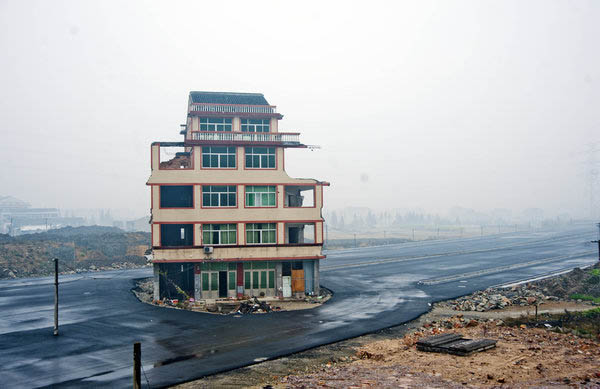
HANGZHOU - A five-storey rural brick house stands alone in the middle of the road. Cars drive around the house as they pass by.
The bizarre scene in the eastern city of Wenling, Zhejiang province is the latest hit on China's Internet and shows signs of change in the tug-of-war between home owners and developers.
Netizens dubbed the road house the toughest "nail house" because for more than a year it has not met the fate of so many others - being violently bulldozed. Some have been demolished at night, with owners being forcibly evicted as construction projects carry on.
 |
|
A half-demolished residential building stands alone in the middle of a vast construction site near a railway station in Wenling city of East China's Zhejiang province on Nov 21, 2012. The residents refuse to leave as they are not satisfied with the amount of compensation offered to move. Their plight and stand has won them praise online. [Photo/CFP] |
Demolition is a thorny issue across the country. In Beijing, the Chinese character "Chai" - or demolish - is often seen on brick walls of old alleyway courtyard homes. Cynical designers fashioned "Chai" on T-shirts, mugs, and art pieces while musicians composed rock songs featuring violent demolition.
In the past, the government and developers were able to pay just a little for relocation, but not any more. As property prices soared, the home owners' demand also grew. So did the number of "nail houses."
In 2008, the government of Wenling planned to relocate about three dozen households in Xiayangzhang village to make way for a main road in front of the city's new railway station. All but one accepted the compensation deal and moved out before construction started last year.
Luo Baogen, 67, who lives in the lone house with his wife, said he held on because the government's offer - 260,000 yuan ($40,945) - was less than half his five-storey house was worth.
"I still owe money for building the house. I can not afford to buy a resettlement apartment," said Luo. "I will move if the government gives me a same-size house with similar furnishings."
Lin Xufang, a township government spokesperson, said Luo's demand was beyond the compensation levels and could not be met.
He said the government had already offered subsidized housing for relocated families at a low price of 2,000 yuan per square meter.
However, Lin and other officials said they will not force the old couple to move.
Indeed, the Luos still have electricity and water supplies to their lone home unlike most "nail house" owners who have been forced out by daily necessity supplies being cut off.
"My only worry (of living here) is the traffic. There is a safety concern," Luo said.
Though the road house might not be safe, netizens and experts are able to see the positives.
"Actually I would like to see more 'nail houses' like this one because it means the government has begun to respect private property," said a micro-blogger on the Twitter-like Sina Weibo site.
Xia Jiapin, a lawyer with Hangzhou-based Zhejiang Brighteous Law Firm, said the way the government has dealt with the Wenling house shows progress in China's rule-of-law and may serve as an "example."
China unveiled the country's landmark property law in 2007 and President Hu Jintao reiterated in a report delivered to the 18th National Congress of the Communist Party of China that the ruling party will pay more attention to the role the rule-of-law plays in governance of society.
Yang Jianhua, a researcher with the Academy of Social Sciences of Zhejiang, said the government, house owner, and the developer are all equal, and they should resolve disputes through negotiations.
Yang sided with the Luos. He said that the huge difference between the cost of the house and the compensation offered left the old couple with little choice.
"The government shouldn't sacrifice people's well-being for construction of public projects." Yang said, "A better compensation deal with interests of all parties being considered should be made."
Last year, China's State Council, or cabinet, published a regulation on expropriation and compensation of houses on state-owned land. It replaced the old rule that had seen authorizing local governments enforce demolition at their own will.
According to the new regulation, if the government can not reach agreement about the expropriation or compensation with homeowners, demolition can only be carried out after a court's review and approval.
Copyright 1995 - 2010 . All rights reserved. The content (including but not limited to text, photo, multimedia information, etc) published in this site belongs to China Daily Information Co (CDIC). Without written authorization from CDIC, such content shall not be republished or used in any form. Note: Browsers with 1024*768 or higher resolution are suggested for this site.
License for publishing multimedia online 0108263 Registration Number: 20100000002731