Comments
  Print
Print  Mail
Mail  Large Medium Small
100-year-old company sees greener future for building materials industry in the nation
Nearly all the companies that our grandparents admired have disappeared because of the fast pace of change in today's world.
"For a company that lives 100 years, it has to evolve through time," said Ian Riley, China country head of Switzerland-based Holcim Group, one of the world's largest cement producers and the archrival of France's Lafarge SA.
|
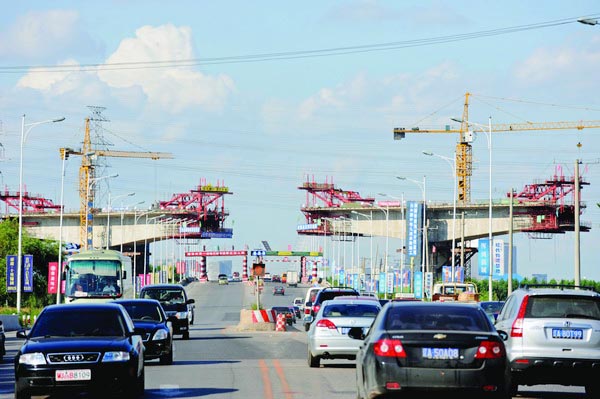 The Harbin-Dalian High-speed Railway under construction in Shenyang, capital of Liaoning province. China's generous investment in infrastructure and housing nurtured the nation's cement industry, which now has 3,800 producers and more than 2.9 billion tons of production capacity annually. [Photo/China Daily] |
Riley shared the simple secret at Holcim's centennial celebration in Beijing recently. He is ready to develop the company's China business into something more environmentally friendly. His plan is to turn garbage into an alternative fuel, replacing coal to produce cement.
"The vision we have in the future is that we can clean up the environment while at the same time produce reliable building materials," said the 54-year-old British senior executive.
More than 100 years ago, Holcim opened its first plant in a small village in Switzerland called Holderbank, producing 90,000 tons of cement in its first year of operation.
Today, the company's annual cement production capacity has reached 216 million tons with 149 plants plus 492 aggregates factories and 1,435 ready-mix concrete production centers in 80 countries.
|
 |
"The longevity and the success of the company is not necessarily a secret. It is 100 years of very hard work and commitment and evolution to understand what the needs of today's society may be," said Riley.
For Riley, who has been involved with the China business since 1994 and moved to the country in 1998, China's needs for the sustainable development of its cement industry are pretty clear.
The National Development and Reform Commission, China's top economic planning agency, has already demanded a better environmental performance by the heavy industry that uses not only a massive amount of energy and resources for production but also emits a huge volume of greenhouse gases, such as carbon dioxide.
Most importantly, the Chinese government sees the cement industry as a potentially large contributor to solving problems in municipal waste, which can be turned into alternative fuels. The technology can also help reduce CO2 emissions.
CO2 emissions from China's cement industry account for about one-eighth of the country's industrial output of carbon dioxide, according to a recent paper by Chris Nielsen, executive director of the China Project with Harvard School of Engineering and Applied Science.
According to the 12th Five-Year Development Plan of China's Cement Industry (2011-15), the country, which currently has hardly any co-processing production lines that burn waste in the making of cement, will see around 10 percent of its cement production lines equipped with this technology by 2015.
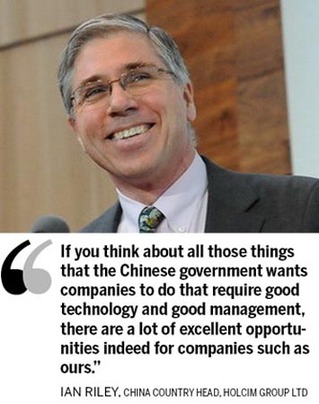
"If you think about all those things that the Chinese government wants companies to do that require good technology and good management, there are a lot of excellent opportunities indeed for companies such as ours," Riley said.
As early as the late 1990s, the company and nine other big cement makers co-founded the world's first ever green initiative for the cement industry.
The Geneva-based Cement Sustainability Initiative, which develops guidelines for implementing greater efficiency measures through cooperation and sharing expertise among members, has since been regarded as the global pioneer for the sustainable development of the cement industry.
Apart from Holcim's well-established advantages in green cement production, the company's belief in the cement market potential in China is another driving force for Holcim's evolution in the country.
China's robust economic growth over the past several years has nurtured the world's largest cement industry because of its generous investment in infrastructure and housing, the biggest users of the product.
Concrete, which is made from cement, aggregates and water, is the second-most consumed material in the world after water, according to the Cement Sustainability Initiative.
Cement demand in China has grown by double digits each year over the past decade, in line with the economy's annual average growth rate of 10.7 percent, according to the China Cement Association.
 Disney Town staff members greet visitors with smiles
 Special session of internet conference held in Berlin
 Top 10 most attractive Chinese cities for expats
 High–tech gadgets, not girls, main attraction at Beijing auto show
 Infographic: Highlights of China Q1 economic data
 Top 10 luxury cars at Beijing auto show
 Highlights of smart hardware on display at 2016 GMIC Beijing
 Two students return from abroad to open beer factory
 China's manufacturing activity expands at slower pace

Copyright 1995 - . All rights reserved. The content (including but not limited to text, photo, multimedia information, etc) published in this site belongs to China Daily Information Co (CDIC). Without written authorization from CDIC, such content shall not be republished or used in any form. Note: Browsers with 1024*768 or higher resolution are suggested for this site.
License for publishing multimedia online 0108263 Registration Number: 20100000002731