Comments
  Print
Print  Mail
Mail  Large Medium Small
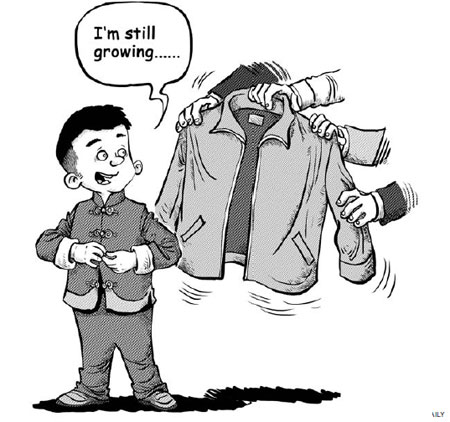
In his opening speech to the recently concluded 18th National Congress of the Communist Party of China, former CPC general secretary Hu Jintao emphasized the goal to build a xiaokang, or moderately well-off, society by 2020. The specific goal is to double GDP and per capita income of rural and urban residents both. Xi Jinping re-emphasized the goal after he was elected CPC general secretary.
The Chinese economy is widely speculated to overtake the US' economy to become the largest in the world at some point in the not-so-distant future. But does all this mean China will soon be in a position to challenge the US and the rest of the Western world in terms of economic and social development? The answer, I'm afraid, is "no".
The challenges that China faces today are enormous and, to some extent, also the result of the chaotic period of the last century. That's why the Chinese leadership has maintained its sobriety and repeatedly emphasized the importance of xiaokang, a society in which people's life is better but far from wealthy.
China in all probability will continue to be a developing country in 2020, perhaps with even bigger problems than those it faces today. China has a lot of work to do to reach the goals it has set for itself, some of which need urgent action.
First, doubling personal income, in nominal terms, in a decade implies an average growth rate of about 7 percent a year. Taking into account the erosion effect of inflation - and, of course, no one knows what it will be in the future - the real improvement in living conditions of an average Chinese will only be a very low single digit percentage points. Yes, it would be better than nothing. But it would be like the growth rate of a developed economy, not that of a country in the middle-income range - unless, of course, the target is meant to be in real terms.
This brings me to the next and most important point: How is China going to escape the middle-income trap? The middle-income trap occurs when a country loses its ability to compete internationally as a low-cost-manufacturing center without having moved up the value chain to be able to compete in higher-value products.
The solution is not easy and it looks like a loop from which it is not easy to come out. Raising people's income, as is the plan for 2020, on one hand, and helping raise the standard of living, on the other, may throw China's manufacturing sector out of business. That's because in China, it is unskilled workers' wages - people that tend to work in the low value-added manufacturing sector - that grow faster than even graduate employees' pay. In fact, the faster the wages rise the easier it is for a country to fall into the middle-income trap.
One possible way out of the problem is to make the pace of innovation and scaling-up faster than the growth of wages. But this is easier said than done, because it requires building a modern, freethinking environment where new ideas are encouraged. This cannot be done in a few years and at the core of this lies a proper educational system, which China may still lack in 2020.
Offering free higher education in universities to all students is the only way to achieve this - a necessary but not a sufficient condition. Though the target sounds difficult, even unpractical, it should be set as a long-time goal. People's demands are getting increasingly urgent and people cannot wait to see their lives improve until China becomes the new Silicon Valley.
A xiaokang society is not just about money. By 2020 China's healthcare system should be able to cover its entire population, and the country should be able to provide equal opportunities for social advancement, a fully developed judicial system, a truly free market economy, a proper banking and financial system, equal terms for foreign investors, more effective enforcement of copyright protection, a total halt to illegal property expropriation, cleaner environment and safe food - the list goes on.
With all these and many other domestic issues on the plate, it would not be surprising for China to continue to refrain from playing a significant role in the international arena. Avoiding to play that role should not be perceived by foreign observers as an excuse for being a developing country, because China will still be a developing country in 2020.
Thus it would be normal for the country's new leadership to focus on the most demanding domestic issues, rather than being pre-occupied with international ones. The US, as usual, appears willing to play the role of international police (of course, only when it is also in its own interest), so China should let it do so in the foreseeable future.
Finally, I would like to emphasize that it is relatively easy for us economists, whether perched on ivory towers or out in the fields, to suggest what should be done. It is quite a different thing to lead a country with more than 1.3 billion people and try to manage an extremely complex system with millions of changing variables, almost on a daily basis. I can only wish the new leadership a successful tenure and good luck.
The author is head of Global Policy Institute China and professor of finance at Zhejiang University, Hangzhou, and Nottingham University Business School, Ningbo.
 Top 10 developing countries for retail investment
 Alibaba's sampling inspection procedures revealed
 Top 10 best employers in China 2016
 Chinese drones gear up for global takeoff
 Labor of love: Graduate creates exquisite artwork with paper-rolling
 Top 10 overseas M&As of Chinese auto companies
 Chinese factories score a goal with Euro 2016
 Young car racer pursues dream, speed

 Synchronized swimmers hope for hometown success in Brazil
 The party's just starting for Cavaliers' triumph
Copyright 1995 - . All rights reserved. The content (including but not limited to text, photo, multimedia information, etc) published in this site belongs to China Daily Information Co (CDIC). Without written authorization from CDIC, such content shall not be republished or used in any form. Note: Browsers with 1024*768 or higher resolution are suggested for this site.
License for publishing multimedia online 0108263 Registration Number: 20100000002731