Comments
  Print
Print  Mail
Mail  Large Medium Small
|
 |
|
China's Gini coefficient, which is commonly used as a measure of inequality of income or wealth, stood at 0.61 in 2010, much higher than the alarm level of 0.4, a report showed on Sunday. |
China faces extraordinary inequality in its social distribution system, but the government still has adequate options to deal with the problem, according to a semi-official report.
The country's Gini coefficient, which is commonly used as a measure of inequality of income or wealth, stood at 0.61 in 2010, much higher than the alarm level of 0.4, a report from the Survey and Research Center for China Household Finance showed on Sunday.
The level was also well above the global average of 0.44, according to the World Bank's release.
A higher Gini coefficient stands for higher inequality. Zero represents perfect equality while an index of one would be maximum inequality.
According to the report, inequality was higher in villages than in cities, as the coefficient for rural households was 0.6, while that for urban families was 0.56.
Meanwhile, the Gini coefficient in eastern regions, which was 0.59, outstripped that of western provinces, which was 0.55, the report showed.
The figures were an update of the last official release on the country's inequality level in 2000, which put the overall Gini coefficient at 0.412.
The new data was published by a center co-founded by Southwestern University of Finance and Economics and the Institute of Financial Research of the People's Bank of China.
Gan Li, head of the research center, said such a high Gini coefficient is "rarely seen in the world", but he also said "it is a common phenomenon for fast-growing economies, as a result of the effective resource allocation by the market, and so should not be feared too much".
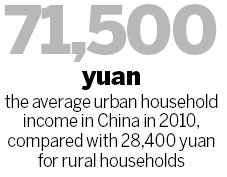
According to the report, the average household income in 2010 was 71,500 yuan ($11,500) for urban families, and 28,400 yuan for rural households.
Social security income was a major difference between the two. For example, the average pension income for urban families was 33,000 yuan, while for rural families it was only 12,000 yuan.
Educational background was another decisive factor for income level. People who have a bachelor's degree or above earn four times more than those who did not finish junior high school.
"There are many references to how to reduce the inequality," Gan said.
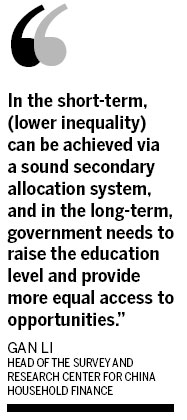
"In the short-term, it can be achieved via a sound secondary allocation system, and in the long-term, government needs to raise the education level and provide more equal access to opportunities."
According to Gan's research, if the government uses the growth in its fiscal income - which has increased by an average of 20 percent annually in recent years - plus the profits from State-owned enterprises, it will have 3.8 trillion yuan in hand to subsidize 60 percent of the low-income families, and bring China's Gini coefficient down from 0.61 to 0.4.
Despite the still large inequality, the gap between China's rich and poor has now come to a turning point, according to a report from Beijing Normal University's Labor Market Research Center.
Lai Desheng, director of the center, said although many considered the gap to be still widening, the income difference between the urban and rural areas has been declining in recent years, which can be regarded as a sign of reduced inequality.
In addition, the incomes of the lower and middle classes were growing faster than the high-income groups, which suggests the difference between rural and urban residents is also shrinking.
An important reason for the narrowing income gap, Lai said, was a growth in the proportion of the labor force with a higher education from 4.6 percent in 2000 to 10 percent in 2010.
A rapid expansion in the number of college graduates has established a massive talent base for China, and the labor market must make changes to adapt to the trend, he said.
Another study by Gan's center found that the unemployment rate in China's urban areas was 8 percent in 2011, which translated to 27.7 million people without work.
Also speaking at the release of the Gini coefficient, Pan Jiancheng, deputy director-general of the China Economic Monitoring and Analysis Center, said the country would steadily push forward its urbanization process and economic transformation in an effort to tackle the disparity.
He added: "We must continue to raise the educational level to improve both the income level and employment rate."
?
weitian@chinadaily.com.cn
 Huawei launches new smartphone P9 in Vietnam
 Top 10 box office movies on China market in H1
 Woman resigned from high salary job to make notebooks
 Hurun publishes Global Chinese Big Philanthropy Report 2016
 Top 10 new economy issues in China
 Wetland helps preserve ecology of Dianchi Lake
 A million ways to beat the summer heat
 Top 10 livable Chinese cities

 Sports star Ivanovic, Schweinsteiger holds wedding in Venice
 Relive the glories and defeats in France-Germany rivalry
Copyright 1995 - . All rights reserved. The content (including but not limited to text, photo, multimedia information, etc) published in this site belongs to China Daily Information Co (CDIC). Without written authorization from CDIC, such content shall not be republished or used in any form. Note: Browsers with 1024*768 or higher resolution are suggested for this site.
License for publishing multimedia online 0108263 Registration Number: 20100000002731