Comments
  Print
Print  Mail
Mail  Large Medium Small
Lower target will help maintain continuity of macroeconomic policies and efforts to change the mode of development
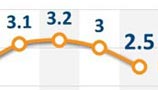
Based on the report delivered by Hu Jintao, the former leader of the Communist Party of China, to the 18th National Congress of the CPC and the 12th Five-Year Plan (2011-15) for national economic and social development, the upcoming Central Economic Work Conference is likely to set a 7.5 percent growth rate as the target for China's economy in 2013.
Such a relatively moderate growth rate will help China maintain the continuity of its macroeconomic policies and also create a good platform for its new leadership to change the country's economic growth model. The principles for economic growth over the next five years or longer mapped out in Hu's report and the recent emphasis put on urbanization by Vice-Premier Li Keqiang as a driving force of economic growth show that the new leadership wants to extricate the country's economy from its excessive dependency on exports, real estate and investment for growth.
The authorities will reduce the demand for real estate, push for a full transformation of its industrial structure and make some substantial adjustments to its national economic development strategy. The efforts to promote new industrialization, informationalization, urbanization and agricultural modernization, as depicted in Hu's report, unambiguously show China's greater determination to advance such a transformation. Domestic circumstances, together with lingering international economic uncertainties, mean it is possible for China to lower its economic growth expectations for the next year.
The internal and external circumstances favorable to China's fast economic growth have changed over the past decade and it will be difficult to maintain the same high-speed growth. As China runs out of its comparative trade advantages, its fast-growing export momentum since 2000 has come to an end. Export prospects have become gloomier due to shrinking external demand since the eruption of the global financial crisis. China's export growth has slowed from more than 20 percent in previous years to less than 10 percent. The bleak external environment, if it does not improve, will make it difficult to pursue even medium-level economic growth if the country maintains the export-driven growth model.
Domestically, the fast GDP growth over the past decade has been fuelled to a large extent by a nationwide real estate boom and rocketing property prices. To free itself from a growth path dependent on the soaring prices of real estate, China needs a complete overhaul of a GDP growth model fuelled by high housing prices. The soaring housing prices have caused the central government to launch harsher-than-ever real estate regulations. However, some local governments have never abandoned their attempts to loosen the housing regulations, because of their reluctance to really disable their housing-dependent fiscal revenues and their desire to maintain economic growth.
But loosening the country's real estate regulations will inevitably nullify efforts to reduce or eradicate overcapacity in such related industries as mining, steel and iron, and construction materials.
China's ongoing housing de-inventory efforts in second and third-tier cities are far from over, as indicated by the meager 1.2 percent growth year-on-year in its housing sales from January to November. Worse, a negative housing sales growth in Beijing and Shanghai and other first-tier cities last year is now spreading to some second and third-tier cities. If China's housing de-inventory efforts cannot make progress, the risk of a systematic financial crisis triggered by housing bubbles will grow.
It is expected the country's new leadership will strengthen efforts to eradicate housing bubbles and thus consequently further lower its GDP growth target. The reason is that lower GDP growth will help the country forestall potential risks and reduce their negative impacts on the national economy to a minimum.
China's fast-growing economy over the past decade is also the result of investment rather than its efforts to raise efficiency and productivity through technological progress or institutional reforms. This is one of the main reasons why China's current marginal capital output ratio declined from 2.4-to-1 in 2000 to 6-to-1 in 2010. The declining marginal capital output ratio means a narrowing space for the use of investment to drive economic growth.
China's new leaders will go all out to change such an unbalanced economic structure and pursue higher quality growth.
The author is a researcher with the Institute of Finance and Banking under the Chinese Academy of Social Sciences.
 Wetland helps preserve ecology of Dianchi Lake
 A million ways to beat the summer heat
 Top 10 livable Chinese cities
 AR glasses offer new experience
 Merchandize for Rio 2016 a hit in run-up to games
 Water sports drive swimwear sales in China market
 Infographic: Decoding Chinese tech corporate philanthropists
 Top 10 best Chinese cities to own a house

 Sports star Ivanovic, Schweinsteiger holds wedding in Venice
 Relive the glories and defeats in France-Germany rivalry
Copyright 1995 - . All rights reserved. The content (including but not limited to text, photo, multimedia information, etc) published in this site belongs to China Daily Information Co (CDIC). Without written authorization from CDIC, such content shall not be republished or used in any form. Note: Browsers with 1024*768 or higher resolution are suggested for this site.
License for publishing multimedia online 0108263 Registration Number: 20100000002731