 |
|
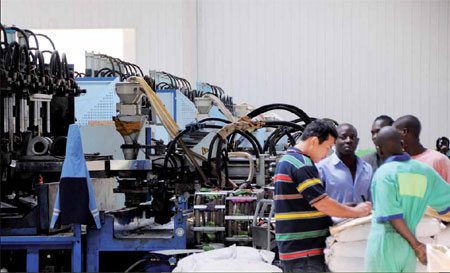
A shoe factory in a Chinese industrial park in Uganda. [Photo/Xinhua] |
Growing Chinese business presence has brought Kampala not only goods but also infrastructure and job opportunities
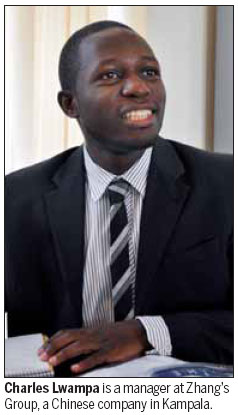
Charles Lwampa, a 28-year-old resident of Kampala, the capital and the largest city in Uganda, says he hears the greeting "Nihao" often on the streets of his hometown. Lwampa, who has been working as a business manager for the past six years for one of the largest Chinese companies in Kampala, says the Chinese influence has grown rapidly in that time. In various parts of the city, which has a population of around 1.7 million, many Chinese businesses have knitted themselves firmly into the local community.
Chinese businesses have brought new goods, new technologies, and even introduced new culture to a city and country, which only a few years ago were considered among the world's poorest and least-developed, he says.
|
The launch of a Chinese industrial park in Uganda in October 2010. [Photo/ Xinhua] |
They have been warmly welcomed, too, because Kampalans recognize just what an important ingredient their presence has become to the local economy.
According to the latest estimates, more than 10,000 Chinese have been involved in bringing different business activities to the East African country in recent years.
"These Chinese investors are helping the Ugandan people live the dream of social transformation," says Lwampa.
"We didn't even have many good buildings in this town 10 years ago. But just look at the growth we have experienced in our local infrastructure.
"This is what Africans need right now. Every bit of investment helps African people, and if the Chinese want to double their level of investment, we would welcome that."
The Chinese influx has been dramatic, especially over the past decade, and it's no coincidence that Uganda too has experienced rapid modernization in that period, as the economic and trade ties grew stronger between the two nations.
In 2005, Chinese investment in Uganda was limited to a few hotels and restaurants. But within just five years, China had become the country's second-biggest trading partner after the United Kingdom.
Statistics from the Chinese customs department show that China-Uganda trade was worth $400 million in 2011, and the planned investment portfolio is now estimated at $2 billion.
The growth of Uganda's gross domestic product is in line with the increasing investment from China. Statistics from the International Monetary Fund show that the Uganda's GDP has jumped from $10.56 billion in 2008 to $17.13 billion in 2011.
More than 260 Chinese companies have now opened in the country, across different sectors, creating 30,000 local jobs.
Sam Kutesa, Uganda's minister of foreign affairs, recently said that large State-owned enterprises from China have been instrumental in improving the country's infrastructure.
China Communications Construction Co Ltd, for instance, has been in the country since 1996, and will play a major role in building the Kampala-Entebbe Expressway - Uganda's first toll highway connecting the capital to the country's most important international airport. The expressway is expected to open within five years.
The $476 million project benefited from a $350 million low-interest loan from the Export-Import Bank of China, with the rest raised by the Ugandan government, says China Communications Project Manager Zhang Weidong.
The construction was an enormous challenge, not least because most of the raw materials needed - such as iron, cement, and much of the machinery -had to be imported, he says.
But crucially for the local economy, 90 percent of the employees on the project will be Ugandan, with some expected to take up important management positions.
After many years working for Chinese construction projects in Africa including Uganda, Zhang says local workers praise the training they have been given by their Chinese employers, and many have become highly experienced as a result.
"Many have picked up good Mandarin, and say they take pride in working for a Chinese company," he adds.
"All the companies I have worked for have made long-term development plans in Africa."


Copyright 1995 - . All rights reserved. The content (including but not limited to text, photo, multimedia information, etc) published in this site belongs to China Daily Information Co (CDIC). Without written authorization from CDIC, such content shall not be republished or used in any form. Note: Browsers with 1024*768 or higher resolution are suggested for this site.
License for publishing multimedia online 0108263 Registration Number: 130349