Hongbao places financial burden on New Year celebrations


 |
|
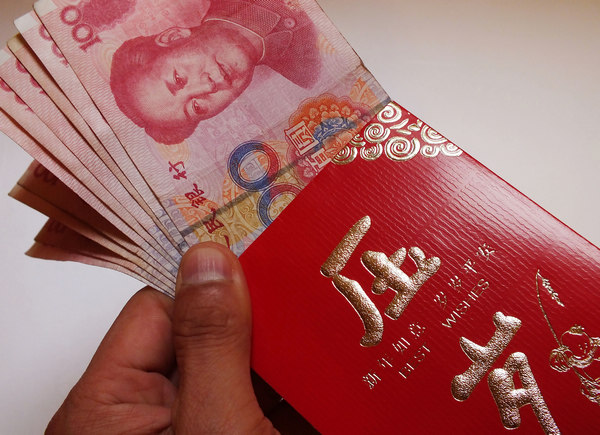
Parents are under pressure to give more lucky money to their children during Spring Festival, and face the challenge of teaching them about fi nancial management. [LIU JUNFENG / FOR CHINA DAILY] |
Pu, 27, who works in Beijing earning a monthly income of 4,500 yuan ($720), has drained his savings by returning to his home in Penglai, a county in Shandong province, for Chinese Lunar New Year.
"Instead of racking my brain for gift ideas, I choose to give money. It's much easier," said Pu, who refused to give his full name.
At Spring Festival, it is a tradition for families and friends to get together and give younger generations cash sealed in a red envelope, known as hongbao.
However, this custom, which is supposed to add happiness and festive flavor to the holiday, has placed a heavy burden on Pu and his peers.
Pu's family members all reside in rural areas. As the only college diploma holder and only person who works in a big city, he is the pride of his family and is assumed to be richer than many of his family members.
"I gave my parents 4,000 yuan in total and my cousin's kids 600 yuan each," said Pu. "A few years ago 200 yuan would suffice, but now giving 200 yuan is kind of losing face and my relatives would think I am mean."
Pu attributed the rise in hongbao to high inflation. "Two hundred yuan cannot buy nice clothes," he said. "Everything is rising except my salary."
Unhappiness in the happy season is also rising. Having spent the whole year working at an accounting firm in Shanghai earning 6,000 yuan a month, Sun Xiaofei gave away almost half of her annual income during Spring Festival.
"This is the first time I give out hongbao since I was married and started to work last year," said the 26-year-old. "I gave my husband's parents and my parents 6,000 yuan in total, bought two cashmere sweaters, one for my mother and the other for my mother-in-law, and gave five kids 800 yuan each."
To make things worse, social activities at Spring Festival piled up, all requiring money.
"There were five to six parties organized by friends, colleagues or bosses. Each meal requires around 300 yuan. I can't decline those invitations; it is kind of a public relations.
"Now the thought of coming back for Chinese New Year will be a headache."
Chinese micro-bloggers have come up with several suggestions of ways to dodge the obligation of giving cash and save money. Traveling is listed as No 1.
Sun said that she and her husband are planning to travel to a warm place with sunshine and a beach to spend the holiday next year, to avoid the "new year robbery".
Other solutions include giving gifts instead or adopting the Hong Kong style of giving hongbao, which only contains HK$10 to HK$20.
Wang Zuoyi, a folklore expert in Beijing, said hongbao pressure is losing its traditional meaning of good will.
"In this sense, Hong Kong preserves the hongbao culture better than the Chinese mainland," said Wang. "What matters is the wishes you send to others, not the value of money you put in an envelope."
While giving money has been a burden to grownups, younger generations are becoming spoiled by receiving money.
Zhu Tianyu, 20, a sophomore at a university in Nanjing in Jiangsu province, said New Year is an opportunity for him to earn money. This year, he has collected almost 10,000 yuan.
The phenomenon of children becoming rich during the holiday by receiving hongbao has also triggered business. Banks such as China Merchants Bank and Bank of Communications have started new financial products specially targeted at this new rich group.
"Parents should also guide their kids in spending the money," said Wang. "It is a good idea to start saving at a young age.
"Giving children large amounts of money should not be encouraged."