Waste no time in disposing e-waste aptly


I have a pile of used electronic devices, tangled with USB lines, lying at home. I may carry on the Chinese tradition of thrift, but it is difficult for me to dispose of the obsolete e-gadgets in an environmental friendly manner.
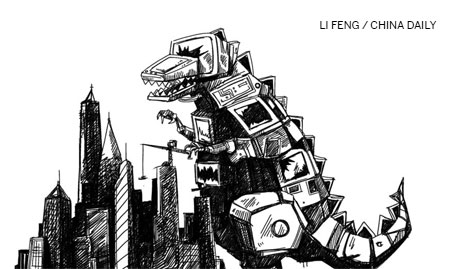
China is arguably the world's second largest generator of e-waste. It generates 2.3 million tons of such waste every year. A United Nations Environment Programme report says computer waste in China will increase by 400 percent from 2007 to 2020. But perhaps more worrying than the mounting e-waste is the absence of effective recycling channels and a comprehensive e-waste management system in China.
Urban residents like me, including eco-conscious consumers, have very little information about environmentally friendly channels to dispose of electronic castoffs. Apart from the irregular drop-off or collection centers run by NGOs and environmental groups in a few urban areas, a large majority of urban residents have no option but to sell used or scrap electronics in second hand markets or to door-to-door vendors.
The people who collect e-waste in my neighborhood near the Bird's Nest, or Beijing National Stadium, usually pedal their wagons or carts around, which sometimes carry cardboard signs telling residents what they can dispose of. I have never given any of my used e-gadgets to peddlers because I suspect a majority of them are processed by informal sectors, including individuals and small illegal or informal workshops, which sometimes process them without providing enough protection to laborers and then dump the toxic waste on streets or in landfills. The ultimate victim of such indiscriminate disposal is the environment, and thus the people.
E-waste is a double-edged sword. If well managed, it will help conserve resources, improve energy efficiency and create new jobs. But if not, it will inflict serious damage on the environment and people's health.
Researchers who published a study in Environmental Research Letters in May 2011, cited in Science Daily, took air samples from Taizhou in Zhejiang province, where more than 60,000 people are engaged in dismantling over 2 million tons of e-waste for metals each year. They found that workers in the e-waste dumps suffered from inflammation and stress, which could cause heart disease, DNA damage and even cancer, because of the toxic air they inhaled.
Different from the smog over Beijing and other cities in China, the damage caused by e-waste to the environment is so intangible that we could already be facing a long-term threat. Because of improper recycling processes, heavy metals and toxic chemicals are absorbed in the atmosphere, seep into soil and water bodies, and cause serious pollution, damaging the environment.
Given the enormous health and environmental risk that e-wastes pose, effective recycling channels encompassing households are too few. In June 2010, the country extended nationwide the "old-for-new" program, a recycling mechanism that encouraged consumers to buy new household appliances at a discount by handing over their old ones. It was a successful recycling program for mitigating environmental pollution, especially because used household appliances were reclaimed through a set of official channels.
But after the program ended in 2011, residents have been left with few channels to dispose of their used gadgets and appliances. In the absence of financial incentives, coupled with the lack of policy enforcement, manufacturers, retailers and dismantling companies are no longer enthusiastic about continuing the practice.
According to China Economic Net, formal recycling companies usually face the problems of high reclaim cost and hindered channels, which condemn most of the household e-waste to gray channels like street vendors.
Official data show that at the end of 2011, 84 companies were registered with the Ministry of Environmental Protection to process e-waste, but they have not set up effective recycling channels either with local communities or extensive third parties.
Perhaps the government can use some of the better practices abroad as examples to provide effective recycling channels for household e-waste in China. For example, in France, social communities have to reclaim at least 4 kilograms of electronic waste every year, and Swedish laws stipulate that the disposal cost be borne by manufacturers and the government, according to China Economic Net.
Although authorities in China, too, have extended the responsibility mechanism to electrical and electronic goods' manufacturers, inadequate logistics, lax regulation, lack of incentives and poor supervision make it extremely difficult for consumers to contact manufacturers to drop off their old appliances.
Confronted with mounting e-wastes, complicated further by lack of proper recycling channels, it is high time China established an effective e-waste recycling mechanism to avoid further environmental and health problems.
Experts say that for building an effective circular economic system, the electronics industry should have well-built lines starting from product designing to channels for second-hand utilization and recycling and, finally, for disposal of decontaminated non-recyclable components. This is the appropriate time for the government to raise consumers' awareness and provide them easy and environmentally friendly channels to dispose of their e-waste.
The author is a reporter with China Daily. E-mail: dongfangyu@chinadaily.com.cn.?