Comments
  Print
Print  Mail
Mail  Large Medium Small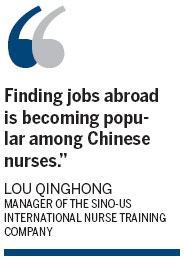
According to him, some Chinese nurses used working abroad as a "springboard" to finally settle down there.
Judy Duan, 33, said that when she was as a contract worker in a public hospital in Wuhan, Hubei province, from 2004 to 2007, her salary was less than 3,000 yuan ($490) a month, and her bonus and healthcare reimbursements were much lower than for "officially employed" colleagues.
In 2007, she passed the examination to become a registered nurse in Singapore and began to work there.
She worked in the long-term care unit in two hospitals and earned more than S$1,680 ($1,370) a month.
But challenges such as language accompanied the higher salary.
"Chinese nurses are very proficient in nursing skills. But Singaporeans speak English with a heavy accent. I also needed to communicate with co-workers from the Philippines, India and Myanmar," she said.
"Instead of Mandarin, many Chinese in Singapore speak Cantonese and Teochew dialects, which I found hard to understand," she noted.
In May 2010, she applied to immigrate to Canada, moved there with her family in March 2012, and is now applying to take an exam to become a registered nurse.
"Unlike in China and Singapore, a registered nurse here (in Canada) is a respected occupation and pays much more," she said.
Duan, who now lives in Ontario, considers herself lucky.
"I and my husband got permanent residency in Singapore in January 2008, whereas it got harder for my friends who later went to work there to obtain the status," she said.
"People came to Canada to work as nurses from around the world. Doctors and teachers emigrating from China are also willing to get a nursing degree and work as a nurse there if they don't find a job that suits them."
Stephanie Gu, 29, who is taking a nursing course in Melbourne, Australia, also finds herself accompanied by other aspiring Chinese students.
Upon graduating from medical school in Hebei province in 2006, she was chosen by a nursing agency in Beijing to work in a private hospital in Saudi Arabia for three years. At the end of 2009, she began to work in Singapore. Last year, she finally went to Australia to take a one-year nursing course at Deakin University, achieving her dream to work and live in a developed country.
Gu said she will become a registered nurse in Australia if she finishes the course and gets enough points at the IELTS exam, but finding a job as a nurse there is harder than before.
"Many Chinese nursing students came here to take the nursing course, for example from Peking University and the Capital Medical University," she said. "We all would like to settle here. But we have to compete with each other and many local would-be nurses, who may not be as proficient in clinical practice but speak much better English. I have seen so many cases of failure."
But she still wants to fight for the chance to stay.
"I work as a personal care assistant in a nursing home three times a week, each time for about five hours. My job is to take care of the daily lives of people living there. It's a lot of physical work and sometimes dirty, but I get A$19 ($19) an hour. It's a lot of money," she said.
"You can certainly make a living as a nurse in China, but not earn much money. It's harder if you want to buy a house and have children. Maybe I'll have to return, but I'll try to settle here," she said.
In recent years, Japan has been another country where Chinese agencies find booming business opportunities.
"Many agencies are introducing nurses to Japanese hospitals and other medical facilities," said a woman identified as Liu at the Sichuan Tianfu agency in Chengdu, Sichuan province.
Liu, who is in charge of the agency's program that introduces Chinese nurses to Japan, said this year it has introduced 15 nurses to the country, and it is planning to send at least another 15 there within the year.
"After going to Japan, nurses need to have language training courses and get the nurse certification there before officially working in a hospital. But they do part-time jobs in local hospitals to support themselves," she said.
The agency's website listed programs recruiting nurses for hospitals in Japanese cities and prefectures such as Nagoya, Osaka, Nara and Saitama. The introduction says "Japan now lacks 40,000 nurses" and nurses in Japan make "3 million to 4.2 million yen ($41,300) a year".
China had more than 2.49 million registered nurses last year, up 1.15 million over 2005, statistics from the National Health and Family Planning Commission showed.
Currently, China's doctor-nurse ratio stands at 1:1.5, far lower than the international average of 1:4.
The demand for nursing services is expected to increase as China's ongoing healthcare reform makes medical care services accessible to more people via an almost universal healthcare policy, according to Guo Yanhong, deputy director of the ministry's medical administration department.
"Thereafter, making the team stable is highly important," she said.
Besides the pay increase and favorable policies for nurses, more incentives like advanced training programs should be introduced to encourage good nurses and improve their working environment, she said.
 HK's new cruise terminal receives luxury liner
 Future points to carbon trading
 Seafood businesses flounder amid spending cut
 Equities slump amid slow-growth estimates
 Auto show opens with much fanfare in Xi'an
 Sunnylands summit fuels Chinese tourism interest
 'Palace on wheels' on sale for $3.13m in Dubai
 Fortune smiles on Chengdu as forum concludes
Copyright 1995 - . All rights reserved. The content (including but not limited to text, photo, multimedia information, etc) published in this site belongs to China Daily Information Co (CDIC). Without written authorization from CDIC, such content shall not be republished or used in any form. Note: Browsers with 1024*768 or higher resolution are suggested for this site.
License for publishing multimedia online 0108263 Registration Number: 20100000002731